
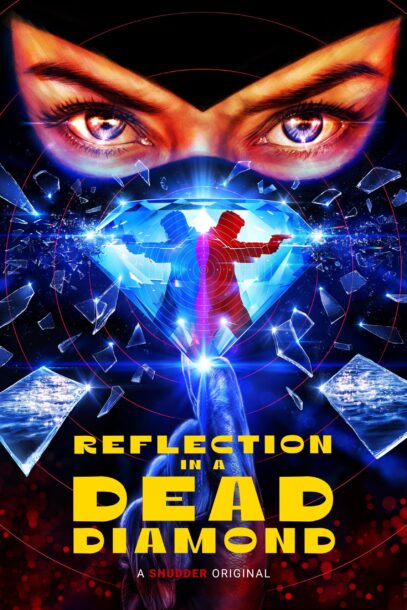
A lesser film by Belgium’s Bruno Forzani and Hélène Cattet, who specialize in uniquely tripped-out takes on European genre cinema from years past. The subject is 1960s spy cinema, to which Forzani and Cattet don’t take to as well as they did 1970s giallo films (the subject of their earlier efforts AMER and THE STRANGE COLOR OF YOUR BODY’S TEARS), but REFLECTION IN A DEAD DIAMOND (Reflet day un diamant mort; 2025) contains everything any Forzani-Cattet fan could desire, and had the further benefit of arriving at a time when daring and imaginative cinema wasn’t too widespread.
REFLECTION IN A DEAD DIAMOND (2025) Trailer
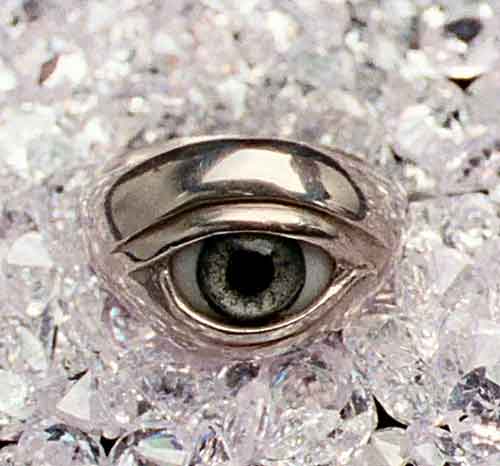
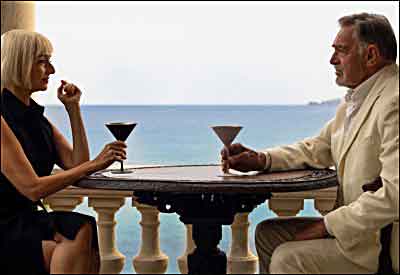
REFLECTION IN A DEAD DIAMOND’s focus is on John Diman, who exists in two guises: an old spy (Fabio Testi) thinking back over his past exploits in a swanky hotel on the French Riviera, and his younger self (Yannick Renier), who’s tasked with protecting the millionaire Markus Strand (Koen De Bouw). The youthful Diman has a number of high-tech accoutrements, including a ring with an eyeball set into it that shoots laser beams, buy they fail to keep Strand from meeting his inevitable end. Mixed up in this nutty saga is a sexy woman (Kézia Quental) who wears a dress comprised of tiny mirrors that function as mini-surveillance cameras.
Enter a gang of ruthless assassins who include an Irma Vep-like murderess with ultra-sharp fingernails and equally sharp high heels, and a person who hypnotizes people into believing they’re in a movie. All these assassins are revealed to be a single individual known as Serpentik, who constantly changes (Fantomas-like) her guise and leaves select portions (eyes, lips, etc.) of her facial masks for Diman to find.
Serpentik successfully hypnotizes Diman, as evidenced by the fact that he comes to increasingly believe he’s part of an elaborate movie, as in a bit in which he mistakes a dressing down by his superiors for a publicity interview. An apparent side-effect of the hypnosis is that it makes Diman think he’s in a comic book, as a portion of the remainder of the film plays out in the form of comic book panels (accompanied by sound effects). There’s also an old flame (Maria de Medeiros) who appears to have some bearing on the preceding events, although any sort of narrative clarity has long since evaporated by the time she appears.
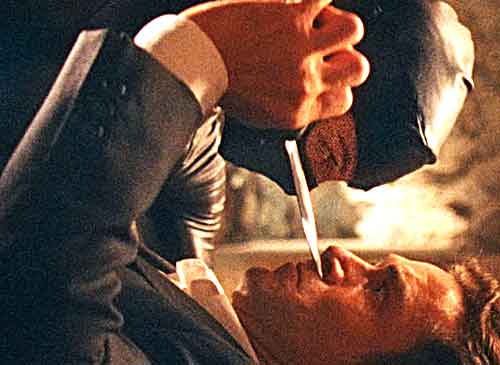
Horror wasn’t Forzani and Cattet’s objective here, but gore and shock effects tend to predominate. Those things clash with the colorful spy movie spoof/tribute intended by the filmmakers, although Forzani and Cattet have, as in their earlier features, created a sui generis concoction that has more in common with the delirious late 1960s provocations of Japan’s Seijun Suzuki (such as TOKYO DRIFTER and BRANDED TO KILL) than any European horror or spy films from the same era.
The ultra-self-conscious filmmaking takes some getting used to (especially in the absence of a coherent narrative), but ultimately proves quite enjoyable. Entailed is hallucinatory collage-like editing that thrives on exotic juxtapositions (flowing water with bubbling champagne, etc.), art direction that favors wavy lined carpet and wallpaper design, characters whose guises are subject to sudden and unexpected change (with the old and young versions of the protagonist constantly replacing each other) and pacing that never pauses to allow viewers to catch up with it.
REFLECTION IN A DEAD DIAMOND is, in short, a jaw-dropping exercise in artful dissociation that leaves one with the question of whether there’s anything of real substance to be found amid all the directorial bravura. The answer to that query, I’m afraid, is a big Nope.
Vital Statistics
REFLECTION IN A DEAD DIAMOND (Reflet dans un diamant mort)
Kozak Films
Directors: Bruno Forzani, Hélène Cattet
Producer: Pierre Foulon
Screenplay: Bruno Forzani, Hélène Cattet
Cinematography: Manuel Dacosse
Editing: Bernard Beets
Cast: Fabio Testi, Yannick Renier, Koen de Bouw, Maria de Medeiros, Thi Mai Nguyen, Céline Camara, Kézia Quental