
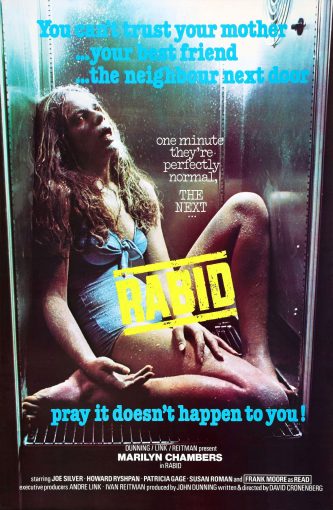
David Cronenberg’s 1977 second feature stands as a companion-piece to his first, the notorious SHIVERS (1975). RABID is widely regarded as a step down, but I say it marked a solid path forward for this most unconventional of auteurs.
RABID 1977 (Trailer)
RABID was certainly an above-average entry in the 1970s Canuxploitation field. It satisfies as exploitation, providing all the gore, nudity and down-market shock anyone could ask for, tempered with a fair amount of deranged invention and intellectual discourse (with the story inspired, it’s been claimed, by the Montreal based October Crisis of 1970). It also starred porn legend Marilyn Chambers, selected by executive producer Ivan Reitman (as legitimate actresses were outside the scope of the budget).
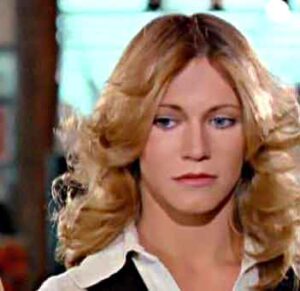
Marilyn Chambers
On the outskirts of Montreal, a motorcycle accident leaves the gorgeous young Rose (Chambers) and her boyfriend Hart (Frank Moore) severely maimed. Luckily the accident occurs near the Keloid Clinic, a plastic surgery resort whose head, one Dr. Dan Keloid (Howard Ryshpan), elects to provide experimental skin grafts to the nearly dead cyclists. Hart comes through the process unscathed, but Rose requires far more surgical attention, and is confined to the clinic for the foreseeable future. During her time therein she somehow develops a penis-like organ that emerges from her left armpit to suck the blood of Hart’s unfortunate pal Lloyd (Roger Periard).
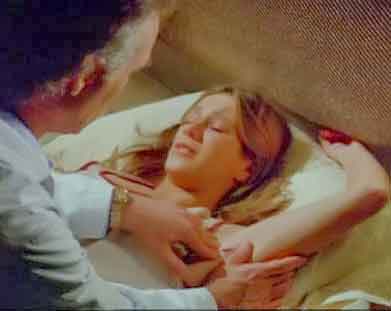
Needing more blood (which has taken the place of food), Rose sneaks out of the clinic and drains the bodily fluids of a farmer, followed by a woman inside the clinic and then Dr. Keloid. Around the same time, Lloyd, on a car ride to a hospital, turns into a frothing-at-the-mouth loon and causes a huge accident, thus showcasing the effect of Rose’s vampirism: it transmits a mutated form of rabies.
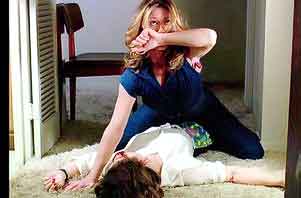
Dr. Keloid evidences symptoms of the contagion during an operation, and in the melee Rose makes her way out of the hospital. In the meantime, the rabies strain penetrates into Montreal, causing the authorities to institute martial law; gunmen are stationed around the city to shoot infected people and load them into garbage trucks, whose cargo inevitably comes to include Rose.
The most common complaint made about RABID is that it plays like two separate movies in the (supposed) intimacy of the first half and more panoramic gist of the second. In truth, the script is filled with viewpoint shifts that impart a very novelistic air in their depictions of characters who are introduced only to be immediately killed off (a feature of many a 1970s horror novel). The downside of this approach is that David Cronenberg’s depictions of the many working class folk who orbit Rose tend to be quite stereotypical (drunkenness and aggression are constants), and that the supposed heroine is reduced to a supporting player.
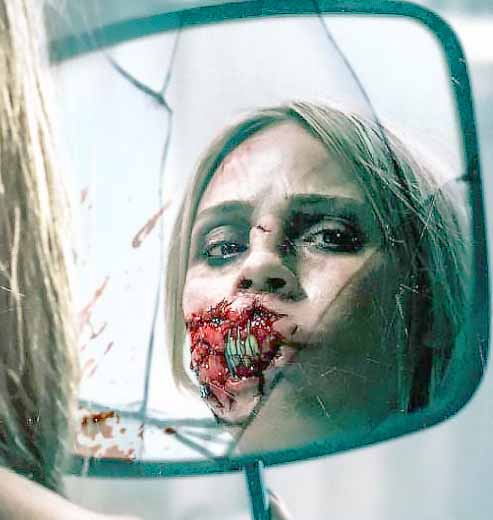
In that role Marilyn Chambers proves quite a compelling presence, while the elaborate make-up effects of Joe Blasco serve (as they did in SHIVERS) as cast members in their own right. Blasco’s effects run riot in the later scenes, which with their depictions of societal breakdown and martial law showcase Cronenberg’s talent for getting the most out of a painfully low budget. Obviously he and his collaborators lacked the resources to properly depict the whole of Montreal overtaken by chaos, but they came surprisingly close.
Vital Statistics
RABID
Dunning/Link/Reitman
Director: David Cronenberg
Producer: John Dunning
Screenplay: David Cronenberg
Cinematography: Rene Verzier
Editing: Jean Lafleur
Cast: Marilyn Chambers, Frank Moore, Joe Silver, Howard Ryshpan, Patricia Gage, Susan Roman, J. Roger Periard, Lynne Deragon, Terry Schonblum, Victor Desy, Julie Anna, Gary McKeehan, Terrence G. Ross, Miguel Fernandes, Robert O’Ree, Greg Van Riel