
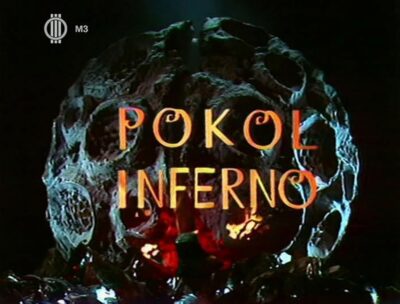
The Hungarian TV ace András Rajnai (1934–2004) brought quite a few classic works of literature to the small screen, ranging from GILGAMES (1976, adapting THE EPIC OF GILGAMESH) to MÜNCHAUSEN FANTÁZIAORSZÁGBAN (1978, which transposed THE SINGULAR ADVENTURES OF BARON MUNCHAUSEN) and this 56-minute telefilm. Initially screened on November 25, 1974, POKOL INFERNO’s literary source was the “Inferno” portion of Dante Alighieri’s epic poem THE DIVINE COMEDY (1321). Rajnai’s dedication to the project was evident in the fact that he only made one other film in 1974 (the GULLIVER’S TRAVELS pastiche GULLIVER A TÖRPÉK ORSZÁGÁBAN), a sharp decrease from his standard three-to-five a year average.
Depicted is a tour of the nine circles of Hell by Dante (Imre Sinkovits), led the poet Virgil (György Bánffy). Obviously not all of Dante’s torments were able to be compressed into 56 minutes, and graphic detail wasn’t possible under Soviet-era censorship.
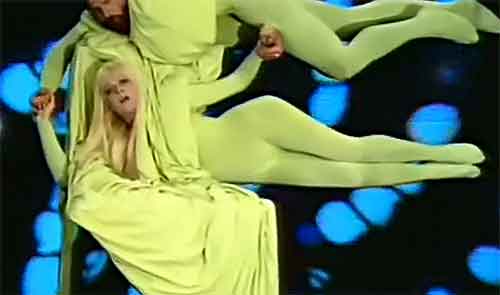
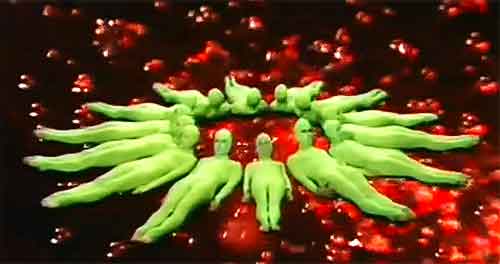
Rajnai solved the latter problem by having the sinners of hell represented by members of a Hungarian ballet troupe wearing featureless green jumpsuits, with their torments conveyed through interpretive dances superimposed over kaleidoscopic expanses. Those expanses are depicted via Rajani’s patented Chroma Key compositing that layered flesh and blood actors into miniature landscapes that appear to have been filmed in somebody’s backyard.
Many of Dante’s imaginings are given literal interpretations, such as the poet’s muse Beatrice (Káldy Nóra), who doesn’t appear in THE DIVINE COMEDY until the “Paradiso” portion, but turns up early on in POKOL INFERNO as a fabulously decked-out immortal; Cerebus, the guardian of the third circle, who sports a trio of barking dog heads; the City of Dis, represented by what looks like a campfire viewed through rocky blocks; a pair of bow-and-arrow wielding centaurs charged with guarding a river of blood; the talking severed head of the medieval conspirator Bertran de Born (Zsigmond Fülöp); and a three-faced Lucifer whose painted features closely resemble those of Mexican wrestlers.
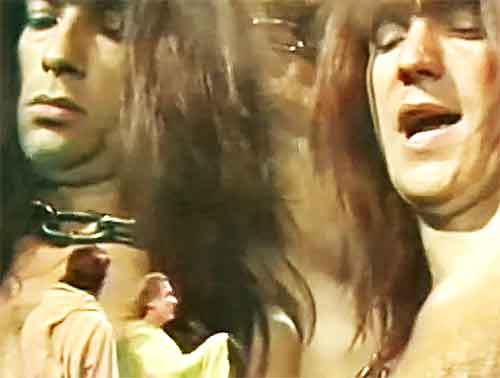
The film is similar in many respects to Peter Greenaway and Tom Phillips’ portion of A TV DANTE: THE INFERNO (1989), albeit without that project’s academic overlay. A large part of the appeal of POKOL INFERNO, and of all Rajnai’s literary adaptations, is its straightforwardness; in his films what you see is truly what you get, hidden meanings and intellectual subtext be damned, yet if POKOL INFERNO were at all known in the US (which it isn’t) it would probably be labeled avant-garde.
Rajnai’s artistic choices lean toward the bizarre, with lighting effects that serve to forcibly remind us this film emerged at the tail end of the psychedelic era, which certainly isn’t the only dated element. There are, however, some amazing sights that by themselves render POKOL INFERNO a must see: a communal dance led by a giant hand and another that takes place on the belly of a scorpion, vertebral bones serving as an infernal staircase, the teeth of a dog skeleton employed as a throne, and flames that color the dancing sinners both inside and out.
Vital Statistics
POKOL INFERNO
Magyar Televízió
Director: András Rajnai
Producer: Jozsef Lovasi
Screenplay: Sándor Weöres
(Based on a poem by Dante Alighieri)
Cinematography: Antal Abonyi
Cast: Imre Sinkovits, György Bánffy, Káldy Nóra, Rudolf Somogyvári, Teri Tordai, István Bujtor, György Györffy, László Inke, Gábor Csíkos, István Velenczei, Iván Darvas, Zsigmond Fülöp, Gábor Harsányi, András Kozák, Attila Nagy, László Sinkó