
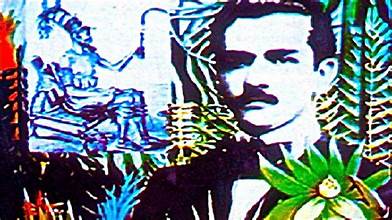
The delirious fiction of France’s Raymond Roussel (1877-1933) is about as close to unfilmable as it’s possible to get. To date, only one attempt has been made at translating Roussel’s writing to the audiovisual medium: Jean-Christophe Averty’s IMPRESSIONS OF AFRICA (Impressions d’Afrique), a French telefilm broadcast on October 22, 1977.
IMPRESSIONS OF AFRICA (1977) Full Movie
IMPRESSIONS OF AFRICA (1910) was Roussel’s first novel. Inspired by a trip to Africa (during which Roussel reportedly never left his hotel), it was marked by ahead-of-their-time literary quirks (automatic writing, etc.), fractured chronology, and disaffected children’s novel prose. Jean-Christophe Averty (1928-2017) was a French TV innovator whose eccentric bent wasn’t too far removed from that of Roussel, and his adaptation followed equally eccentric TV renderings of Alfred Jarry’s UBO ROI (1965), Julien Gracq’s UN BEAU TENEBREUX (1971) and Lewis Carroll’s ALICE IN WONDERLAND (1970).
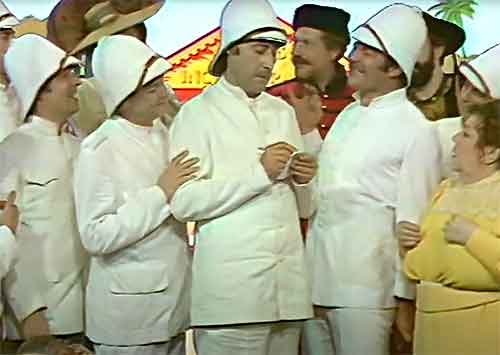
The latter film directly anticipated Averty’s IMPRESSIONS OF AFRICA in its elaborate intermixing of live action and animation. Averty also incorporates biographical tidbits about Roussel (such as his method of developing ideas around interrelated words, fleshed out in the essay HOW I WROTE CERTAIN OF MY BOOKS) and paintings that often stand in for actual locations.
IMPRESSIONS OF AFRICA takes place in the spring of 1904, with the Lycee, a “vast and fast ship,” setting sail from South America. Its passengers include a historian (Benoît Allemane), a retired ballerina (Georgette Anys), a falsetto singer (Michel Modo), several members of an Argentine circus and Raymond Roussel himself, who takes the form of a vintage black and white photo with an animated mouth.
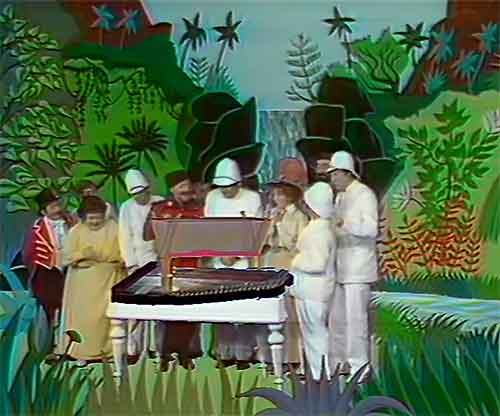
In the Atlantic ocean, tragedy strikes: the boat is slammed by a hurricane and crashes on the coast of Africa. The Lycee’s surviving passengers are taken hostage by an African tribe, represented by a French-speaking emissary (Ibrahim Seck) who leads them to the capitol city of a most eccentric kingdom whose emperor (Bachir Touré) has his captives write letters to their relatives demanding ransoms (Roussel’s depictions of non-white races have repeatedly been called into question, and Averty’s impressions of African natives are equally questionable).
This multi-talented gathering christens itself the Club of the Incomparable, and while waiting for replies to their ransom notes creates a mini-France in this African kingdom, complete with a stock exchange and an outdoor theater. The club also puts on elaborate performances via a segmented worm that drips water onto strings, a liquified metal that when subjected to clashing temperatures plays elaborate musical symphonies, an unpublished early draft of ROMEO AND JULIET, a one-legged man who uses his right tibia as a flute, and an electronic device that (as Averty makes sure to spell out) directly anticipated what’s now known as a TV set.
All this is in preparation for a vast gala that in the novel resulted in a delirious flurry of description (at the book’s beginning, to be exact) but is inexplicably glossed over here. The problem may have been that Averty had exceeded both his budget and allocated runtime (the film runs 129 minutes, over 40 minutes longer than the average French TVM) and had to wrap things up quickly. The result is a film that takes great pains to do Roussel’s imaginings justice, which may have been the whole problem; in his zeal to be as faithful as possible to his source text, Averty conversely missed a great deal (quite a few of the book’s baroque inventions are left out), leaving us with a film that doesn’t fully satisfy as a Roussel adaptation, nor as a standalone work.
The visual design, involving flesh and blood actors composited into outrageously primitive animated landscapes, is certainly unique. It’s redolent of 1970s-era children’s programming (a not-inappropriate approach given the childlike air of Roussel’s prose), and utilizes a plethora of once-innovative video effects that harken forward to the films of Peter Greenaway. I wish I could say the result of all this innovation was at least a partial success, but that, I’m afraid, simply isn’t the case.
Vital Statistics
IMPRESSIONS OF AFRICA (Impressions d’Afrique)
Societe Francaise de Production
Director/Screenplay: Jean-Christophe Averty
(Based on a novel by Raymond Roussel)
Cinematography: Claude Gallaud
Editing: Christiane Ceutel
Cast: José Artur, Benoit Allemane, Bachir Touré, Michel Modo, Ibrahim Seck, Guy Grosso, Jacques Ferrière, Nicole Croisille, Jenny Astruc, André Badin, Bernard Cara, Jacques Blot, Michel Duplaix, Michel Muller, Gérard Essomba, Georgette Anys, Marie-Christine Darah, Maurice Travail