
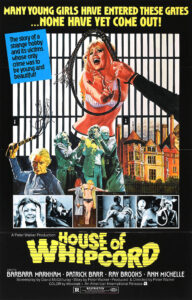
This 1974 film was something of an anomaly in the career of England’s Peter Walker, in that it received largely positive reviews and didn’t incite a lot of controversy. Made at a perilous time for the British film industry—Hollywood had decamped, money was tight and finding pretty ladies who could act (and do nudity) was apparently “virtually impossible”—HOUSE OF WHIPCORD was Walker’s take on the women in prison genre, filtered through his favorite premise: young women menaced by elderly psychopaths in a secluded setting.
HOUSE OF WHIPCORD (1974) Trailer
It opens with what Walker describes as a “mischievous wind-up” text: “This film is dedicated to those who are disturbed by today’s lax moral codes and who eagerly await the return of corporal and capital punishment…” We’re introduced to Jack Kind (Ivor Salter), a trucker who on an especially rainy night is approached by a horrifically brutalized young woman (Penny Irving). Extended flashbacks reveal the woman as Ann-Marie, a naive French model who at a party meets the creepy Tony (Ray Brooks), and, against the wishes of her more worldly friend Julia (Ann Michelle), agrees to accompany him on a road trip.
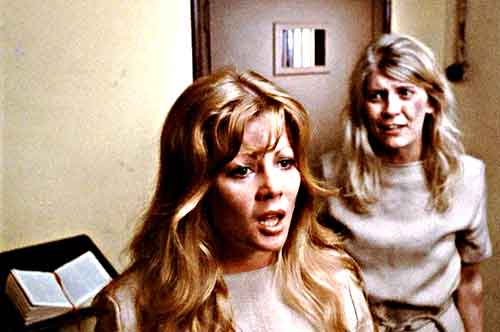
Ann Michelle
Their destination is a supremely forbidding structure owned by former prison matron Margaret Wakehurst (Barbara Markham) and retired judge Desmond Bailey (Patrick Barr), an unmarried couple who happen to be Tony’s parents. They’ve converted the abode into a private penitentiary, run by the supremely sadistic Walker (Sheila Keith); she lords over young women judged trangressive by Mrs. Wakehurst, and administers punishments that include humiliation, whipping and hanging.
Julia becomes suspicious about Ann-Marie’s absence and mounts an investigation, just as Ann-Marie manages to escape her confines and make contact with Mr. Kind (in the sequence that began the film). Kind unknowingly drives her back to the very place she just escaped, but he proves useful to Julia’s investigation, which leads to a finale that involves insanity, brutality and at least one unexpected death.
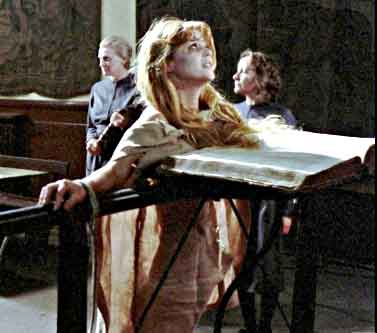
Sheila Keith, Ann Michelle
As was usually the case with Peter Walker’s films, HOUSE OF WHIPCORD is undeniably well made. The stately blocking, austere Stanley Myers score and relatively restrained (by 1970s grindhouse standards) nudity and violence quotient are enough to almost convince one that Walker and his collaborators had something in mind other than exploitation.
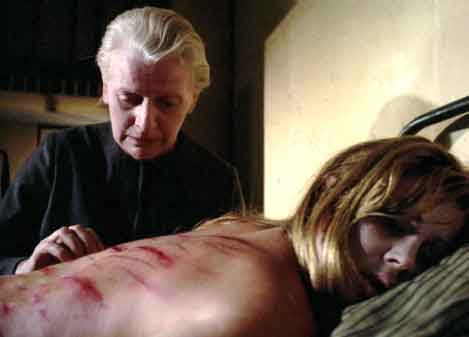
Sheila Keith, Ann Michelle
Tonally the film may be a bit too grim for its own good. Missing is the gonzo energy of Walker classics like FRIGHTMARE (1974) and SCHIZO (1976), which has given way to an air of dour hopelessness, with cinematographer Peter Jessop bathing nearly every indoor shot in shades of darkness, while the outdoor scenes all seem to be either overcast or rainy. A compelling film, to be sure, but it’s not much fun.
Vital Statistics
HOUSE OF WHIPCORD
Peter Walker (Heritage) Ltd.
Director/Producer: Peter Walker
Screenplay: David McGillibray
Cinematography: Peter Jessop
Editing: John Black
Cast: Barbara Markham, Patrick Barr, Ray Brooks, Ann Michelle, Sheila Keith, Dorothy Gordon, Robert Tayman, Ibor Salter, Laren David, Celia Quickie, Ron Smerczak, Tony Sympson, Judy Robinson, Jane Hayward, Celia Imrie, Barry Martin, Rose Hill, Dave Butler, Penny Irving