
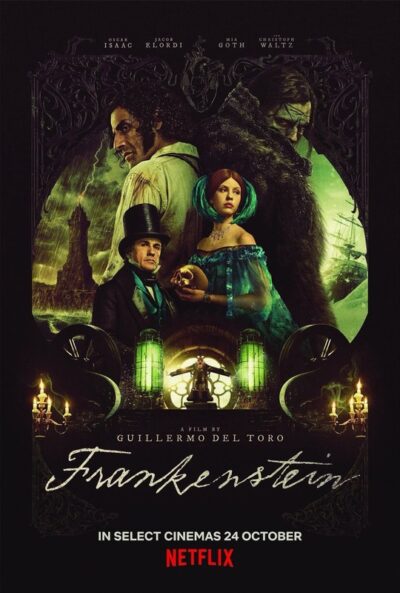
A lovingly mounted, highly reverential take on Mary Shelley’s immortal 1818 novel, this FRANKENSTEIN (2025) was directed by Guillermo del Toro, who has apparently been wanting to make it for decades. I’m pleased he finally got his chance, but del Toro would have been better off lavishing his efforts on long-simmering passion projects like THE LEFT HAND OF DARKNESS and AT THE MONTAINS OF MADNESS, as FRANKENSTEIN has many drawbacks, starting with the fact that it’s been done before.
FRANKENSTEIN (2025) Trailer
Of the story’s previous incarnations, the one this FRANKENSTEIN most closely resembles is Kenneth Branagh’s wildly baroque and operatic, and ultimately unsuccessful, 1994 interpretation (see below). As with Branagh, del Toro sought to craft the ultimate elaboration on all things FRANKENSTEIN, with nearly equivalent results.
MARY SHELLEY’S FRANKENSTEIN (1994) Trailer
The action begins in 1857, in “Farthermost North” (i.e. the point at which Mary Shelley ended her novel). There the crew of an ice-locked Danish ship discover the nearly frozen Victor Frankenstein (Oscar Isaac); pursuing him is “the Creature” (Jacob Elordi), who possesses superhuman strength and is impervious to bullets. In its zeal the Creature falls into a frozen lake and sinks beneath the ice, removing it from the picture (for a while, at least) and allowing Victor to tell his story.
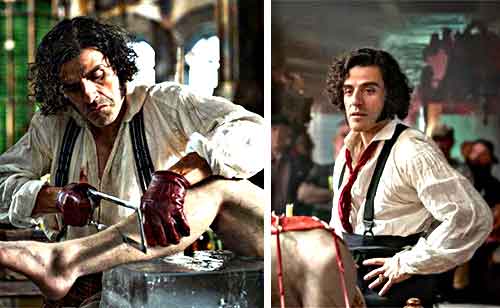
We learn that the young Victor (Christian Convery) enjoyed an aristocratic childhood lorded over by an abusive father (Charles Dance). Traumatized by the untimely demise of his mother (Mia Goth), Victor becomes determined to “conquer death.” He becomes an experimental surgeon, sewing together various peoples’ body parts to create an electrically charged being with which he terrorizes a theater full of medical students.
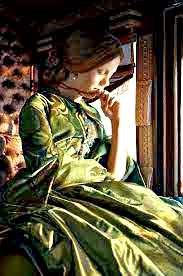
Teaming up with the dying ex-surgeon Harlander (Christoph Waltz), and romancing the latter’s niece Elizabeth (Mia Goth again), Victor moves into an uber-gothic tower where “For the first time I became more interested in life, and somewhat less interested in death.” Utilizing corpses left behind by the Crimean War, Victor creates the Creature, and brings it to life in a lightning storm, during which Harlander falls to his death (a death Victor pins on the Creature). Elizabeth develops an immediate rapport with the Creature, while Victor, deciding that his creation is intellectually deficient, elects to dispose of it by burning down the tower.
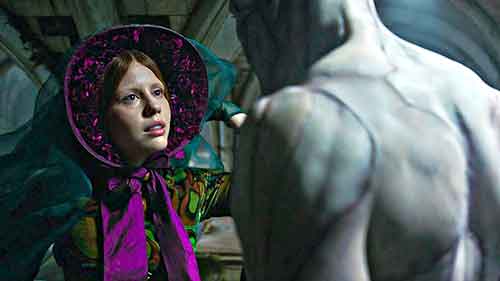
Back in the present, the Creature manages to escape the frozen lake and board the ice-trapped ship, where it tells its side of the story. Revealed is the Creature’s escape from Victor’s conflagration, and how it falls under the spell of a blind codger (David Bradley). The latter teaches the Creature to read, and provides it with some literature (including the poem “Ozymandias,” written by the husband of Mary Shelley), only to be massacred by wolves.
The Creature makes its way back to Victor, who’s about to marry Elizabeth. The result is a massive cluster-fuck that concludes with Elizabeth dying and the Arctic pursuit commencing. Eventually the monster and its creator are brought face to face for what comes very close to a happy ending.
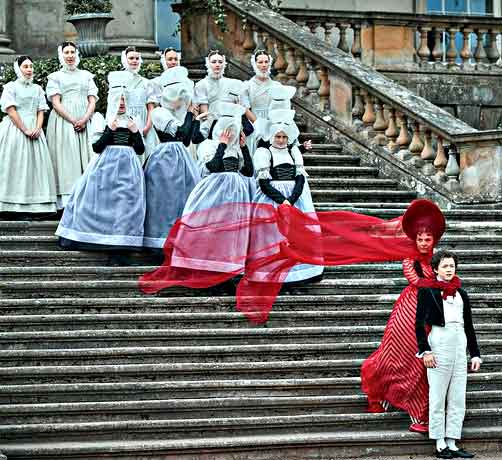
Excess appears to have been del Toro’s guiding principle. From the outrageously ornate design of Frankenstein’s domicile to the teeming extras-packed depictions of 19th Century London, the film is quite sweeping in both design and execution. Also on the excessive side is the symbolism (the crucifixion imagery is extremely copious) and bloodletting; this FRANKENSTEIN contains what must be ranked as the screen’s most graphic, and grotesque, depiction of the creation of Frankenstein’s Monster.
As the abovementioned 1994 FRANKENSTEIN proved, Mary Shelley’s tale is expansive enough in scope and thematic heft that a sprawling treatment is appropriate. Del Toro’s more-is-more approach furthermore provides some striking images, such as the sight of the Creature silhouetted against a desolate horizon and the nightmare-inducing stitched-together creation introduced by Victor in an early scene. On the downside, the film’s Victorian landscapes all have a synthetic look, resembling nothing so much as the CGI renderings they are.
The American Oscar Isaac, speaking in a fake English accent, is seriously miscast as a Victorian baron. Faring slightly better is Mia Goth, playing a 19th Century variant on the manic pixie dream girl archetype (the many snazzy outfits she wears speak louder than her dialogue), while Jacob Elordi endows the Creature with a poignancy and menace that help offset a shockingly nondescript physical appearance.
Vital Statistics
FRANKENSTEIN
Netflix
Director: Guillermo del Toro
Producers: Guillermo del Toro, J. Miles Dale, Scott Stuber
Screenplay: Guillermo del Toro
(Based on a novel by Mary Shelley)
Cinematography: Dan Laustsen
Editing: Evan Schiff
Cast: Oscar Isaac, Jacob Elordi, Mia Goth, Felix Kammerer, David Bradley, Lars Mikkelsen, Christian Convery, Charles Dance, Christoph Waltz, Nikolaj Lie Kaas, Kyle Gatehouse, Lauren Collins, Sofia Galasso, Joachim Fjelstrup, Ralph Ineson, Peter Millard, Peter MacNeill, Burn Gorman