
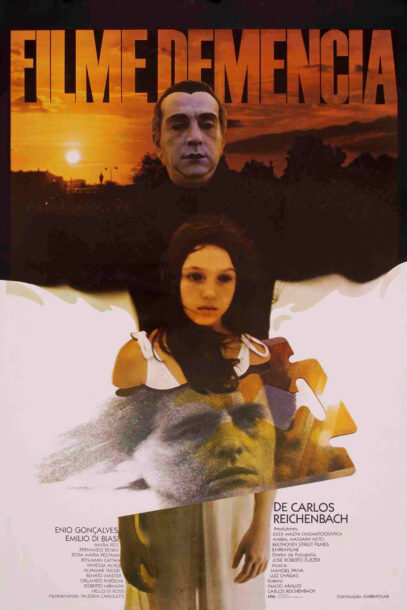
A weird Faust movie in the grand tradition of weird Faust movies. Following FAUST XX (1966), THE STRANGE CASE OF DR. FAUST (El extraño caso del doctor Fausto; 1969) and PRESIDENT FAUST (1974), and preceding FAUST (1994) and FAUSTO 5.0 (2001), FILME DEMÊNCIA (1986), hailing from Brazil’s late Carlos Reichenbach (1945-2012), offered an overtly surreal take on the Faust legend. Involved, as we all know, is a deal with the devil undertaken by a guy named Faust, or as he’s named here, Fausto.
FILME DEMÊNCIA (1986) Trailer
The film opens with a profoundly disturbing series of images involving the removal of the blade from a hand razor by Mr. Fausto (Ênio Gonçalves), a São Paulo based businessman who puts said blade in his mouth and then runs its edge up and down the naked body of his sleeping wife. This, it turns out, is an illustration of the severely unsettled mental state of Fausto, who’s lost his fortune in the implosion of the Eden cigarette brand he helped found. In frustration he filches a pistol from a security guard, and uses it to shoot a punk who threatens a philosophy professor.
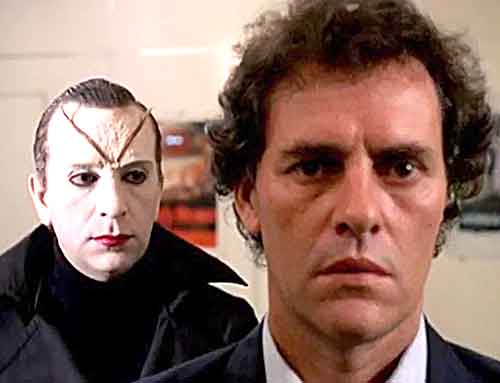
Enter Mephisto (Emilio Di Biasi), who first approaches Fausto outside a movie theater and offers him a free trip to a beachfront paradise with which Fausto is obsessed. Fausto rejects the offer, but Mephisto periodically reappears to make offers in different guises, including that of a sleazy fellow who lures Fausto into a brothel, in which he shoots a man who tries to rob him, and a businessman, to whom Fausto sells some of his Eden inventory.

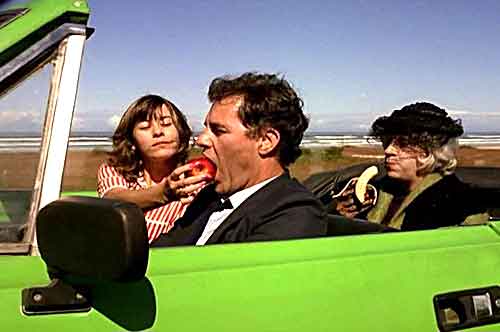
After using the pistol to shake down his business partners, Fausto purchases a convertible from a college buddy turned used car dealer and heads off in search of the paradise of his dreams. On this odyssey he meets a gypsy woman who demands cash to read Fausto’s palms, only to freak out upon doing so and refund his money. More significantly, he picks up a very mannish old woman who happens to possess a stash of Eden cigarettes.
The ending is a disappointment, justifying the bizarre and discordant air that pervades the film in the most hackneyed way imaginable (spoiler: it all turns out to be a you-know-what). A shame, as up until then the film’s surrealist bent is quite palpable in its oddly nonchalant air, which is maintained even in the violent and sexual bits. Note the books that periodically turn up, which include canonical surrealist texts like THE TORTURE GARDEN by Octave Mirbeau and NADJA by Andre Breton, as well as dialogue like “Only he who travels within knows how to distinguish truth from its shadow” and numerous discordant shots of the back of the protagonist’s head.
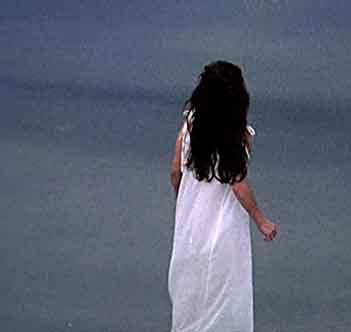
As is often the case with surreal cinema, all the weirdness has a distancing effect. The problems faced by the protagonist, which include corporate and urban ennui, are quite universal, yet difficult-if-not-impossible to relate to (or even follow), this being a film that demands to be seen at least twice.
What ultimately resonates are the performances of Ênio Gonçalves as the increasingly harried Fausto and Emilio di Biasi as the multi-guised Mephisto. I’ll also credit the film’s depiction of São Paulo in the 1980s, a demonic swirl of anonymous crowds and dehumanizing architecture that’s as surreal in its own way as anything dreamed up by Mirbeau or Breton.
Vital Statistics
FILME DEMÊNCIA
Beethoven Street Filmes/Cinearte Filmes/E.M. Cinematografica/Embrafilme
Director: Carlos Reichenbach
Producers: Eder Mazzini, Carlos Reichenbach
Screenplay: Inácio Araújo, Carlos Reichenbach
Cinematography: Jose Roberto Eliezer
Editing: Eder Mazini
Cast: Ênio Gonçalves, Emilio di Biasi, Imara Reis, Fernando Benini, Rosa Maria Pestana, Benjamin Cattan, Alvamar Taddei, Vanessa, Renato Master, Roberto Miranda, Orlando Parolini, Nello De’ Rossi, Ben Silva, Julio Calasso Jr., John Doo, Wilson Sampson, Farah Abdalla, Jairo Ferriera, Norberto Feyon, Toni Souza