
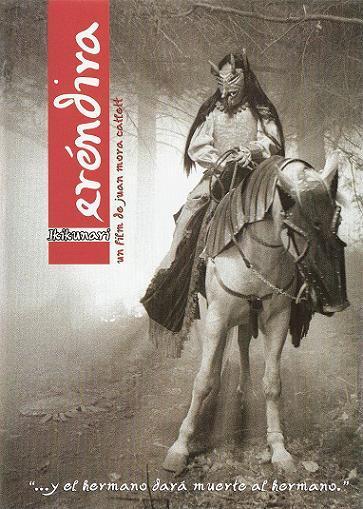
 One of a loose-knit trio of late 1990s-2000 films about the pre-Columbian era that included THE OTHER CONQUEST (La otra conquista; 1998) and APOCALYPTO (2006), with the Mexican made historical art film ERENDIRA IKIUNARI (Eréndira la indomable; 2006) being the most idiosyncratic of the three by far. It was based on the Purépecha folk tale of Erendira Ikikundari, a Joan of Arc like figure who fought against the invading Spanish conquistadores in 16th Century Tenochtitlan, and was filmed in the Michoacán region of western Mexico (formerly the Purépecha Empire) in the native Purépecha dialect.
In a brightly lit, craggy landscape of rocks and untamed brush is a kingdom ruled by Lord Tangaxoan (Rubén Bautista). One of his subjects, an old woman, speaks of a vision that “New gods are coming…and they’ll conquer the world…and also the heavens.” More similarly oriented dreams follow, causing mass panic, with the only person immune to the strife being the teenaged Erendira (Xochiquetzal Rodríguez), a proto feminist who chafes against taking part in an arranged marriage.
The New Gods, a.k.a. the Spanish conquistadores (depicted as men with featureless white faced masks), turn up and promptly loot Tangaxoan’s gold stash. This leads the cowardly Tangaxoan to give his kingdom over to the Spanish and drown himself in a lake, while Erendira elects to join a group of rebels led by her uncle Timas (Roberto Isidro Rangel). After Timas’ men capture a “hornless deer” (or horse) from the Spanish as a sacrifice, Erendira proves her mettle by learning to ride the animal. This renders her a goddess in the eyes of the locals, and greatly effects the outcome of a battle that occurs when the Spaniards and their collaborators show up to decimate Timas and his coalition.
That his film was folklore inspired is something writer-director Juan Mora Catlett never lets us forget, incorporating two dimensional artwork (taken from the RELACION DE MICHOACAN 16th Century illustrated manuscript that was used as research by Catlett) into a live action format. A fair amount of bloodletting and head-lopping are included, but the tone is uniformly subdued and contemplative (it is, once again, an art film), and Catlett makes no effort to hide the artifice. That’s in addition to a quirky filming style that haphazardly juxtaposes stationery and handheld camerawork, and color and black-and-white imagery in a highly operatic, digitally lensed historical fantasia (the decision to use DV was apparently quite controversial in 2006, with Catlett spending much of the DVD making-of featurette defending the choice).
The cast, comprised of non-professional actors from Morelia, Michoacán, deliver lived-in performances (even if there are no standouts), and the props and scenery, made by Michoacán craftspeople, have an authentic, if not entirely “realistic,” feel. Authentic but not realistic likewise sums up ERENDIRA IKIKUNARI, which isn’t fully successful in its aims, but is quite unique.
Vital Statistics
ERENDIRA IKIKUNARI
Imcine
Director/Screenplay: Juan Roberto Mora Catlett
Producers: Elizabeth Catlett, Luis Kelly, Mariana Lizárraga, Juan Mora Catlett
Cinematography: Toni Kuhn
Editing: Rodrigo Montes de Oca
Cast: Xochiquetzal Rodríguez, Rubén Bautista, Roberto Isidro Rangel, Copérnico Vega, Carlos Enrique Alarcón, Luís Copérnico, Sergio González Pérez, José Flores Martínez, Sergio González Pérez, Justo Alberto Rodríguez