

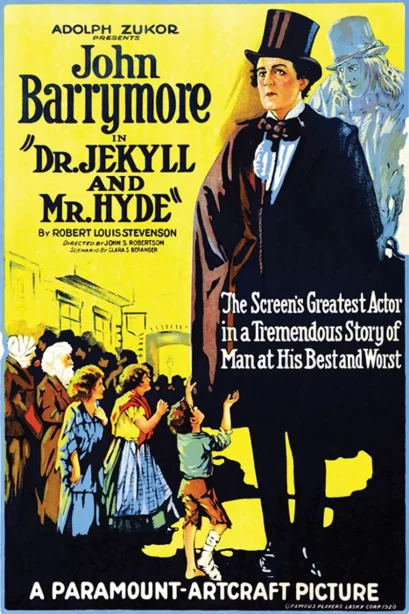
No, it was by no means the “first” film to be adapted from Robert Louis Stevenson’s immortal STRANGE CASE OF DR. JEKYLL AND MR. HYDE (1886), but the 1920 DR. JEKYLL AND MR. HYDE can lay claim to being the definitive screen version. It certainly marked a breakthrough in the career of John Barrymore, who was known up to then as a handsome leading man in various 1910s films, and like the transformative serum that figures so heavily in the story, DR. JEKYLL AND MR. HYDE irrevocably altered his image forevermore.
DR. JEKYLL AND MR. HYDE (1920) Full Movie
Stevenson credited the entirety of his oeuvre to “Brownies,” his term for “some Familiar, some unseen collaborator, whom I keep locked in a back garret, while I get all the praise and he but a share…” STRANGE CASE OF DR. JEKYLL AND MR. HYDE offered an ideal outlet for the Brownies, and has proven so influential you likely know the story even if you haven’t read it.
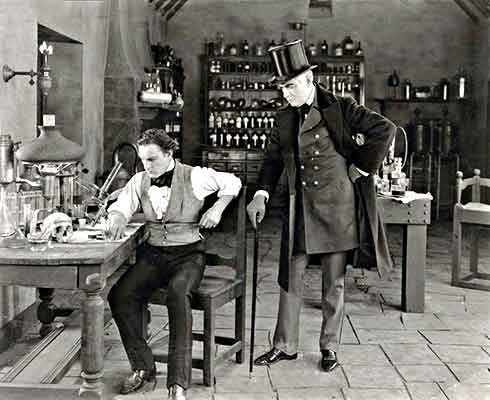
This film, an expensive Paramount Pictures release produced by the legendary Adolph Zukor, followed several previous stage and screen adaptations, and was quite controversial in its day (according to one reviewer, “only in Dante’s INFERNO can similar horror be found”). It was iconic enough that a rival version, made by the independent production outfit Pioneer Film Corp., was rushed into theaters around the same time. Needless to add, it was the present film, directed by John S. Robertson, that took the golden ring.
Henry Jekyll (Barrymore) is an idealistic medical doctor obsessed with using science for the betterment of mankind (inspired, apparently, by the hunt for a syphilis vaccine in post-WWI America). One night at a party an upscale guest, Sir George Carew (Brandon Hurst), informs Jekyll that “The only way to get rid of temptation is to yield to it,” and for confirmation takes him to view a sensuous dance performed by the seductive Gina (Nita Naldi), which stirs Jekyll’s “baser nature.” He becomes obsessed with forcibly separating man’s good and evil states, allowing one to “yield to every evil impulse but leave the soul untouched.”
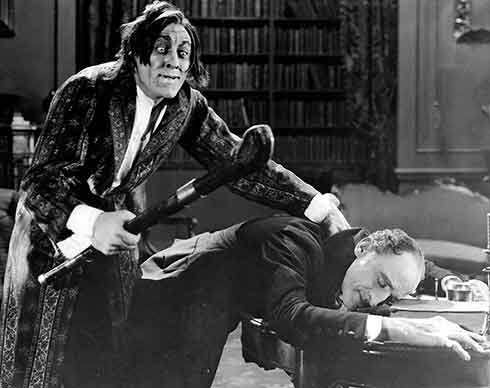
To this end Dr. Jekyll creates a serum that transforms him into Mr. Edward Hyde, a scraggly haired, bug-eyed creep—and when ingested a second time the serum turns him back into Jekyll. He finds a hideaway house for Hyde to give his evil machinations full reign and even draws up a will in which he leaves all his worldly belongings to his evil half.
Inevitably, Hyde comes to disrupt Jekyll’s existence, needling Jekyll’s sweet-natured girlfriend Millicent (Martha Mansfield). Things get so bad that Jekyll transforms into Hyde while asleep, depicted by the latter taking the form of a giant spider and climbing into the body of Jekyll. He becomes determined to find some way to end the transformation process altogether, but Mr. Hyde is still lurking within and determined to keep the party going.
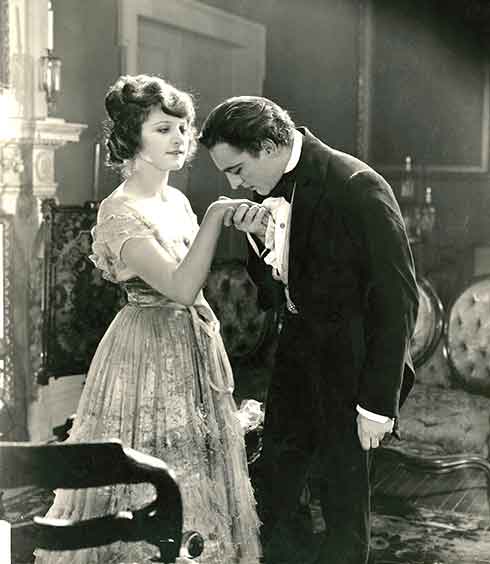
The silent medium proves an ideal vehicle for Stevenson’s tale, and director John S. Robertson (TESS OF THE STORM COUNTRY) went about his job with enormous skill and confidence. The visual depth of field, particularly in the outdoor shots of cluttered streets and alleyways (in which characters are seen cavorting in the distance), is impressive, as are the surprisingly unshowy and well-integrated special effects. The viewer doesn’t have to be as forgiving here as s/he does with most silent horror films, as the scares in this DR. JEKYLL… are well earned.
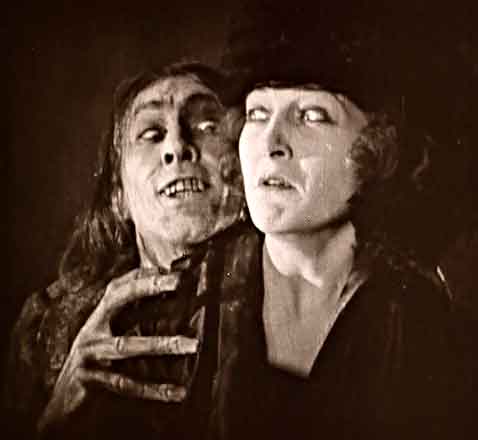
This is said to be the first film, Jekyll and Hyde related or otherwise, that focused on hands, depicted becoming progressively bony and wrinkled via successive dissolves, as a signifier of transformation. Barrymore’s facial expressions also contribute mightily to the effect; quite simply, nobody could contort his face like John Barrymore, an actor whose offscreen predilections were nearly as freaky as those of Mr. Hyde.
Many different versions of this film are available online and off (most notably a 67 minute cut copyrighted in 1971 by Killiam Films), but interested parties are urged to check out the restored 73 minute version. Featured is the original color tinting that renders the night scenes in shades of blue and intertitles decorated with suitably infernal artwork.
Vital Statistics
DR. JEKYLL AND MR. HYDE
Paramount/Artcraft
Director: John S. Robertson
Producer: Adolph Zukor
Screenplay: Clara S. Beranger
(Based on a novella by Robert Louis Stevenson)
Cinematography: Roy Overbaugh
Cast: John Barrymore, Martha Mansfield, Brandon Hurst, Charles Lane, Cecil Clovelly, Nita Naldi, Louis Wolheim, George Stevens