
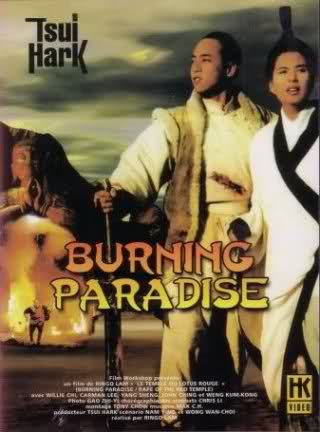
For me, this “gothic hell prison movie” will always be the most satisfying film directed by Hong Kong’s late Ringo Lam (1955-2018). Produced by Tsui Hark, BURNING PARADISE (Huo shao hong lian si; 1994) is in fact an old school actioner in the mold of quite a few classic martial arts films, and one of several to feature the Chinese folk hero Fong Sai-Yuk. Yet the film was a flop in its day, due most likely to the complete lack of star power (the headliners Willie Chi and Carman Li were given “Introducing” credits and haven’t been seen much since) and the relentlessness of Lam’s filmmaking.
BURNING PARADISE (1994) Trailer
The period is the Ching Dynasty, with Fong (Chi) and his “Uncle-master” Chi Shan (Ji Li) captured in a round-up of the disciples of Shaolin. During the melee a guy gets sliced in half (with a shot of the bottom part, spurting blood, still seated on his horse as it gallops away), Fong’s horse is decapitated by a Flying Guillotine (a popular device in old school Asian action cinema), and Fong and Chi find themselves thrown together with the runaway prostitute Dou Dou (Carman Li).
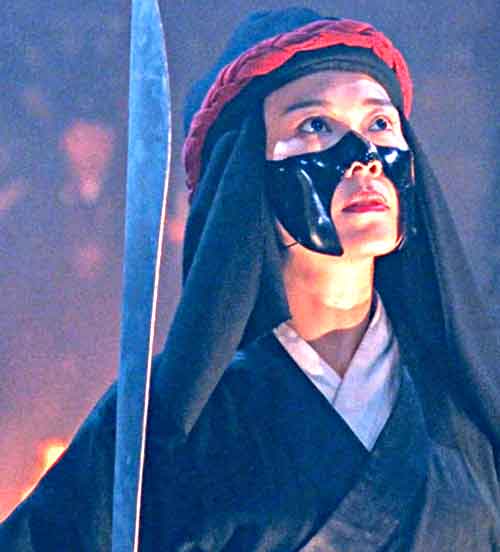
Chi Nun ends up stabbed to death, and Fong and Dou are taken to the Red Lotus Temple, an underground prison whose exterior is festooned with skulls and hanging corpses. The interior of this place, ruled by the evil Shen Kung (Wong Kam Kong), is even more horrific, riddled with deadly booby traps and hidden corridors that lead, more often than not, to masses of male corpses and mummified women.
Fong ends up having to fight his way out of this horror-scape, which entails a lot of large-scale ass-kicking and, in the case of Kung’s seductive right hand woman Tsui Ho (Chun Lam), sexual shenanigans. Dou Dou, meanwhile, has to contend with the advances of Kung, who immediately takes a fancy to her; his sexual predilections turn out to be plenty twisted, with an attempted nighttime tryst with Duo somehow entailing the decapitation of a courtesan.
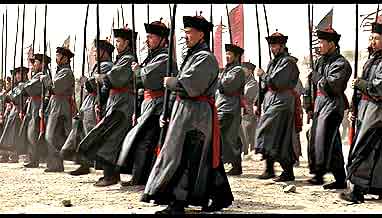
All of this is superbly choreographed by Lam and martial arts director Chris Li. It’s no surprise that where the film falls flat is in its attempts at comic relief, ordered no doubt by producer Tsui Hark, whose commercial sensibilities are far removed from the relentlessness that characterized Ringo Lam’s filmmaking. The violence in his films was rendered with a heightened level of reality-based brutality and an emphasis on pain. That sensibility, I’d argue, detracted from previous Lam efforts like CITY ON FIRE (Lung foo fung wan, 1987) and FULL CONTACT (Hap do Ko Fei, 1992), but actually works in BURNING PARADISE’S favor, it being, in essence, a horror movie.
Furthermore, Lam’s eye for casting (it was he, let’s not forget, who gave Chow Yun-Fat one of his earliest starring roles in CITY ON FIRE) was as spot-on as ever. As Fong Sai Yuk, the little-known Wilie Chi exhibits all the physical dexterity and impish charisma the role demands, and the equally little-known Carman Li makes for an agile and sexy romantic partner. Both should have done much more.
Vital Statistics
BURNING PARADISE (Huo shao hong lian si)
DLO Films Production/Silver Metal Productions
Director: Ringo Lam
Producer: Tsui Hark
Screenplay: Nam Yin, Wong Wan Choi
Cinematography: Gao Zi Yi
Editing: Tony Chow
Cast: Willie Chi, Carman Li, Ji Li, Yamson Domingo, Wong Kam Kong, Chun Lam, Quan Lin, Kam-Kong Wong, Xiqian Wu, Kam-Fai Yuen