

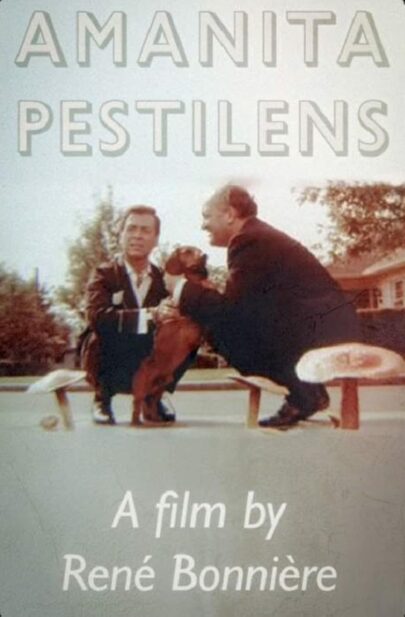
This Quebec lensed 1963 release, an eco-horror tinged psychodrama, had the distinction of being the first Canadian live-action feature to be filmed in color. It was also the first Canadian film to be lensed in dual English and French versions with the same actors (whose ranks included a debuting Geneviève Bujold). It’s the French language cut that’s currently the most readily available version of AMANITA PESTILENS (POISONED LOVE), directed by the French born René Bonnière and scripted by the British novelist David Walker.
AMANITA PESTILENS (1963) Clip
In a comically exaggerated suburban setting the middle aged Henri Martin (Jacques Labrecque) is given a trophy for being a “Great champion of the lawn.” This guy loves taking care of his front lawn, and so is quite non-plussed when an odd pink-headed mushroom sprouts up from the grass. Henri promptly disposes of it, but several identical ‘shrooms quickly sprout up.
Henri has his lawn repeatedly bulldozed, after which he obsessively reseeds the ground. This does nothing to deter the mushroom growth, which drives him to near-madness. His wife Louise (Huguette Oligny) grows fed up with his antics, while their teenage daughter Sophie (Bujold) runs off with a local garbage collector. Upon seeing Sophie perform in a downtown strip club, Henri freaks out, resulting in a week’s stay in prison.
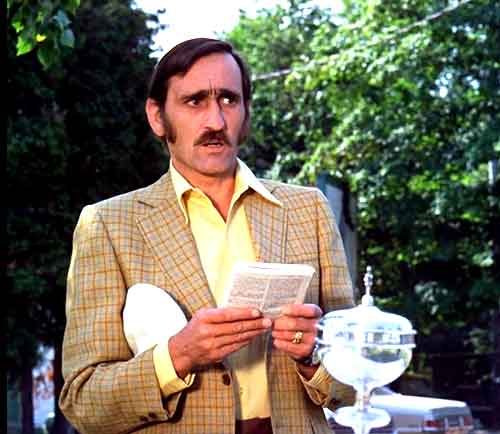
After his release Henri makes a great effort to reign in his obsession. All would appear to be well until he discovers that Louise has broken his prized lawn champion trophy, which pushes him over the edge entirely, leading to further lawn battles, a murder and a fantastic twist.
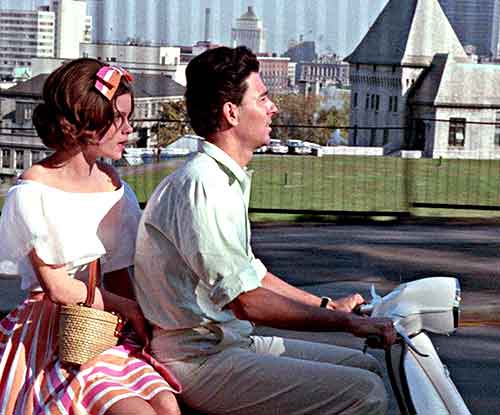
Given that this film’s director René Bonnière and producer F.R. Crawley both got their starts (in common with Canadian cinema as a whole) filming documentaries, it makes sense that so much of the proceedings are so documentary like. We get verité depictions of Quebec’s early 1960s suburbs, its urban cityscapes, its rural farmland and even its freeways. No wonder the film often feels like a travelogue, with the psychologically based narrative subject to frequent digressions.
Further directorial unsteadiness is evident in the (over)use of music to make dramatic points. A depiction of horse-drawn carriages being driven down the center of a busy intersection is odd and compelling enough that it doesn’t need the jazzy histrionics of Larry Crosley’s score to underline that fact.
The pic is, in short, a mess, with its insights limited to the time and place of its inception. It does, however, have a sense of darkly comedic strangeness that points forward to the very Canadian-centric films of Guy Maddin and John Paizs, so AMANITA PESTILENS has some intertest as a historical artifact.
Vital Statistics
AMANITA PESTILENS
Crawley Films
Director: René Bonnière
Producer: F.R. Crawley
Screenplay: David Walker
Cinematography: Frank Stokes
Editing: René Bonnière
Cast: Jacques Labrecque, Huguette Oligny, Geneviève Bujold, Benoit Girard, Blake James, Jean Louis Millette, Julien Lippe, Gabriel Vigneault, Pierre Baron, Denise Bombardier, Georges Cortez, Ronald France, J. Leo Gagnon, Gisele, Juliette Huot, Francoise Lemieux, Yvon Leroux, Jacques Normand, Roger Garceau