
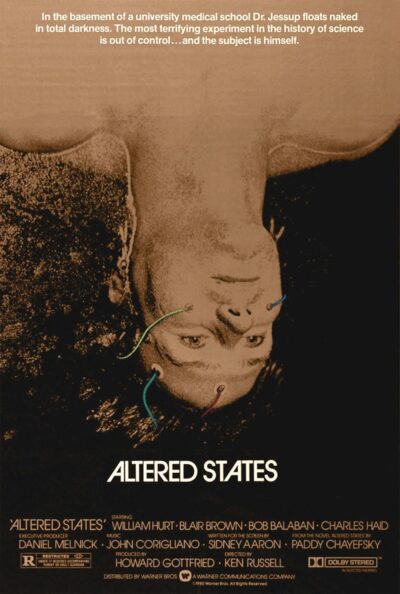
A product of what Pauline Kael dubbed the most “grotesquely inspired” writer-director combo of all time: the thoughtful and verbose American dramatist Paddy Chayefsky and Ken Russell, the UK’s master of all things outrageous. This 1980 Collaboration from Hell came about, apparently, through necessity: after Arthur Penn was fired as director of the Chayefsky penned ALTERED STATES, a search was mounted for a new helmer that encompassed Steven Spielberg, Orson Welles and Andrei Tarkovsky. Russell, in director jail following the back-to-back flops LISZTOMANIA (1975) and VALENTINO (1977), ranked at the bottom of the list, but got the job (he claimed) because nobody else would take it.
ALTERED STATES (1980) Trailer
The Chayefsky-Russell dynamic was, unsurprisingly, a fraught one. The script, adapted from Chayefsky’s 1978 novel (actually a film treatment stretched to novel form), was respected, but Chayefsky was enraged by Russell’s habit of having the actors deliver their lines in rapid fire fashion, often while walking, eating, ascending stairs and even, in one case, simultaneously. Russell, for his part, chafed under Chayefsky’s authoritarian manner (he had creative control), and caused a minor stir by smart-assedly asking for Chayefsky’s input on the grunts in a sex scene. Chayefsky ended up removing his name (substituting “Sidney Aaron,” ironically his actual moniker) and died less than a year after the film’s release, a death some attribute to “a broken heart.”
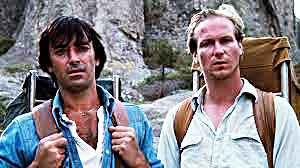
Bob Balaban, William Hurt
New York City, 1967: graduate student Eddie Jessup (William Hurt, in his film debut), with the help of his pal Arthur (Bob Balaban), submerges himself in a water-filled isolation tank as part of a grand experiment, and experiences hallucinations that recall his religious childhood. At a party he meets Emily (Blair Brown), a would-be anthropologist he decides to marry, despite diverging worldviews—he’s obsessed with finding a deeper meaning while she’s content with meaninglessness—and the fact that he can’t bring himself to say he loves her.
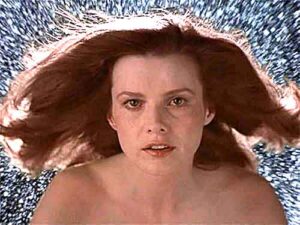
Blair Brown
1974: Jessup and Emily have split up after relocating to Boston and birthing two daughters (one of them played by a very young Drew Barrymore). Jessup travels to South America, where during a Mayan ceremony he imbibes a liquid made from magic mushrooms, and has further hallucinations. This inspires him to resume his isolation experiments upon returning to Boston, utilizing an ancient metal box set into the floor of a Harvard laboratory and injecting himself with the Mayan compound. This inspires hallucinations so vivid they cause Jessup to regress to a simian state of evolution; in this state he runs through the streets, severely beats a security guard and devours a sheep, a period he later dubs “the most supremely satisfying time of my life.”
A final stay in the isolation tank follows (Jessup having somehow managed to avoid any serious repercussions for his simian antics) with Arthur and Emily present. That’s a good thing, as Jessup regresses to pure energy, and she has to wade into the tank and rescue him. But it seems this particular “altered state,” in which Jessup experiences the horror of the first moment of creation, is still extant in his body, waiting to swallow him up—and, it turns out, Emily as well.
ALTERED STATES aptly demonstrated Ken Russell’s talent for taking material unsuited to his sensibilities and making it his own. This occurred previously with TOMMY (1975), in which the classically-oriented Russell crafted a highly characteristic concoction from The Who’s 1969 rock opera; with ALTERED STATES Russell was stuck with a genre, science fiction, that interested him even less than rock ‘n’ roll, yet once again turned out a thoroughly representative film.
The Chayefsky script, in truth, isn’t all that. The set-up is far from original (being virtually identical to that of Leonard Cline’s 1927 novel THE DARK CHAMBER) and requires a great deal of expository dialogue. In this manner Russell’s rapid fire handling of the line readings, which so enraged Chayefsky, works in the film’s favor, maintaining viewer attention amid wordage like “You carry on like a flagellant which can be very nice, but I sometimes wonder if it’s me that’s being made love to.”
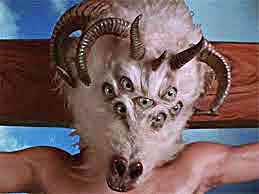
But of course, the film is most famous for its hallucination sequences. These were conceived entirely by Russell, whose flamboyant Catholic-tinged sensibilities are on full display in these scenes, which utilize extensive macro photography and morphing effects supervised by the great Dick Smith.
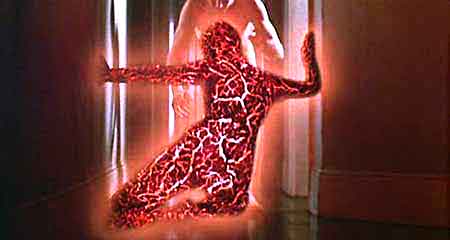
Somehow it all comes together in a gorgeously odd film containing a little something for everyone: body horror, brainy SF, monsters and hallucinations, not to mention impeccable cinematography by Jordan Cronenweth and a supremely bombastic score by the classical composer John Croigliano that (if one views ALTERED STATES in its intended big screen form) conjures a definite frenzied magic. Whether the film is truly as profound as its makers seem to believe it is (with the overriding message being “All you need is love”) remains an open question.
Vital Statistics
ALTERED STATES
Warner Bros.
Director: Ken Russell
Producer: Howard Gottfried
Screenplay: “Sidney Aaron” (Paddy Chayefsky)
(Based on a novel by Paddy Chayefsky)
Cinematography: Jordan Cronenweth
Editing: Eric Jenkins
Cast: William Hurt, Blair Brown, Bob Balaban, Charles Haid, Thaao Penghlis, Miguel Godreau, Dori Brenner, Peter Brandon, Charles White-Eagle, Drew Barrymore, Megan Jeffers, Jack Murdock, Frank McCarthy, Deborah Baltzell, Evan Richards, Hap Lawrence, John Walter Davis, Cynthia Burr