
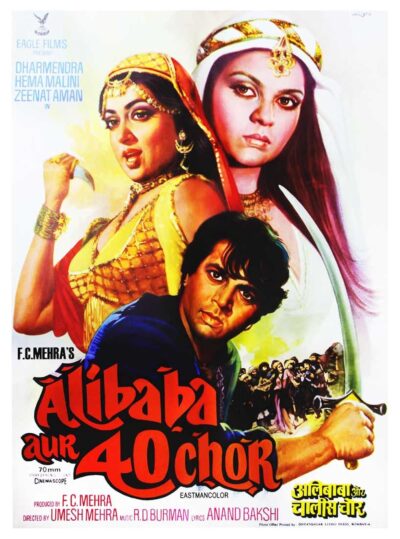
 The ARABIAN NIGHTS craze that gripped the 1970s, manifested in THE ARABIAN NIGHTS (Il fiore delle mille e una notte; 1974), the Danish miniseries ALADDIN ELLER DEN FORUNDERLINGE LAMPE (1975-76), ADVENTURES OF ALADDIN (1978), SINBAD AND THE EYE OF THE TIGER (1977) and ARABIAN ADVENTURE (1979), found its apotheosis in ADVENTURES OF ALI BABA AND THE 40 THIEVES (Alibaba Aur 40 Chor; 1980), a highly ambitious and very of-its-time Hindi language (or Bollywood) Indo-Soviet co-production.
India has been responsible for many of the screen’s premiere ARABIAN NIGHTS screen interpretations, including ALADDIN AND THE WONDERFUL LAMP (Aladdin Aur Jadui Chirag; 1952), ALIF LAILA (1953) and HATIM TAI (1956). ADVENTURES OF ALI BABA AND THE 40 THIEVES, whose cast contains a smattering of Indian and Soviet performers headed by Bollywood mega-star Dharmendra, was the most ambitious film of the lot (although not the best, a designation I say goes to the 1993 Urdu language TV series version of ALIF LAILA), and a sizeable hit, scoring an estimated 21 million admissions in India and 52.8 million in the Soviet Union.
The film certainly starts with a bang, depicting the notorious bandit Abu Hassan (Rolan Bykov) causing a massive cliff to split apart with the invocation “Open Sesame.” Hassan and his 40 criminal companions enter the opening, which leads to a gaudily illuminated, opulently decorated cave filled with priceless treasure, and fill their pockets.
Cut to Gulabad, a small town threatened by Hassan, who drains the reservoir containing the community’s water supply, and Gulabad’s slimy ruler Qazi Sahib, who appears to be in cahoots with Hassan. Among the latter’s outrages are the fact that he imprisons a man (Madan Puri) in a dungeon and forces him to make “satanic fire” (a.k.a. gunpowder). The man is driven to suicide, leaving his gorgeous daughter Fatima (Zeenat Aman) obsessed with avenging her father’s death. Then there’s the Gulabad dwelling Alibaba (Dharmendra), who’s dispatched by his mother (Sofiko Chiaureli) to find his father Yusuf (Zakir Mukhamedzhanov), who left home decades earlier and has yet to return.
Yusuf is found, but dies before he and Alibaba can have a proper reunion. Enter Princess Marjeena (Hema Malini), who literally falls into Alibaba’s arms. The two are immediately smitten, but she’s a slave, and Alibaba needs 1000 dinars to buy her freedom; he gets the money from his greedy brother Qasim (Yoqub Ahmedov), who in the meantime takes in the revenge-minded Fatima, in the hope that she’ll be able to provide the riches Qasim so ardently desires.
Alibaba happens to witness Hasan open the cliff face by intoning “Open sesame,” and repeats the invocation himself. Inside he finds Hassan’s wealth, and also the spectral Simsim (Elen Sanayeva), the “Keeper of the Cave.” Alibaba later makes the mistake of revealing the secret of the opening of the cliff to Qasim, who becomes caught inside the cave when Hassan and the 40 thieves turn up, and doesn’t survive the encounter.
Further mayhem follows as Alibaba’s mom leaves her home to shack up with him and Marjeena, while Fatima tries to get herself crowned the most beautiful woman in the land and the true identity of Gulabad’s corrupt ruler Qazi Sahib is revealed. It all ends happily, of course.
Froma purely physical standpoint this is an impressive production, with elaborate production design constructed on location in India and Uzbekistan, and a wealth of highly panoramic, extras-packed battle scenes. The special effects are quite dated, yet strong and convincing nonetheless, and executed with Mario Bava-like ingenuity.
The filmmaking, credited to the Uzbekistani Latif Faiziyev and Bollywood legend Umesh Mehra (the son of the film’s producer F.C. Mehra), is undistinguished. The two directors don’t appear to have gelled, resulting in handheld camerawork that’s constantly going out of focus (which isn’t helped by the fact that surviving prints of the film are quite blurry) and undercutting the widescreen compositions, which are further marred by a clumsy juxtaposition of wide shots and close-ups.
The tone, in common with those of most Bollywood films, is borderline hysterical, and the narrative VERY involved, with so many protagonists jostling for position that the title character assumes the status of a supporting player. The action, for its part, is continuous, with the romance and periodic song and dance numbers functioning as distractions. Said music numbers, a requisite of old school Bollywood, date the film quite dramatically, with very disco-fied music and dancing (complete with a flashing multi-hued floor in one scene) presented several years before Bollywood officially went disco.
Vital Statistics
ADVENTURES OF ALI BABA AND THE 40 THIEVES (Alibaba Aur 40 Chor)
Eagle Films/Uzbek Film
Directors: Latif Faiziyev, Umesh Mehra
Producer: F.C. Mehra
Screenplay: Shanti Prakash Bakshi, Boris Saakov
Cinematography: Leonid Travitsky, Peter Pereira
Editing: M.S. Shinde, M. Makarova
Cast: Dharmendra, Hema Malini, Zeenat Aman, Yoqub Ahmedov, Rolan Bykov, Sofiko Chiaureli, Elena Sanayeva, Zakir Mukhamedzhanov, Kuatbai Abdreimov, Frunzik Mkrtchyan, Khodzha Durdy Narliyev, Prem Chopra, Madan Puri, Pinchoo Kapoor, Mac Mohan, Sanat Divanov, Kuatbai Abdreimov, Sharif Kabilov