
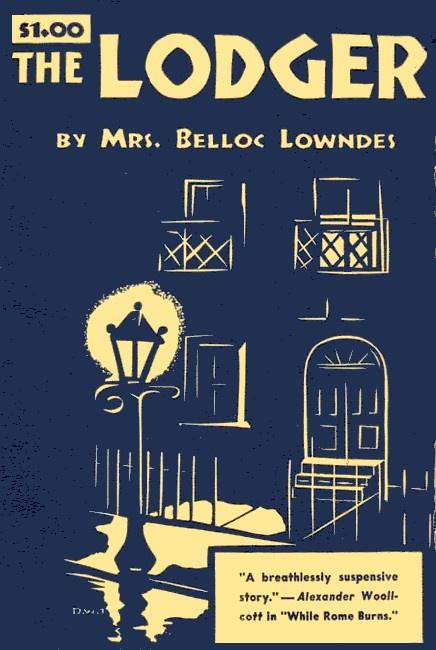
 By MARIE BELLOC LOWNDES (Methuen Publishing; 1913)
I think it goes without saying that this iconic suspensor, published at the tail end of the Edwardian era (and initially serialized in the DAILY TELEGRAPH), has dated quite dramatically. In fact, enjoyment of THE LODGER by Marie Belloc Lowndes (1868-1947) is contingent on the ability to cast one’s mind back to 1913 and view the text through the eyes of an Edwardian, in which guise it’s pretty impressive.
The premiere fictional extrapolation of the 1888 Jack the Ripper killings, THE LODGER was also a landmark in the psychological thriller field, harkening forward to the work of masters of the form like Patricia Highsmith and Hugh Fleetwood (and also, it’s been claimed, the famous urban legend “The Hook”). With a sense of mounting tension that might be called Hitchcockian (appropriately, Alfred Hitchcock adapted THE LODGER for film in 1927), Lowndes focuses on the Buntings, a retired servant couple running a failing London based lodging-house whose bad luck would appear to be reversed when an odd fellow named Sleuth turns up wanting to utilize the residence.
The city is being terrorized by what nowadays would be called a serial killer. The Buntings’ better half Helen, who serves as protagonist, finds her feelings toward her tenant and his odd behavior, which includes walking the streets at night and performing unidentified “experiments” in his room, growing increasingly complicated. She doesn’t initially suspect that Sleuth is the mysterious killer, but the truth gradually becomes impossible to ignore—and ignoring it is something Helen tries very hard to accomplish, as she’s well aware that she’ll be seen as an accessory to Sleuth’s madness, and also because she simply doesn’t want this horrifying reality to be true.
That this novel was an expansion of a short story (published in the January 1911 edition of McCLURE’S magazine) is evident in a narrative that despite its intensity seems needlessly drawn-out and uneventful. It takes Ellen an unconscionably long time to connect the odd behavior of Sleuth to the killings occurring in the area (and her husband even longer), and culminates in an open-ended denouement that, as with the actual case that inspired the novel, has the killer going uncaught. A final act twist might have livened things up, but there’s no such twist to be found.