
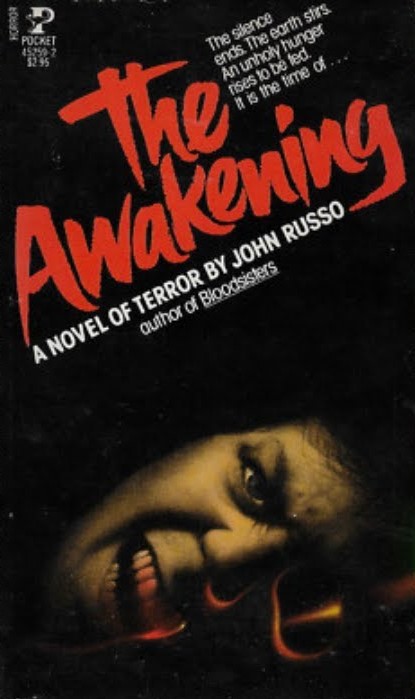
By JOHN RUSSO (Pocket Books; 1983)
Another 1980s take on vampire lore? Yes, and an ambitious example by filmmaker John Russo, who generally fared far better as a novelist than he did behind the camera. This is the best Russo novel I’ve read, a bold and imaginative take that ranks with early eighties classics of vampire lit like VAMPIRE JUNCTION, THEY THIRST and THE REVENANTS. THE AWAKENING has the added bonus of a time travel angle, with a man executed in late 1700s America returning to life in 1983 Pittsburgh (Russo’s stomping grounds). Think THE VAMPIRE TAPESTRY meets TIME AFTER TIME.
Benjamin Latham is an 18th Century colonist who’s accused of sorcery and vampirism, and executed accordingly. Yet due to the anti-vampire rituals carried out on his corpse—cloves of garlic strung around the neck, a stake driven through the heart, etc.—vampirism is actually induced, with the garlic and staking “preventing an essential part of his spirit from leaving his body.” Over the next 200 years Benjamin’s former vessel rots away and a new form coalesces, providing a biological rationale for vampirism that nearly places the book in science fiction territory.
As a time travelling vamp Benjamin finds himself bestowed with all sorts of neat powers, including superhuman strength and telepathy. There are, however, some accompanying rules: he can turn invisible, for instance, but only to someone who hasn’t already seen him. He also has the insatiable bloodlust that drives most vampires, and is capable of killing his victims with a single bite—as occurs with the first 20th Century person he meets: a little girl. Other characters include Lenora Clayton, a young history major who adds a romantic, and sexually frank, angle, and Benjamin’s descendent Matthew Latham, who happens to be a murderous psychopath.
All this is terrific, but Russo’s authorial shortcomings keep THE AWAKENING from full achievement. His descriptions aren’t all they could be, marred by an uninvigorating vocabulary that employs adjectives like “groggy” and “weird.” The fact that Benjamin is a dedicated Tory who in his former life was opposed to the American revolution is interesting, but not taken very far. Russo also has a weakness for cliches, including the presence of a pair of stock detective characters boringly investigating the doings of the “Vampire Killer,” the particulars of which we know, as the majority of the novel is told from said killer’s vantage point.