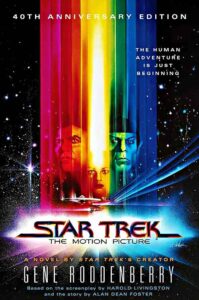
By GENE RODDENBERRY (Pocket; 1979)
One of the more famous late Twentieth Century movie novelizations was this prose rendering of the first STAR TREK feature, credited to series’ creator Gene Roddenberry. Alan Dean Foster is often rumored to have ghostwritten the book, but in truth Foster only contributed story material, with Roddenberry having indeed been the true writer. That the text is superior to the film it novelized should be obvious, as the flick was a notorious snooze-fest that even its principals disliked (with a 2000 director’s cut doing little to help matters); this doesn’t mean, however, that the book is all that good.
STAR TREK: The Motion Picture (1991) Trailer
The late Harlan Ellison (scripter of the famous 1967 STAR TREK episode “The City on the Edge of Forever”) claimed Roddenberry, who apparently “can’t write for sour owl poop,” only ever had one idea, which in Ellison’s words went like this: “the crew of the Enterprise goes into deepest space, finds God, and God turns out to be insane, or a child, or both.” That, as it happens, essentially sums up STAR TREK: THE MOTION PICTURE (on which Roddenberry, for the record, wasn’t given a screenwriting credit).
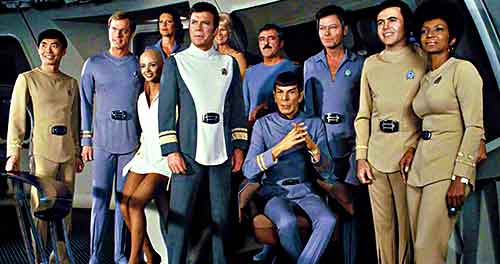
Beyond that you probably know the story’s particulars: Captain—now Admiral—James T. Kirk and the crew of the ENTERPRISE, including Mr. Spock, Dr. McCoy, Scotty, Chekov, Uhura and Sulu, are reassembled after the conclusion of their five-year mission to investigate a godlike entity contained in a massive space cloud. Turns out the cloud is manned by a mechanical something called Vejur, which is upset that its creator hasn’t answered a request for information about its place in the Universe and isn’t above cajoling a response in the form of planetary destruction. Along for the ride is Kirk’s protégée and chief competitor Captain Decker, and the latter’s seductive ex-lover Lieutenant Ilia, who serves as the ship’s navigator.
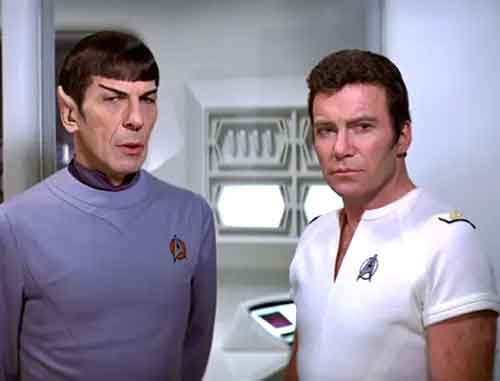
The script Roddenberry was adapting, credited to the veteran TV scribe Harold Livingston, suffered from a mercilessly deliberate build-up that was bolstered onscreen by a torturously slow pace. The director Robert Wise, a Hollywood veteran, treated the special effects in the way old timey war movies did combat, drawing out the footage interminably because it was so expensive.

The problem facing Roddenberry was that, outside all the effects footage and endless shots of the principals gawping at the ENTERPRISE’s viewer screen, the core narrative was perilously thin. Compounded the issue was the fact that Roddenberry lacked the descriptive capabilities to do justice to the artistry of the effects directors Douglas Trumbull and John Dykstra. What we tend to get in place of those effects is a lot of nonspecific word stew: “layer after layer of information,” “a geometrical wonderland of shapes and colors,” etc.
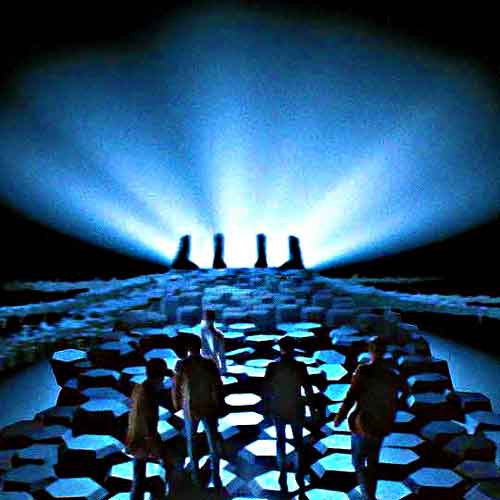
Yet Roddenberry also added details that were absent from the film, such as the particulars of the “machine planet” from which Vejur emerges, and how the Big V. attained its present level of power despite being, as Mr. Spock (and Harlan Ellison) dub it, a child. Roddenberry also improves upon the ending of the film, in which we were asked to believe that despite its supposedly Godlike powers Vejur was unable to wipe the grease off its face and learn its true name; here the obfuscation is rendered a bit more convincingly, with a “torn, gaping hole” in place of the missing words.
The book’s sexual content has been much remarked upon, it being far franker than that of the film (which was initially rated G). This is most evident in the characterization of Ilia, who’s part of an “odd and highly evolved race” who emit pheromones that make people experience “considerable sexual excitement without understanding why.” Another perverse aspect Roddenberry confronts is the possibility that Kirk and Spock’s “unusually close” friendship may have a homosexual component, as speculated upon in a lengthy footnote, which concludes with Kirk assuring us that “although I have no moral or other objections to physical love in any of its many Earthly, alien, and mixed forms, I have always found my best gratification in that creature woman.”