
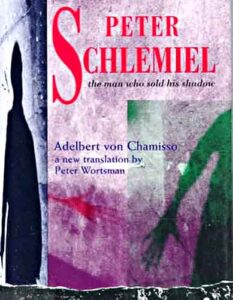
By ADELBERT VON CHAMISSO (Fromm; 1814/1993)
This admirably succinct German language fantasy classic, originally published in 1813, may sound like a run-of-the-mill fairy tale, and was apparently intended as a simple children’s story. Yet it has a powerfully surreal, dreamlike charge that puts it in the company of Franz Kafka and the magic realists; indeed, translator Peter Wortsman, in his introduction to this 1993 English language edition, calls PETER SCHLEMIEL a direct precursor to THE METAMORPHOSIS.
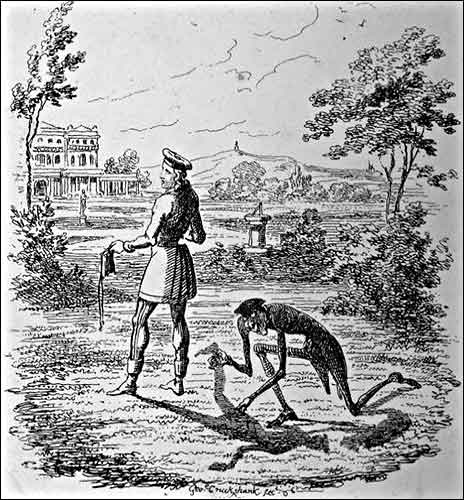
From the book.
As the title suggests, it concerns a man named Peter Schlemiel. As I’m sure most of us are aware, Schlemiel is an unflattering Yiddish term; the literal meaning (according to Wikipedia) is “inept/incompetent person,” which provides a none-too-subtle indication of Peter’s true nature (akin to a modern writer naming a character “Joe Shithead”), which he lives up to by selling his shadow.
This is something Peter does in exchange for a never-ending supply of gold, provided by a strange man in a grey suit. Unfortunately for Peter Schlemiel, life without a shadow proves intolerable. He’s forced to live as a recluse, which puts quite a damper on his newfound wealth, and also his love life, as his major female companion freaks out over his lack of a shadow. Eventually the man in the grey suit turns up again and offers to give Peter’s shadow back, in exchange for his immortal soul. The final chapters take the story in a most unexpected direction, with Peter, still shadowless, becoming a globe-trotting naturalist.
This novella is impressive in the extraordinarily vivid way it renders its protagonist’s dilemma. It conveys a palpable sense of loneliness and disillusion, which was apparently in direct response to the upheavals faced by its author Adelbert von Chamisso (1781–1838), specifically the Napoleonic Wars, in which Chamisso served as a Lieutenant, and their aftermath, in which he found himself homeless. The remainder of his life was taken up largely with botanical studies, Chamisso having been a renowned botanist in addition to being a writer-poet. PETER SCHLEMIEL remains his most iconic work, and there’s a reason for that.