
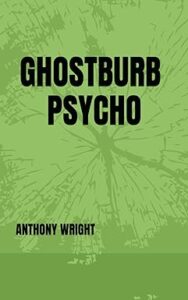
By ANTHONY WRIGHT (2026)
A black-humored exercise in demented misanthropy, GHOSTBURB PSYCHO furthers a literary lineage that includes Chuck Palaniuk’s FIGHT CLUB and Jean-Louis Costes’s LAST CRUSADE, and stretches back to FANTAZIUS MALLARE and MONSIEUR DE PHOCAS.
The setting is Australia, where the narrator, a severely disillusioned “ghostburb” resident who identifies as “Mr. Pantihose,” embarks on a vicious extermination campaign against “trogs.” He defines trog as an “entity of lower, middle, or upper socio-economic status…they are not expected to read a history book, go to a museum or visit a war memorial. They’re expected to get inked…and obsess over housing, football, cars, coffee and mobile phones.”
Such individuals “determine how our nation is perceived; advertisers hold a mirror to their worst qualities and sell them its products. The media apes the trog and fawns over it.” Hence the “holy war against Manifest Ugliness” Pantihose initiates, starting with a “turgid heap of tattooed lard” he stabs to death after setting the man’s car on fire. Subsequent victims include an unlucky highway tailgater, and a graffiti artist caught tagging Mr. Pantihose’s property, both of whom suffer horrific acts of bodily mutilation in addition to death.
As the narrative advances and Mr. Pantihose descends further into madness, the language grows increasingly slip-streamy. Pantihose alternates first and third person viewpoints, with the narrative frequently broken up by news reports into which Pantihose inserts his own language (with trog, of course, being the operative phrase). He grows increasingly fastidious about cataloging his obsessions, which come to include explosives, random memories and deranged manifestos (“Mr. Pantihose systematically dismantles cultural totalitarianism. Once nature is purloined it relinquishes all claims to its superiority. It becomes transmogrified, entering a preserve of philosophical whim as eternal rental space”).
Mr. Pantihose’s constant negativity and shaky grip on reality can be distancing, if not downright obnoxious, but the same can be said about the protagonists of the classic novels mentioned above. Like them, GHOSTBURB PSYCHO exerts a prickly fascination, and, at an economical 235 pages, certainly doesn’t overstay its welcome.