
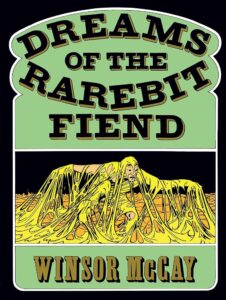
By WINSOR McCAY (Dover; 1905/73)
Winsor McCay (1866-1934) was one of the finest graphic artists America has ever known. A cartoonist, animator and designer, McCay remains best known for his comic strips, of which DREAM OF THE RAREBIT FIEND, which ran from 1904 to 1911 in the EVENING TELEGRAM (and was published under the pen name “Silas”), remains one of the most famous examples. It appeared alongside McCay’s legendary LITTLE NEMO strip (1905-1927), with a dream orientation similar to that child-oriented saga, albeit with a more adult edge.
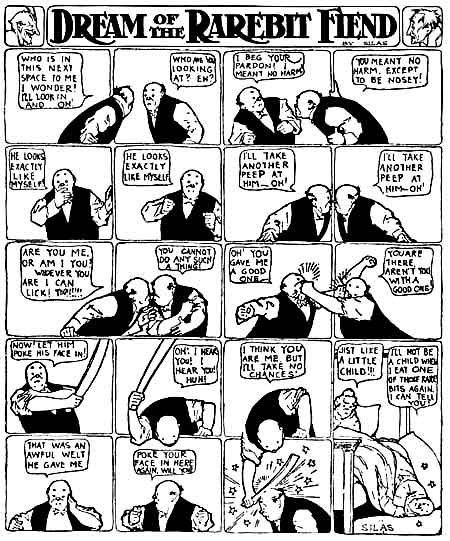
The DREAM OF THE RAREBIT FIEND strips consisted of self-contained panels detailing the misadventures of various individuals who eventually wake up to realize that the preceding was a dream brought on by eating too much rarebit cheese (“Who’d think melted cheese would cause such a dream?”). About sixty of these panels are collected in this 1973 black and white compilation from Dover, who omitted the final panel due to its “minority group humor.”
I found McCay’s imagery authentically dreamlike, and displaying a surprisingly modern attitude: anxiety, transformation and death are constants, along with pitch-dark humor. We see a man get all his limbs hacked off, another get dissected by demented surgeons, another stretch and contract like clay and a depiction of Santa Claus finding himself literally melting off the edge of a roof.
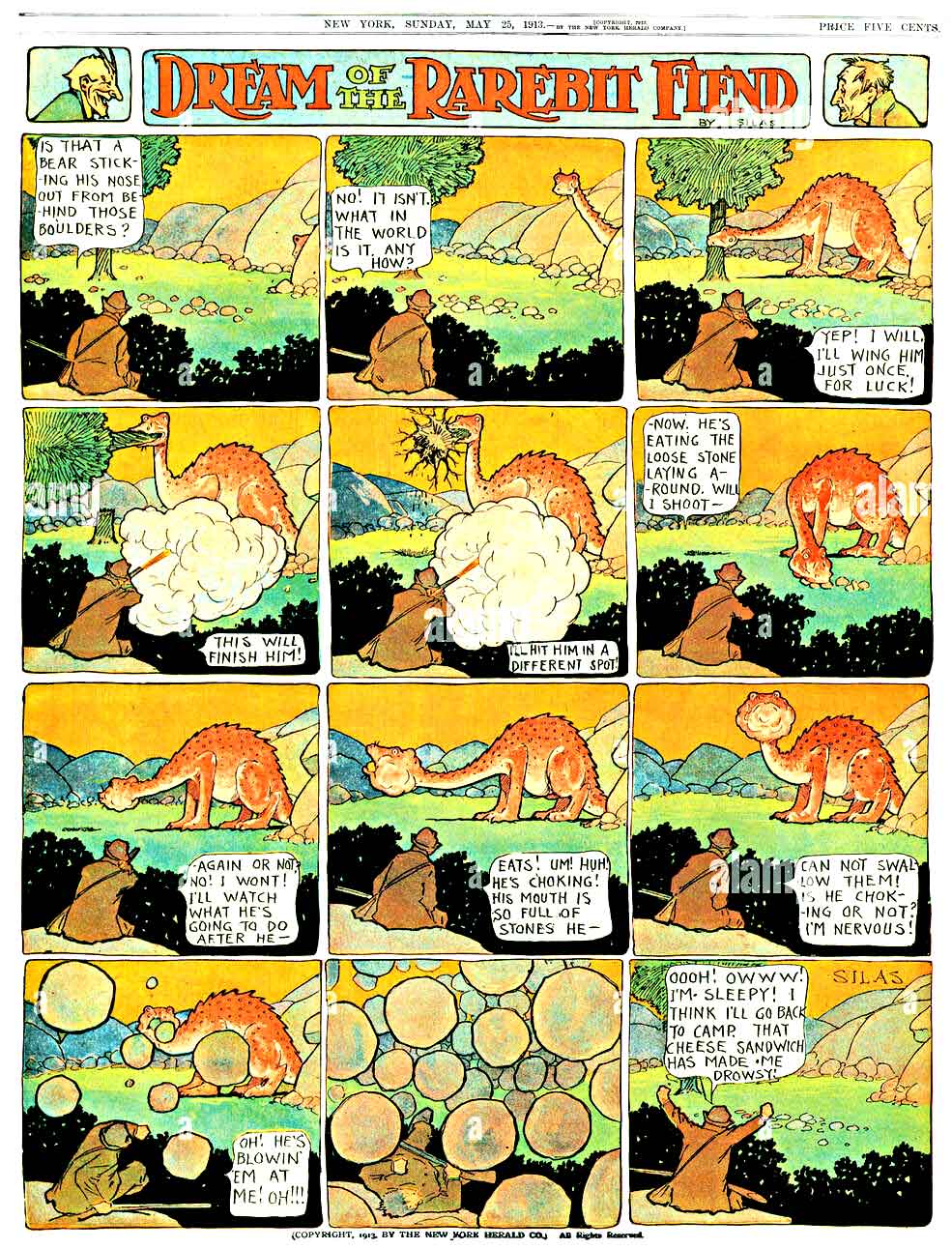
Non-human objects fare similarly, with a trolley lifting off its tracks and floating through the air, a road turning into a vast moebius strip, a furnace transforming into a malevolent creature, etc. In all cases, McCay’s artwork remains second to none, with stunning draftsmanship and perspective rendered all the more impressive by the fact that McCay is said to have never once used a ruler.
The problem (as in NEMO) is with the clumsy dialogue balloons McCay relied upon to relate his narratives. His wordage is dense, overwrought and tends to drag, proving that dialogue was not among McCay’s talents. He’d have been well advised to let his pictures speak for themselves, as they’re more than adequate for the task.