
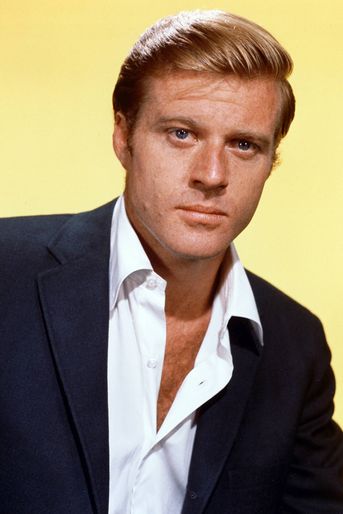
Robert Redford
Robert Redford was an interesting fellow. He was a pure-bred Californian who lived much of his life in the wilds of Utah, a 1960s himbo who somehow became a Serious Cinema icon, an indie film guru who never appeared to have much interest in independent cinema, and a semi-prolific director who rarely ever cast himself (because “As a director, I wouldn’t like me as an actor. As an actor, I wouldn’t like me as a director”).
He was very much a product of his time—a time when, as they say, men were men. Much like his longtime friend and sometime co-star Paul Newman (1925-2008), Redford was known for his frank, even-tempered demeanor. As Tom Cruise once said of Newman, “He didn’t go out of his way to make me feel comfortable or uncomfortable,” which would also seem to describe Redford’s dealings with people. He was, in a word, cool.
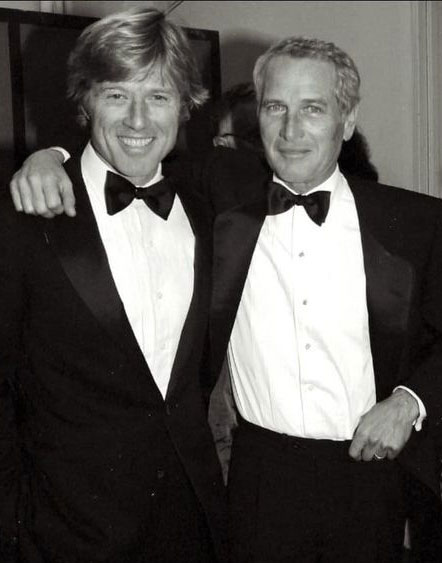
Robert Redford, Paul Newman
Redford was partial to glitzy star turns in commercial fare like BAREFOOT IN THE PARK (1967), THE ELECTRIC HORSEMAN (1979), LEGAL EAGLES (1986) and UP CLOSE & PERSONAL (1996), but he also appeared in interesting films like INSIDE DAISY CLOVER (1965), THREE DAYS OF THE CONDOR (1975) and THE CLEARING (2004). One of his most interesting film roles was in Sydney Pollack’s 1990 mega-flop HAVANA, in which Redford played a professional gambler stationed in 1950s Havana on the eve of the Cuban revolution. A confident and unflappable sort, the character essentially views life as a card game and is never caught off-guard despite residing in an extremely volatile and unstable environment (that HAVANA failed, I believe, is due largely to the fact that Pollack’s filmmaking essentially mimics Redford’s performance, resulting in a film that’s greatly lacking in urgency).
THE CLEARNING (2004) Trailer
HAVANA (1990) Trailer
As I recall, HAVANA was quite controversial in its day for the fact that Redford refused to wear any make-up. That sense of warts-and-all authenticity is on full display in a characterization that didn’t seem too far removed from Redford’s actual self: he played the “game” of show business better than just about anyone, keeping his personal life under wraps while expertly maintaining an old school movie star persona (1993’s INDECENT PROPOSAL was supposed to end with the female lead Demi Moore rejecting Redford’s millionaire suitor, but he changed the script to have him be the one who calls things off).

Another portion of Redford’s mystique was on display in an earlier Sydney Pollack effort: JEREMIAH JOHNSON (1972). It’s a film that, like HAVANA, works largely because Redford is so authoritative in the lead role. He played a mountain man, and the film’s particulars—trudging through snow, shooting animals for food, finding shelter—apparently weren’t too far removed from Redford’s day-to-day existence in the Utah mountains, an existence the film’s screenwriter John Milius liked to claim he himself led. Milius, however, has spent much of his life in sunny California, with Jeremiah Johnson’s onscreen interpreter being far closer to the real thing.
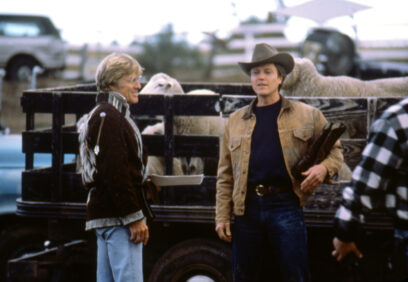
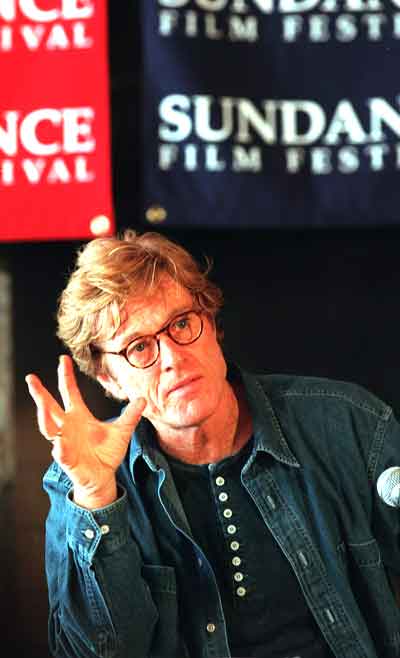
Onto Redford’s biggest mistake, which was conversely one of his greatest successes. The Redford-instituted Utah/US Film Festival, begun in 1978 and renamed the Sundance Film Festival in 1991, bears all the hallmarks of a publicity stunt that got out of hand. This was evident in Redford’s constant complaints about Sundance’s ballooning media profile and increased Hollywood presence, even though the festival’s main reason for being was to establish Redford’s adopted state as a filmmaking hub, a mission that was handily accomplished. There was also the fact that until the 2000s, Redford never deigned to act in or direct the type of indie fare that characterized Sundance.
Of the films Redford helmed, I can take or leave his Oscar winning directorial debut ORDINARY PEOPLE (1980) but am quite partial to QUIZ SHOW (1994). A dramatization of the 1950s quiz show scandal, it’s every bit as biting and corrosive as the politically minded classics, like THE CANDIDATE (1972) and ALL THE PRESIDENT’S MEN (1976), that Redford headlined early in his career.
THE CANDIDATE (1972) Trailer
ALL THE PRESIDENT’S MEN (1976) Trailer
I also like Redford’s second directorial effort THE MILAGRO BEANFIELD WAR (1988), a legendarily troubled production that bowdlerized John Nichols’ phantasmagoric 1974 source novel (which I say would have made quite a movie if visualized close to its original form). Yet, as Nichols himself stated, “For all its flaws…MILAGRO was a gentle and loving picture. I could not for the life of me figure out how something that compassionate, humorous, good-hearted, and decent had emerged from such chaos. All along it must have been a secret inside Robert Redford’s head.”
THE MILAGRO BEANFIELD WAR (1988) Trailer
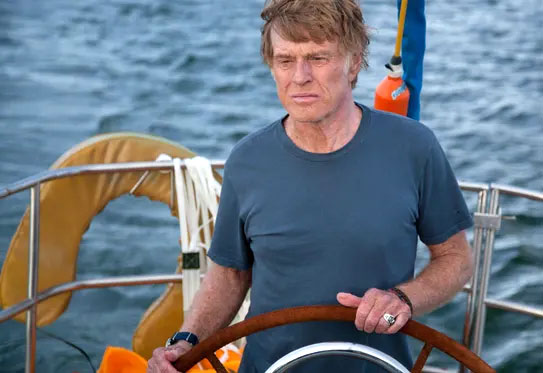
Here I’ll mention what was undoubtedly Redford’s key late period role, which occurred in ALL IS LOST (2013). It required Redford to be the one and only character onscreen from start to finish; that’s a tall order for any actor, but Redford maintains viewer attention. He plays a sailor adrift on the high seas, having to patch up a leak, navigate a storm and eventually abandon his precious boat in favor of a dinky life raft. Writer-director J.C. Chandor keeps the viewer engrossed with impeccably composed visuals, spot-on sound design and well-placed music cues, and does so without ever selling out his central concept.
ALL IS LOST (2013) Trailer
ALL IS LOST might seem like a very un-Redford-like film, containing no idealistic political content or movie star mugging. But as I said, the man was unique and made unique choices. You certainly won’t find too many modern performers able to play a 1950s gambler, a mountain man and a doomed sailor with equal authority, but Robert Redford could and did.