
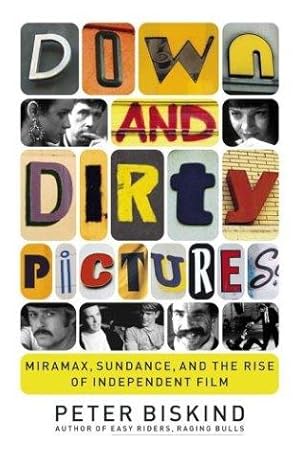
By PETER BISKIND (Simon & Schuster; 2004)
Peter Biskind’s 1997 book EASY RIDERS, RAGING BULLS was a psychotically compelling account of Hollywood in the 1970s (and the inspiration for an equally compelling 2003 documentary). That’s in spite of disputes about the accuracy of its contents; William Friedkin dismissed it as “partial myth and partial out-and-out lies,” while according to Steven Spielberg, “Every single word in that book about me is either erroneous, or a lie.”
EASY RIDERS, RAGING BULLS (2003) Full Documentary
DOWN AND DIRTY PICTURES was Biskind’s 2004 follow-up, chronicling the independent film revolution of the nineties. It’s every bit as transfixing (and contentious) as the earlier book, being informative, fast moving and packed with salacious details. I’ve heard many of the book’s stories before, but Biskind’s achievement is the way he digs beneath the surface, sifting through all the superfluous nonsense that colors most moviemaking accounts (which tend to be heavily vetted by studio spin doctors).
The primary focus is on Miramax, which changed the American movie landscape by booking edgy independent features in shopping malls with incredibly elaborate advertising campaigns, and aggressively promoting directors like Steven Soderbergh and Quentin Tarantino. Miramax’s heads Harvey and Bob Weinstein used bullying and intimidation to claw their way to the top, and their outbursts (as described here) are astounding. Harvey regularly picked fights, made quite a few filmmakers cry, and, according to Biskind, once phoned filmmaker Alexandre Rockwell during a dental appointment and instructed the dentist to “Knock all his teeth out” (this book could well be titled BAD HARVEY).
Miramax had a tendency to recut films against their makers’ wishes and wasn’t too diligent about compensating those filmmakers. Also described in these pages are the sad story of October films, an indie outfit that tried to become the next Miramax and failed spectacularly, and the loopy odyssey of Robert Redford’s Sundance Institute, which never reached its full potential due to its creator’s maddeningly quixotic personality.
The book’s arc is a tragic one. Independent films have long since lost their luster, looking increasingly like their big studio counterparts, while Harvey Weinstein, as we all know, is no longer a free man. The true extent of his outrages wasn’t known (or perhaps more accurately, wasn’t owned up to) in 2004, but our retrospective knowledge places the book’s contents in an entirely different, more troubling context than they initially assumed.
Finally: yes, there have been accuracy complaints about DOWN AND DIRTY PICTURES. A quote attributed by Biskind to producer Christine Vachon, about how Roger Ebert “literally snatched his hand back” from a handshake with filmmaker Todd Haynes upon learning he made POISON (1991), has been disputed by both Vachon and Ebert, with the latter stating that “Biskind has a way of massaging his stories to suit his agenda.” Such claims obviously call Biskind’s reportorial skills into question, but I still recommend the book, as the overall picture it presents is valid, however down and dirty it may be.