
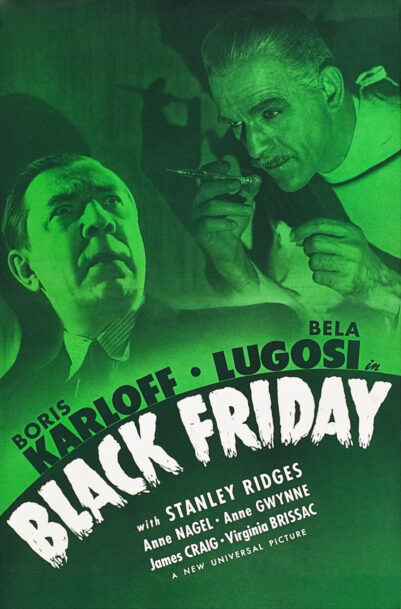
 This 1940 Universal production has nothing to do with the post-Thanksgiving Black Friday we know, but it’s an enjoyable concoction, nonetheless. Boris Karloff and Bela Lugosi headline, yet have what amounts to supporting roles, with the lead played quite ably by the veteran character actor Stanley Ridges (1890-1951) in a most imaginative updating of THE STRANGE CASE OF DR. JEKYLL AND MR. HYDE from screenwriter extraordinaire Curt Siodmak (of THE WOLF MAN and DONOVAN’S BRAIN).
The pic begins with the incarcerated scientist Dr. Ernest Sovac (Karloff) about to be executed. On his way to the electric chair, Sovac gives a news reporter (James Craig), who provided what Sovac believes was the only truly unbiased reportage about him, a notebook.
Said notebook commences with an entry headlined “Friday, 13th.” It’s then that the Newcastle University professor George Kingsley (Ridges), afoot in a big city, is run down by gangsters engaged in a car chase; among those gangsters is the psychopathic Red Cannon, who is also severely injured in the crash. Both men survive, but just barely.
Re-enter Dr. Sovac, a friend of Kingsley who in order to save his life transplants Cannon’s brain into his head. The operation is a success, but it somehow leaves Kingsley with a split personality that sees him periodically assuming the guises of his upstanding self and the unpleasant Cannon.
Sovac convinces Kingsley to relocate to New York City, in the hope that his Cannon guise will reveal the location of a cache of stolen money. The patient, however, skips out to wreak violent havoc on Cannon’s enemies and get back together with his girlfriend Sunny (Anne Nagel). Kingsley’s wife Margaret (Virginia Brissac) and Sovac’s daughter Jean (Anne Gwynne), meanwhile, grow suspicious, inspiring Jean to interrogate her father—who confesses everything.
Cannon tries to retrieve his stolen money cache from its hiding place in the stairwell of a water reservoir. There he’s confronted by rival gangsters, among them Eric Marnay (Lugosi), who manages to snatch the box containing the money. He heads to Sunny’s apartment, having promised her a share of the loot, but Cannon turns up to kill them both. It all concludes in Sovac’s apartment, into which Cannon forcibly enters and threatens Jean, resulting in Sovac shooting his patient and the film coming full circle, with Sovac meeting his destiny in the electric chair.
A highly varied and involved narrative, to be sure, that was compressed into just 70 minutes. This makes for an extremely jam-packed film, with characters who are quite accepting of the implausible premise (as an exasperated Dr. Sovac asks Jean at one point, “Haven’t you guessed the operation I performed was a brain transplantation?”). Reality based it isn’t, with director Arthur Lubin bathing his black and white visuals in stark, ominous shadow; this film’s 1940 copyright date is often tagged as the inception of the Hollywood film noir cycle, and BLACK FRIDAY utilizes all the major noir trademarks.
Of the name actors, Boris Karloff cuts a reasonably compelling figure as Sovac the conflicted scientist, while Bela Lugosi, as the ruthless gangster Marnay, makes surprisingly little impression, his character being largely superfluous to the main storyline (and killed off far too soon). The acting honors, as stated above, go to Stanley Ridges, who impresses as both a kindly professor and a ruthless gangster in a horror-noir combo that works quite well. As with the comedic horror movie hybrids that thrived in the 1940s (many of them helmed by this film’s director Arthur Lubin), BLACK FRIDAY’s genre double dip proves to be a definite case of two great tastes that taste great together.
Vital Statistics
BLACK FRIDAY
Universal Pictures
Director: Arthur Lubin
Screenplay: Kurt Siodmak, Eric Taylor
Cinematography: Elwood Bredell
Editing: Philip Cahn
Cast: Boris Karloff, Bela Lugosi, Stanley Ridges, Anne Nagel, Anne Gwynne, Virginia Brissac, Edmund MacDonald, Paul Fix, Murray Alper, Jack Mulhall, Joe King, John Kelly