
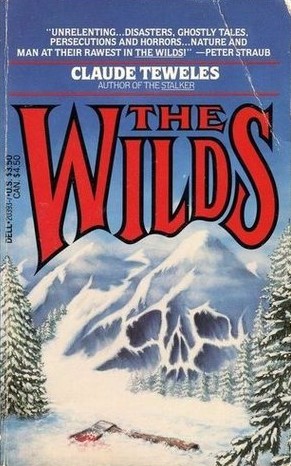
By CLAUDE TEWELES (Dell; 1989)
I first read this paperback original as a teenager, over the course of a single feverish evening spent fighting a cold, and, as I recall, liked it enormously. THE WILDS was the second, and apparently last, novel by Julia Teweles, back when she known as Claude (under which name Teweles published 1984’s THE STALKER, another horror paperback my younger self eagerly devoured).
It’s the pulpy story of several kids at a summer camp in the Sierra Nevada Mountains, and their experiences on the Wolf Gulch Ordeal, an overnight hike through “The Wilds” where the Donner Party met their fate (for those who don’t know, the Donners were a band of California-bound pioneers who in 1846 became snowbound and resorted to cannibalism to survive). Things, unfortunately, turn very bad very quickly when the two instructors charged with overseeing the Ordeal fall from a steep cliff and are presumed dead.
This leaves the teenaged Del, a jock who’s likened to Conan the Barbarian, and Kyle, an introspective punk, to lead the expedition. Anyone who’s read LORD OF THE FLIES or DELIVERANCE can predict the gist of the narrative, which has the kids descending into savagery, terrified of a deranged survivor of the original Donner party who apparently still lurks in the woods. Del and Kyle, meanwhile, deal with the children in their care in very different ways, with one excelling in leadership instinct and the other failing to measure up.
As much as I enjoyed this book as a teenager, to my adult self the comparison of THE WILDS with the abovementioned William Golding and James Dickey classics seems a bit of a stretch. Teweles’ novel can’t hope to measure up to, much less approach, either (and nor is Peter Straub’s cover blurb promising “nature and man at their rawest” entirely accurate). I’d also question the addition of a supernatural angle, as the material is horrific enough without the intercession of the Donner Man.
Writing-wise THE WILDS is extremely readable and conveys a vivid air of rural menace. I just wish it were better drafted overall; the author has an unfortunate penchant for clichéd phrases (“His candy-coated, acerbic wit masked a bitter resentment against anyone who had made something of himself”) and half-baked descriptions (“every last morsel of flesh disappeared into their bellies”) that dilute the effect considerably.