

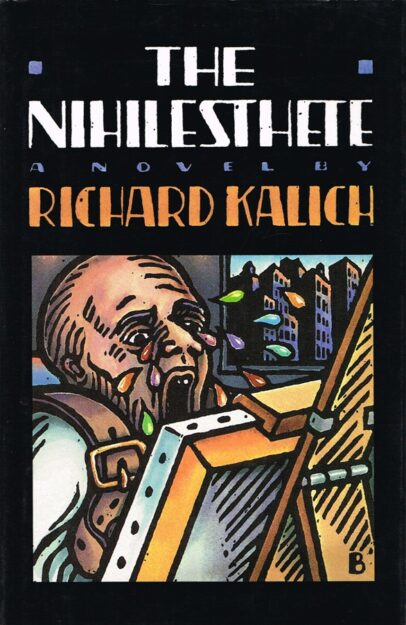
By RICHARD KALICH (The Permanent Press; 1987)
An altogether unique novel that fascinates and annoys in equal measure. THE NIHILESTHETE was the first, and I say most interesting, entry in a trilogy by author Richard Kalich that included CHARLIE P (2005) and PENTHOUSE F (2010), all of which were compiled in a single volume, THE CENTRAL PARK TRILOGY, in 2014.
Initially issued in hardcover by The Permanent Press, THE NIHILESTHETE was republished in paperback by White Wolf Publishing, who billed it as a horror novel. That’s hardly the case, as in actuality it’s an odd and obsessive account that largely stakes out its own genre base. It can even be called literary (evidenced by the high falutin’ blurbs on the hardcover edition: “one of those brilliant grotesqueries that illuminate the human condition,” etc.).

It’s related in the form of a journal by Haberman, a few-bricks-shy-a-load social worker (and, it’s implied, frustrated artist) who becomes obsessed with Brodski, an armless man who can’t speak. It seems Brodski’s an aesthete who lives for beauty, and furthermore, after Haberman provides him with arm extensions so he can paint, Brodski discovers a passion for creating art.
His keeper, meanwhile, maneuvers Brodski’s guardian—his mother—out of the picture so he can take care of him full time. This entails a series of diabolical “games” designed to curb Broski’s artistic ambitions, which Haberman views as unnatural and threatening. The games turn increasingly sadistic, yet Brodski continues to show a healthy artistic appetite, much to the consternation of his keeper, who comes to view Brodski as his project (“If I am an artist…my art is Brodski”).
This story may be intended as an art vs. commerce metaphor or just a twisted look into the darker regions of the human psyche. The prose, in any event, tends to grate (being privy to multiple exclamation points and excessive capitalization), as does the apathetic (to say the least) narrator. t’s no big trick figuring out where it’s all going, as Haberman’s obsessive attempts at breaking his charge become increasingly desperate, with the latter steadfastly resisting to the end.