
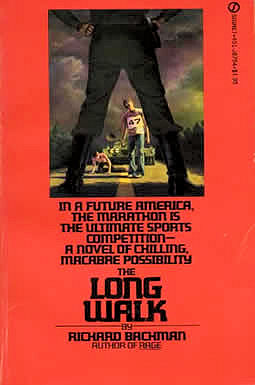
By RICHARD BACHMAN (Signet; 1979)
This was the second of four Stephen King novels published under the Richard Bachman pseudonym early in his career (all of which, including RAGE, 1977, ROADWORK, 1981, THE RUNNING MAN, and 1982, were reissued in omnibus form in 1985). Although it debuted as a paperback original in 1979, THE LONG WALK (filmed in 2025) was apparently written a decade earlier, when King was a freshman in college—his first completed novel, in fact. While I certainly could never have written anything this strong in my college years, there is quite a bit of crude writing in this book that can only be blamed on inexperience.
THE LONG WALK (2025) Trailer
It’s the story of a nightmarish dystopia where the major “sport” is the Marathon, consisting of ninety adolescent boys on a nonstop walk through New England. The rules: keep walking or you’re dead, shot by armed soldiers who keep pace with the walkers and aren’t at all hesitant about doing their duty. This results in many outrageously bloody passages (“Curley’s angular, pimply head disappeared in a hammersmash of blood and brains and flying skull-fragments”), showing that even at such an early point in his career Mr. King was already going for the gross-out.
King neglects to explain the background of this macabre competition, which outside of its metaphoric value (he evidently had the Vietnam War and the draft in mind when he wrote it) doesn’t make much sense, and nor does King go into much detail about why the Marathon is so popular (it doesn’t seem too exciting from the viewpoint of a spectator). The book, in short, fails completely as science fiction, with its unsparing simplicity being the foremost attribute.
It is quite simply one of the most grueling, exhausting narratives ever, related from the third person POV of a walker named Garraty. He provides an up-close and unnervingly personal depiction of leg cramps, shoes falling apart, factions forming and breaking up (foreshadowing today’s reality TV series) and the road stretching on. The wholly predictable ending, however, is a problem; I correctly guessed the Marathon’s winner, and that person’s subsequent fate, long in advance of their occurrence.