
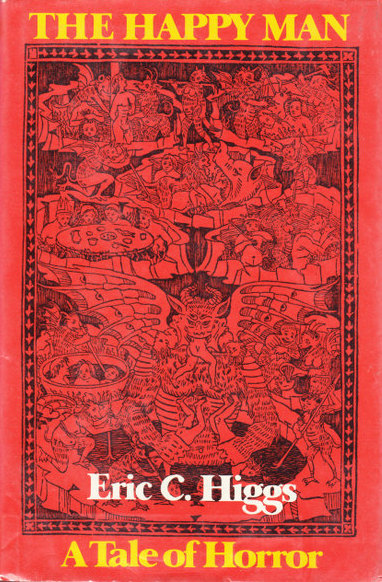
By ERIC C. HIGGS (St. Martin’s Press; 1985)
One of the great modern horror novels, a compelling and profoundly unsettling piece of work that explores untold depths of depravity in 166 well-packed pages. The debut novel by Eric C. Higgs, THE HAPPY MAN is the story a descent into evil, bequeathed by an impossibly contented fellow who’s just moved into the protagonist’s affluent Southern California neighborhood.
The setting is the San Diego suburb Chula Vista, where much of my family was once concentrated. It’s an area I know intimately, and with its dusty hills and canyons proves an extremely effective setting. There Charles Ripley, the aforementioned protagonist, becomes quite intrigued by the seemingly carefree lifestyle led by one Ruskin Marsh, who inducts Ripley into a seductive world of illicit sex, illegal drugs and casual murder.
It transpires that Marsh and his family are members of a shadowy group called The Society of Friends whose adherents are required to read Marquis de Sade’s JULIETTE and unleash their most aberrant impulses. This Ripley does, in gradual and horrifically convincing fashion, with the overriding question being how long he’ll be able to maintain his new-found moral vacuum, and what he might do if and when he regains his senses.
The book is surprisingly restrained in its approach, being a psychologically centered account. That’s not to say it’s in any way boring or self-indulgent, as the narrative is quite lively, with compact and descriptive prose that ensnares the reader in much the same manner as the protagonist—and then, in the final pages, lets loose with an incredibly potent literary kick in the gut.
Eric Higg’s later novels DOPPELGANGER, a horrorfest, and PT COMMANDER, a military thriller, failed to recapture the brilliance of THE HAPPY MAN, which for years was undeservedly obscure despite having seen print in hardcover and paperback editions, and, as Higgs reveals in a newly written introduction, been repeatedly optioned by Hollywood (options that have yet to come to fruition). It’s now back in print, courtesy of Valancourt Books, and will hopefully take its rightful place as a classic that’s every bit as uniquely disquieting as it was in 1985.