
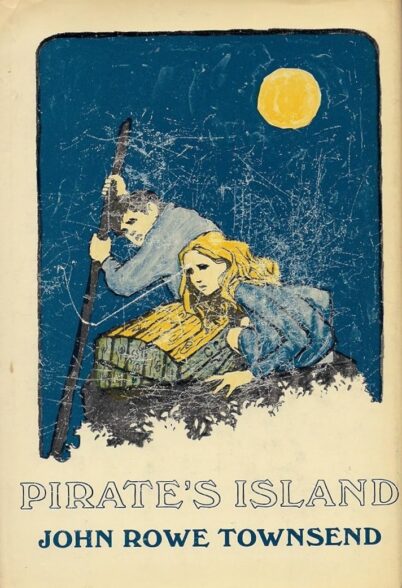
By JOHN ROWE TOWNSEND (J.B. Lippincott; 1968)
This was one of my favorite books as a youngster and rereading it as a grown-up I can understand why I was so enamored with PIRATE’S ISLAND. It’s a (mostly) well-paced and unpredictable account of derring-do within the confines of “the Jungle,” a slum where the author, the British YA book legend John Rowe Townsend (1922-2014), set quite a few of his novels (as indicated by titles like TROUBLE IN THE JUNGLE and GOODBYE TO THE JUNGLE).
The protagonists are the chubby Gordon Dobbs, a put-upon butcher’s son, and Sheila, a much poorer but extremely imaginative little girl. These two form a bond in spite of their divergent backgrounds (with Gordon’s mother lamenting “I don’t know why you can’t mix with nice children”), based on their mutual outsider status and Gordon’s curiosity about a story Sheila tells involving a local man with a peg leg and the initials C.C. over his front door, which stand for (she claims) “Captain Cutlass.”
Sheila is also quite bullish about a treasure she’s convinced is buried somewhere in the Jungle. She and Gordon come to believe they’ve found the loot’s probable location on a tiny island (actually an abandoned boat dock) in the middle of a canal bordering the slum. But this is all thrown into the air when a chest is discovered containing the fortunes of a local codger, leading to thievery, pursuit and a boat trip to the so-called pirate’s island, followed by a genuinely horrific slog through a filthy drainage tunnel and the inevitable happy ending.
PIRATE’S ISLAND is written with great sensitivity to the problems of disadvantaged children (something that obviously went over my head as a kid), and contains some strikingly gritty descriptions of slum life, particularly in the stark depiction of the vacated slaughterhouse where Sheila and her relatives reside. The author, according to the book jacket, had “an active interest in the social conditions surrounding poor children,” with his overall message seeming to be “poor people are people too.”
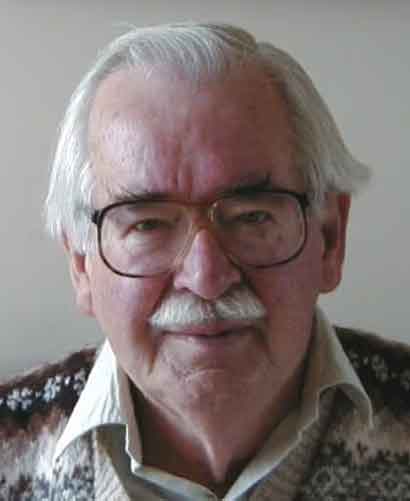
John Rowe Townsend
The book’s real selling point is the nail-biting climax, which is powerfully described and quite intense for a kids’ book. The only problem is that the novel continues for another 20 pages after the action has concluded, taking a bit too long to wrap things up.