
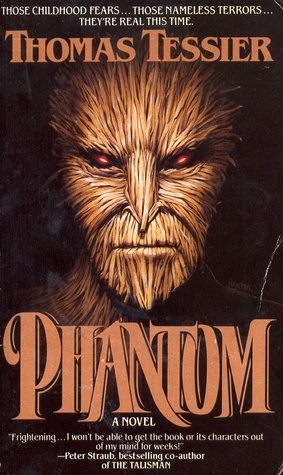
By THOMAS TESSIER (Berkley; 1982/85)
Along with Stephen King’s early novels, PHANTOM by Thomas Tessier can be credited with introducing my young self to horror as a serious art form. I first read it at age twelve, and I find the novel stands up quite well to adult scrutiny. Indeed, it contains many grown-up elements that went clear over my head initially, such as a discreet lesbian reminisce, many heavy-duty literary references, some hallucinatory interludes and a harsh depiction of the realities of death.
PHANTOM is a vivid and pronounced scare-show, but it has an elusive, poetic air. That’s in keeping with Tessier’s oeuvre, which fully showcases his training as a poet, and also his longtime friendship with the late horrormeister Peter Straub (who offered up a highly complementary blurb). Tessier’s really good novels, which include THE NIGHTWALKER, FINISHING TOUCHES, FOG HEART and this book, tend to be powered by an artful spookiness and, more importantly, showcase a defiant originality in both conception and execution.
PHANTOM’s characters are all extremely complicated and individual, each with his/her own highly idiosyncratic speech pattern. Included is the 9-year-old Ned Covington, surely one of the most realistic kid characters I’ve encountered in any novel, a precocious sort who believes phantoms are invading the coastal house he’s moved into. His clueless parents do their best to comfort him, unaware that Ned must face the demons on his own. This is a fact Peeler and Cloudy, Ned’s elderly wharf rat buddies, understand quite well, refusing to fill Ned in on the nature of the supernatural forces confronting him.
The frankly meandering narrative has Ned finding himself repeatedly accosted by invisible monsters, emanating from an abandoned spa, that seem intent on doing him in. I was never entirely convinced that the terrors weren’t all just a part of Ned’s mind, but Tessier’s point seems to be that it doesn’t matter one way or the other, as it’s the effect they have on his developing psyche that ultimately matters.
I’m not sure the fanciful climax, in which Ted confronts his tormentors on an otherworldly plane, sat too well with me, as it violates the novel’s reality-centered gist. The final pages, however, are quite strong.