
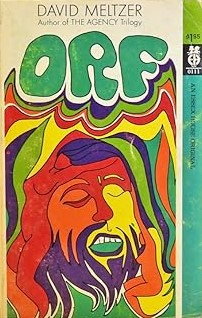
By DAVID MELTZER (Essex House; 1968)
In which late 1960s America was given a most fitting epitaph by the late upscale smut outfit Essex House and its top author David Meltzer. ORF is ostensibly about the corporate rock scene, written by an author who knew it inside and out; Meltzer played in a late 1960s rock band, and this book fully embodies Hunter S. Thompson’s observation that “The music business is a cruel and shallow money trench, a long plastic hallway where thieves and pimps run free, and good men die like dogs. There’s also a negative side.” The novel’s true concerns, however, stretch far beyond the confines of the music biz.
Of Meltzer’s nine Essex House novels, ORF is the most redolent of the poetry for which he was best known. It’s druggy, kaleidoscopic and staunchly resistant to traditional narrative demands, with storytelling often abandoned altogether in favor of a sensory-oriented multi-character tapestry and collage-like passages that intermix newspaper headlines, random dialogue and commercial slogans evoking the very particular time period in which the novel was written.
The rock star title character, whose first person observations periodically interrupt the third person text, assumes the status of a supporting role. Orf functions as a sacrificial idol, orbited by a cast that includes his agent Shlink, who lives by the motto “bullshit is power”; Orf’s bassist Teddy Roy Burk, the holder of a “proud record of having a chick every night of the year”; the teenage Maureen, a rabid fan who plans a dangerous rushing of the stage at Orf’s upcoming concert; and Orf’s mother, who’s tasked with trying to make sense of the insane reality that’s enveloped her son—and the country overall.
Meltzer’s use of language tends toward the ugly and aggressive—“A great peoplesnake linked together covers the sidewalk,” “They come like guerilla soldiers, like archers scaling castle walls…until the aisles are solid with people being pushed aside by charging girls”—and his anti-narrative is rife with tension and foreboding, building to a grand guignol denouement that nowadays puts one in mind of the horrific events of 1969 (namely the Altamont concert and the Manson murders) that irrevocably transformed the decade. Here the melee occurs at a rock concert—or, as a chapter heading identifies it, “The Rite”—that goes catastrophically wrong.
If there’s one area in which ORF fails to measure up, it’s in the pornographic designation the book was assigned. Meltzer often dubbed his Essex novels “anti-erotic,” and this one certainly lives up to that description, with the sexual content layered on sparingly (here, in direct contrast to most Essex House books, there are entire chapters with no lascivious descriptions). This is nonetheless an adults-only read, and one whose illumination of America’s exploitive underbelly remains a bit too accurate for comfort.