
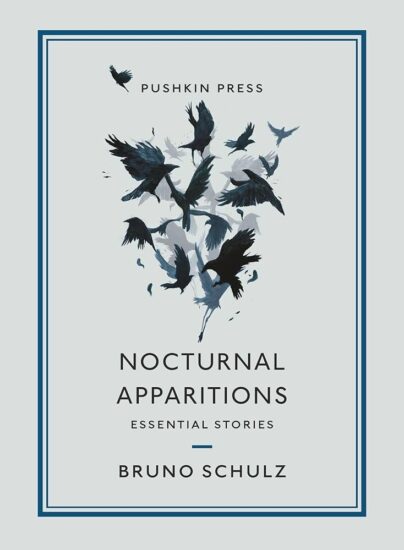
By BRUNO SCHULZ (Pushkin Press; 2022)
As is often the case with updated English language texts by foreign authors, this collection of newly translated stories by Poland’s Bruno Schulz (1892-1942) comes with a claim that it’s the definitive such version. According to translator/editor Stanley Bill, Schulz’s previous translator Celina Wieniewska (who provided excellent English renderings of the Schulz collections STREET OF CROCODILES and SANATORIUM UNDER THE SIGN OF THE HOURGLASS) “adopted a deliberate strategy of simplification…in the interest of comprehensibility.” In 2018 Madeline G. Levine provided her own English version of Schulz’s complete works, which Bill calls “a towering achievement,” but nonetheless took it upon himself to create new, and apparently decisive, translations of several “essential” Schulz stories.
In comparing the contents of NOCTURNAL APPARITIONS, whose translations are solid, with those of the Wieniewska publications, I find that the differences aren’t too concerning. Interested parties, in other words, can read the Wieniewska books without worrying about missing anything essential. The true value of NOCTURNAL APPARITIONS is that it delivers on its other major promise: its contents are indeed essential.
Included are several selections from THE STREET OF CROCODILES (a.k.a. CINNAMON SHOPS), including “August,” “Visitation,” “Birds,” “Cinnamon Shops” and “Cockroaches.” All are told from the point of view of a young boy whose wonder-struck descriptions of his provincial surroundings are couched in ornate metaphors (“Dazzled by the light, we leafed through the great book of holidays, its pages glowing in the bright radiance and holding in their depths the languidly sweet pulp of golden pears”) and dominated by father figures who have a tendency to disappear (“his face departed into absence, forgot itself, and disintegrated”), decompose (“All that was left of him was a bit of bodily shell and a handful of absurd eccentricities”) and metamorphose (into a cockroach).
The latter premise brings up the most common name that comes up in discussions about Schulz: Frank Kafka. In truth Schulz was like nobody else, but there is a definite Kafkaesque tinge to his universe. The comparison is especially evident in “Father’s Last Escape,” a story related in bizarrely unaffected prose that once again involves the narrator’s father metamorphosing (this time into a crayfish).
The finest story contained here, in my view, is the novella-length tale that provides the second of Schulz’s collections with its title (as well as the 2025 film adaptation): “Sanatorium Under the Sign of the Hourglass.” It once again involves a distant father and his son, who travels to a hotel/sanatorium where the old man is being cared for and finds a place where time flows in multiple directions and the dead don’t stay that way for long. It contains all the linguistic pyrotechnics and unaffected surreality that distinguish the other stories, while introducing an attribute they lack: a compelling narrative drive.
Rounding things out is “Undula,” a previously uncollected tale from 1922 (and initially published under the pseudonym Marceli Weron). About an ailing man confined to a cockroach-filled room and the dark, sexually tinged fantasies that overcome him, “Undula” contains all the hallmarks of Shultz’s fiction, but presented in a much cruder manner than his later efforts. He clearly had yet to attain his full writing power, which in the preceding contents is on full display.