
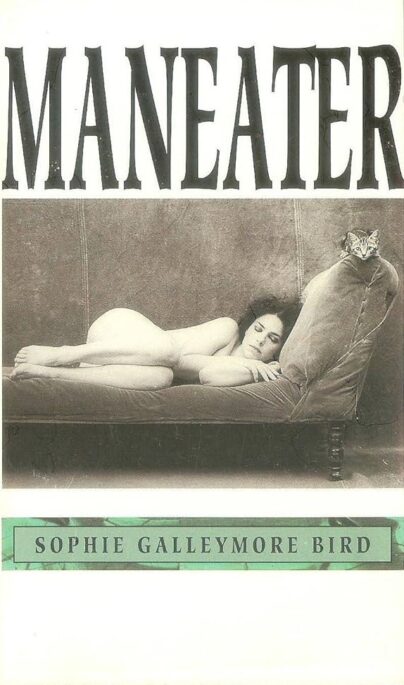
 By SOPHIE GALLEYMORE BIRD (Rhinoceros; 1993)
An example of the type of sci fi-tinged literary erotica that was pioneered by the late Essex House. As with the Essex books, the “filthy feminist Frankenstein fable” MANEATER by Sophie Galleymore Bird is quite verbose and hermetic in its construction, being an autobiographical account of twentysomething lovers adrift in early 1990s London (the book is dedicated, in part, to the iconic British smut mag SKIN TWO, with which Bird, whose former occupations include life model and “fetish shop assistant,” was undoubtedly quite familiar).
The horror-sci fi business, the book’s major selling point, takes until past the halfway point to kick in. Until then we get a highly episodic depiction of Serge, a narcissistic hipster, and his girlfriend LouLou, whose first person recountings frequently puncture the third person narrative, which is further disrupted by Serge’s own first-person observations and italicized descriptions of his sexual exploits—yes, it’s a complex and not at all undistracting treatment, and one that takes a long time to grab hold.
Bird spends a great deal of time detailing the aimless drug-fueled lives led by Serge, LouLou and Susan—LouLou’s “current passionate friend” who distrusts Serge—and the urban milieu they inhabit. A great deal of sexual detail is included (to keep the reader from nodding off) and eventually Serge and LouLou’s relationship begins to turn sour. Enter a weird old woman who gives Serge a vial of something she promises will improve the relationship.
From this “LouLou2” is created, morphing from a tiny being emerging from a slit in LouLou’s belly to a full-grown clone with a voracious appetite for male bodily fluids. This leads to some nasty passages that fit in well with the Essex House “anti-erotic” model (it’s no accident that several late 1960s Essex titles were reprinted in the 90s by this book’s publisher Rhinoceros), and a feminist angle whose perimeters are pretty obvious (as the back cover promises, “MANEATER goes for the jugular of the “perfect woman” myth”).
The problem is that, in true Essex House fashion, the horrific business appears to have been shoehorned in. As stated earlier, it takes until after the halfway point for the fun stuff to be introduced, and a great deal is left unexplained (where does the old woman get her powers, and why was she so eager to use them to assist Serge?), while the wrap-up feels rushed. As a nostalgic portrayal of late Twentieth Century London MANEATER is of some interest, but as the “filthy feminist Frankenstein fable” that was promised it simply doesn’t work.