

By RAINER J. HANSCHE (Contra Mundum; 2025)
HUMANIMALITY follows, and can be considered a spiritual sequel to, DIONYSOS SPEED (2024). Written by Rainer J. Hansche, who runs the micro-niche publisher Contra Mundum Press, DIONYSOS SPEED was “A visionary concoction that can be categorized as surrealist poetry or avant-garde science fiction” (me). The same can be said of HUMANIMALITY, a self-proclaimed “hybrid monster of a book that interrogates humanity’s troubled relationship with its animality, & so its relation to animals, the earth, and ultimately the cosmos.”
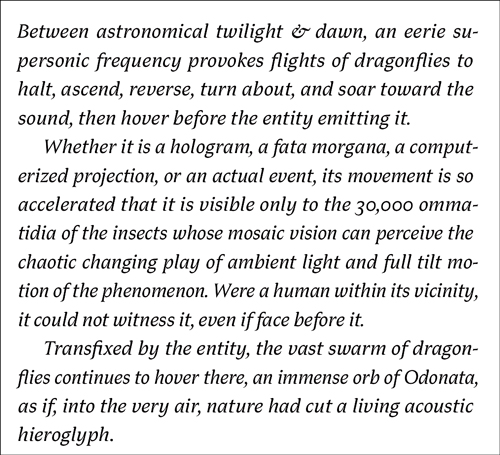
From the book
The opening pages read like an extrapolation on the theories of philosopher John Gray, who (in the bestselling STRAW DOGS: THOUGHTS ON HUMANS AND OTHER ANIMALS, 2002) argued that humanity was nothing more than a non-exotic animal species. That view is repeated by Hansche, in passages like “In fear of its own animality, in terror before the simian, the human must give itself power over insects, animals, & plants to further separate itself from a heritage that continually undermines it.”
There’s also an eco-horror angle, manifested in descriptions of animals the world over savagely turning on humans, and in the process developing advanced intelligence. This results in odd phrases scrawled on walls, plucked-out human pineal glands found massed in bowls, markings on gravestones rendered illegible, and religious artifacts defaced throughout the world. As if all that weren’t enough, an especially deadly pandemic sweeps the Earth, intensified by a rash of tornadoes and dust storms.
The overall arc (as much as this freeform account can be said to have an “arc”) is science fictional, pivoting on humanity being overtaken by “higher Apes” that undo the tenants of civilization and reduce the people in their midst to experimental subjects. This furthers a distinctly animalistic evolution that overtakes humanity, and extends to the environment—and, ultimately, the universe.
The scope is panoramic, with nonexistent characterizations. None of the people described in this novel are given names, existing solely as examples of humanity’s collective misfortune. Hallucinatory imagery takes precedence, in poetic and discordant passages like “The question made their entire bodies quiver, rendering many into jelly-like entities, or pulp, non-compos mentis bags of mute flesh and bone, palpitating heaps of disaggregated organs.”
An anti-human novel? Absolutely, and given the richness of the imagery on display in HUMANIMALITY, I can’t say I’m too offended.