

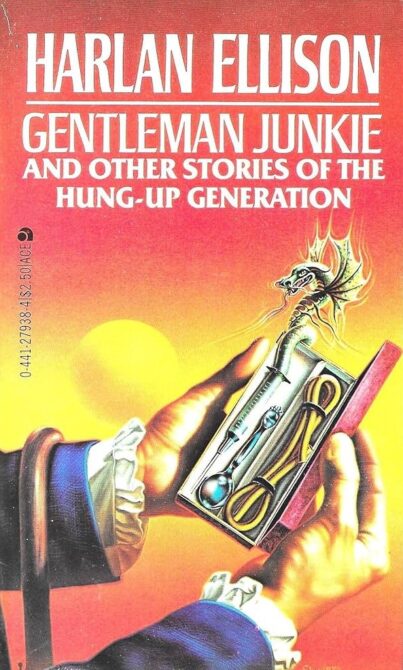
By HARLAN ELLISON (Ace Books; 1961/75/83)
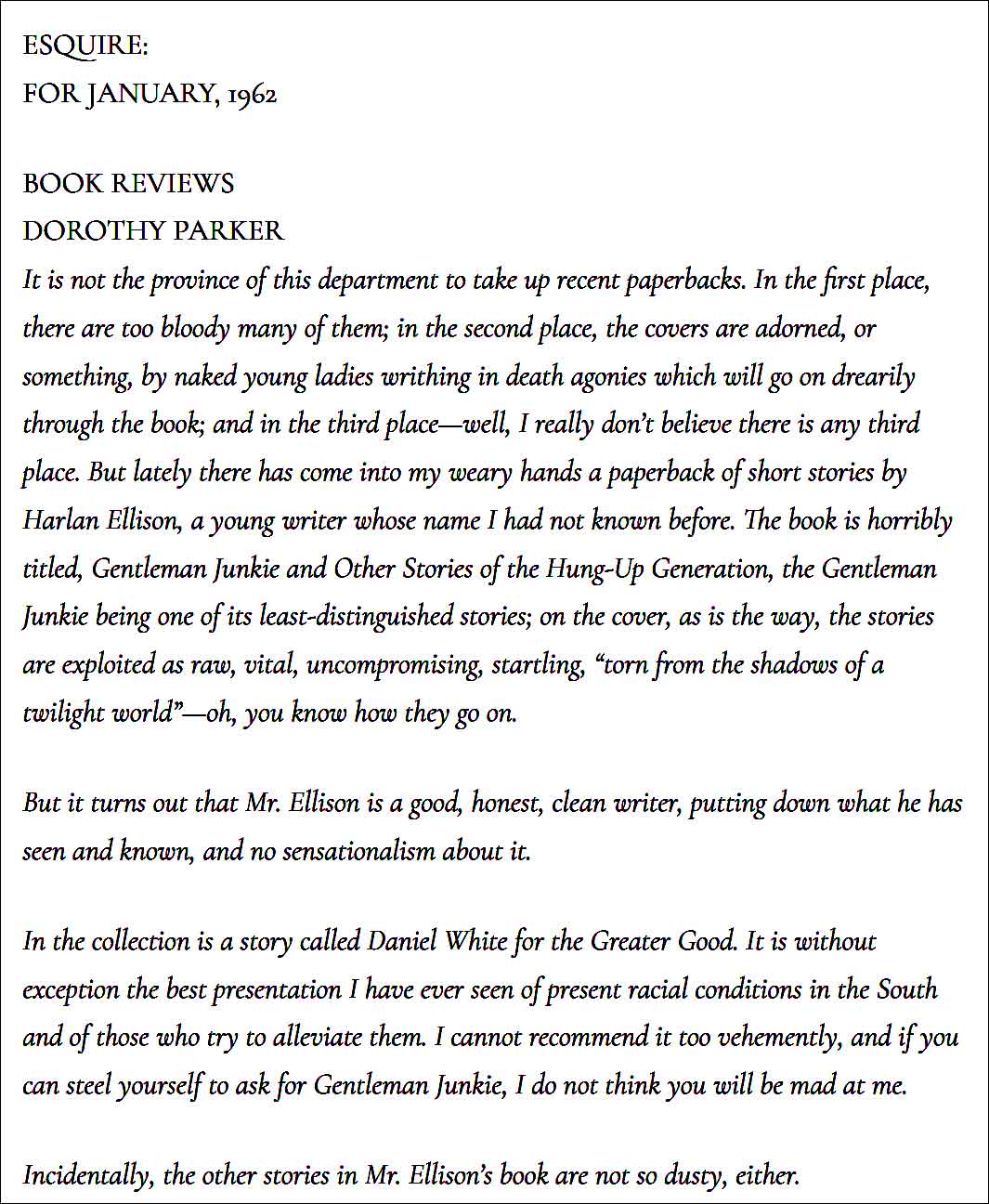
A 1961 Harlan Ellison short story collection that was, Ellison claimed, the book of his he loved the most. That’s because, as he outlined in a 1975 introduction, the one and only Dorothy Parker praised the book (the only paperback original she ever reviewed) in ESQUIRE magazine, which was instrumental in launching Ellison’s career (see below).
GENTLEMAN JUNKIE is unusual in Ellison’s cannon in that none of its contents, consisting of stories published in late 1950s men’s magazines, can be classified as science fiction or fantasy. Rather, its 25 short and sharp stories are all steeped in what was then contemporary reality: the 1950s beatnik scene.
My favorite GENTLEMAN JUNKIE stories included “Free With This Box!,” a tender, and apparently autobiographical, tale of a young boy’s encounter with some nasty cops; “Daniel White for the Greater Good,” a tough-minded account of segregation that Ms. Parker, as quoted in the introduction, called “without exception the best presentation I have ever seen of present racial conditions in the South and of those who try to alleviate them”; and “The Late, Great Arnie Draper,” in which several college friends reminisce about a dead colleague, leading to an ending that’s a real shocker.
Further standouts include “No Game for Children,” the suspenseful account of a pitched battle between a gangbanger and a (seemingly) nice old man. “Someone Is Hungrier” involves a gold-digging woman learning just that, with a final line that once again showcases the young Ellison’s talent for strong and unexpected codas. “No Fourth Commandment” concerns a nice man’s strained (to say the least) encounter with a young boy determined to kill his father.
Lesser tales include the title piece and the four-part “May We Speak?,” two hopelessly archaic looks at the “Hung-Up Generation” that have been bettered many times over in the ensuing years. “RFD #2” is a would-be suspensor with a “twist” ending I saw coming long in advance, while “Night of Delicate Terrors” is marred by the no-longer-prescient arc, which anticipates a political uprising that has long since come and gone. Dated is of course the operative word here, in a book that still manages to impress, but not quite as much as it once did.