
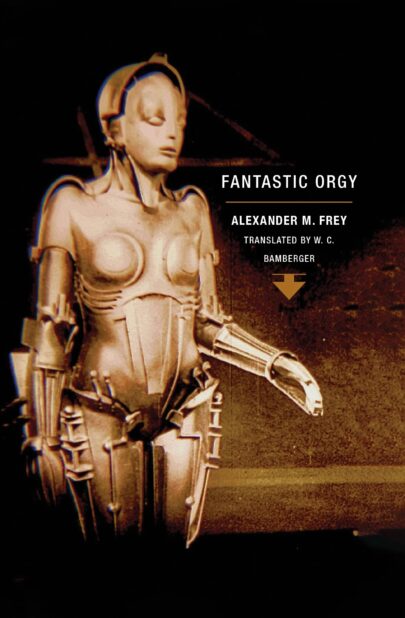
By ALEXANDER M. FREY (Wakefield Press; 1924/2025)
A moldy oldie from early Twentieth Century Germany whose title and packaging, dominated by a still from METROPOLIS (1927), suggest content that’s fantastic and/or speculative. In truth only one of the FANTASTIC ORGY‘s four stories embodies those designations: the title story (a moniker that’s quite misleading, as no orgies occur), a fanciful account of a man who throws a soiree for several homeless veterans and a female automaton.
The story appeared at a very particular time in European culture, with Karel Capek‘s robot-themed play R.U.R. and the film DER GOLEM both appearing in 1920, and the aforementioned METROPOLIS in 1927. Robots, it seemed, were a popular fictional representation of an era marked by widespread disillusionment and dehumanizing technological advancement, and the android woman of “Fantastic Orgy” evokes another popular 1920s trope: the master-slave dynamic, as played out by the ‘bot and a sadistic impresario who forces it to perform for crowds. The story shows its 100-plus year age a bit too well, and is further crippled by prose that has a tendency to switch tenses and viewpoints in a very un-artful manner, a fault that may lie with the English translation by W.C. Bamberger (based on this and other early 20th Century German texts I’ve perused, it seems that Eastern European prose of the era is extremely difficult to render in modern English).
The author was the Munich based Alexander M. Frey (1881-1957), who remains best known for the autobiographical war novel DIE PLASTERKASTEN (THE CROSS-BEARERS; 1931). The stories contained in FANTASTIC ORGY hail from much earlier in his career, when his focus was on the fantastic and grotesque. This is elucidated in an introduction by W.C. Bamberger, who writes of how the mild-mannered Frey fled the Nazis (who burned copies of DIE PLASTERKASTEN) in 1933 and settled in Switzerland, where it took until a few days before his demise for citizenship to be officially granted.
Mr. Frey evidenty had a strong interest in social issues. The book’s most representative story isn’t “Fantastic Orgy” but, rather, the appropriately titled “Poor.” It’s a darkly comedic lark about Turu, a penniless man taunted by Gul, a wealthy asshole, in a most unique manner on the latter’s own grounds. In a smiilar vein is “The Exchange,” which likewise pivots on a rich-poor dynamic, in the form of a wealthy lass who impulsively switches places with a beggar woman, only to discover that returning to her former state isn’t as easy as it might seem. Rounding things out is “The Offering,” about an old woman who tries to assuage her poverty-stricken existence by stealing from a church collection box—unwisely, as it turns out.