
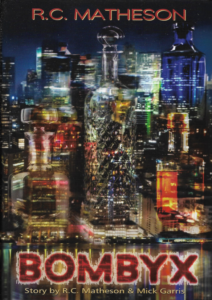
By R.C. MATHESON, MICK GARRIS (PS Publishing; 2026)
That this novella began life as an unfilmed screenplay is evident in several aspects. There’s the fact that its author Richard Christian—or, as he’s identified here, R.C.—Matheson is a screenwriter by trade (who occasionally writes novels), and the highly cinematic action/horror set-pieces (known in the trade as “whammies”) that pack the narrative. BOMBYX also has something that’s extremely common in movies but unheard-of in the literary sphere: a “Story By” credit, shared by Matheson and Mick Garris (also a prolific screenwriter and sometime novelist).
Conceptually, BOMBYX closely recalls the paranoid horror-fantasies of R.C.’s father Richard Matheson. That paranoia is here pushed to its absolute nadir, with a young man learning that the entire world is indeed against him.
The LA based software designer Peter Mitchell has just graduated from the NewLIFE Rehab Clinic. His wife Nancy is cold to him, as are his two children, and that frostiness extends to colleagues, strangers and even Peter’s dog, who inexplicably bites him on the cheek. Eventually Nancy banishes Peter and he becomes homeless, with seemingly everyone he meets hostile and wanting to kill him. It’s only when Peter breaks his sobriety in a bar that people’s hostility appears to thaw. What is going on?
The explanation, when it’s revealed, is actually semi-convincing, and adroitly broadens out a story that begins as an intimate psychological thriller (and so justifies what initially seem like pointless viewpoint shifts). R.C. Matheson’s old man, to whom this book is dedicated, would have been proud, although the younger Matheson isn’t entirely suited to the type of no-frills suspense in which his father specialized.
R.C. Matheson’s prose (as revealed in his previous novels CREATED BY and THE RITUAL OF ILLUSION, and collections SCARS AND OTHER DISTINGUISHING MARKS and DYSTOPIA) is extremely quirky. The highly ornate metaphoric descriptions (“The whole red, white and blue nightmare checked in, falling without a chute; charred, tweaked; gutted”) and action passages that utilize articles and conjunctions extremely freely (“Rinsed hand in sink, washed and soaped the thin spigot of blood. Wrapped it in a washcloth, held it tightly”) tend to detract from easy reading, leaving us with a suspense novel that’s not terribly suspenseful, but is unique and engaging enough to warrant a recommendation.