

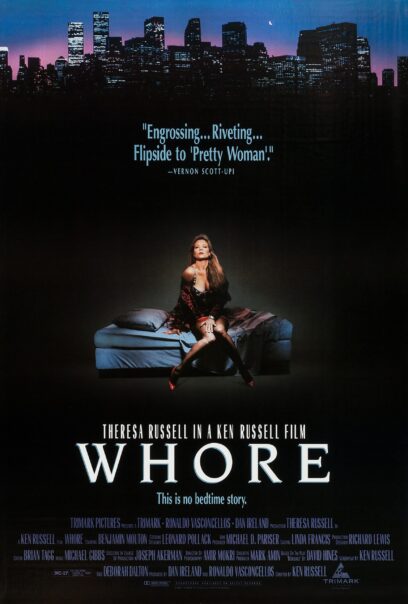
Here’s a pairing that hasn’t been made too often, but it’s a valid one: WHORE, a low budgeter from 1991, and SHOWGIRLS, an expensive tentpole release from 1995. Both explored the dark underbelly of America amid glitzy settings—upscale Los Angeles in the case of WHORE and Las Vegas in SHOWGIRLS—courtesy of the British Ken Russell and the Dutch Paul Verhoeven. Furthermore, both films are notable as tests for the viability of the 1990 instituted NC-17 (no children under 17) rating. In both cases the attempt ended in failure (for both the films and the rating), yet WHORE and SHOWGIRLS both went on to enjoy enormous success on home video.
WHORE (1991) Trailer
WHORE, intended as the inverse of PRETTY WOMAN (1990), was based on BONDAGE, a play by David Hines. He was inspired by actual confessions from London based prostitutes, while co-screenwriter Deborah Dalton interviewed several LA based hookers. This endeared Dalton to Russell, who sought to enhance the gritty details of the title character’s existence while including the campy and flamboyant aspects for which he was known.

Teresa Russell
If anything, Russell enhanced the camp, resulting in a tone that’s rather lopsided. Russell once claimed he liked to keep his audiences unsure of whether he was being intentionally funny or not, but in WHORE the funny business is allowed to predominate.

The hilarity begins with an outrageously theatrical performance by Theresa Russell, who’s tasked with explaining herself via fourth wall breaking narration. She plays Liz, a thirtyish prostitute whose fortunes we follow over the course of a single day. The fact that she walks from place to place, beginning in the Bunker Hill area of downtown LA and ending up in Century City (a distance of nearly 13 miles), demonstrates the anachronistic nature of the material; her actions may have made sense in London, but nobody walks in LA. Nor is it too likely that the existence of a whore would be as glitzy as that of Liz, who’s bathed in neon and situated in spacious locales that include the late ABC Entertainment Center and the fourth street bridge (the setting of an iconic scene from ERASERHEAD, featuring that film’s headliner Jack Nance).

Other major characters include Rasta (Antonio Fargas), an eccentric drifter who becomes a guardian angel of sorts, and Liz’s pimp Blake (Benjamin Mouton), an abusive scumbag who takes over narration duties for a brief period. We’re also made privy to our heroine’s past, which is filled in via flashbacks; it seems she has an estranged son she pines after, the product of a marriage to a drunk who among other sins turned up at a family dinner one evening and puked in the salad. Even more appalling are the many freaks and weirdoes Liz is forced to service, including a rabid shoe fetishist, a misogynistic trash talker and an old guy who drops dead during sex.
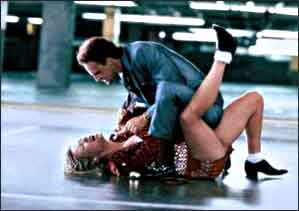
Would-be dramatic set-pieces tend to wind up comedic (such as a bit in which Blake forcibly abducts Liz from a friend’s home, which is sullied by overwrought music cues), while scenes that were supposed to be funny (such as a restaurant scene involving Russell himself as a snooty waiter) fail to elicit anything resembling laughter. The film, in short, can safely be termed a misfire, but the news isn’t all bad.
WHORE has an autobiographical component that nearly transcends its failures. The subject matter clearly resonated with the two Russells (who, as every review of the film has made clear, and which I’ll reiterate, were not related), showbiz veterans both.
Overwrought though it is, Theresa Russell’s performance has an authentically cynical, world-weary air that harkens forward to her appearance in the 2002 documentary SEARCHING FOR DEBRA WINGER, in which she speaks quite bluntly about being discarded by an industry that previously welcomed her. Regarding Ken Russell, WHORE’s Hollywood parallels clearly weren’t lost on him, evidenced by the many scenes set in and outside movie theaters. As a hard-hitting look at prostitution WHORE is a failure, but as a metaphoric depiction of Hollywood (mis)fortune it kind of works.
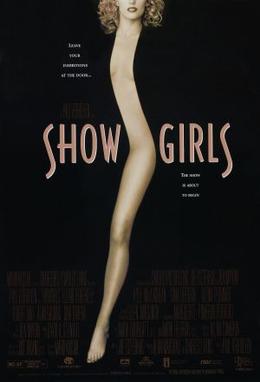
SHOWGIRLS likewise offers up a metaphoric depiction, although here the scope, and target, were much greater: it depicts Las Vegas as nothing less than the decaying soul of America (preceding two other 1995 films, LEAVING LAS VEGAS and CASINO, that attempted the same thing). As with WHORE, it only works in a metaphoric sense, with its sense of “reality” hopelessly wonky.
SHOWGIRLS (1995) Trailer
Once again, we have an overwrought female lead, in this case Elizabeth Berkley as Nomi Malone. A white trash dancer looking to hit it big in sin city, she’s a prickly, amoral, self-centered and very likely evil character who’s supposed to be extremely charismatic. That charisma is key to Nomi’s rise from performing in a sleazy strip club to what this film views as the pinnacle of show business: a topless dance revue put on by a major casino (a job whose perks include the fact that, as Nomi’s former boss enviously observes, nobody jizzes on her).

Elizabeth Berkley
But even that’s not enough, as Nomi becomes determined to headline the show. She fulfills this ambition by pushing the headliner Cristal Connors (Gina Gershon) down a staircase, only to be laid low by revelations of her checkered past. Nomi decides to leave Vegas, but not before performing a rare non-selfish act: she severely beats a slimy pop singer (William Shockley) who raped her best friend (Gina Ravera).

This is all lensed via spastic camerawork that recalls cinematographer Jost Vacano’s iconic work on Wolfgang Peterson’s DAS BOOT (1981). In that film Vacano was attempting to render the interior of a submarine cinematic, whereas here the object was to accentuate the excess of a town that thrives on it. Mission accomplished.
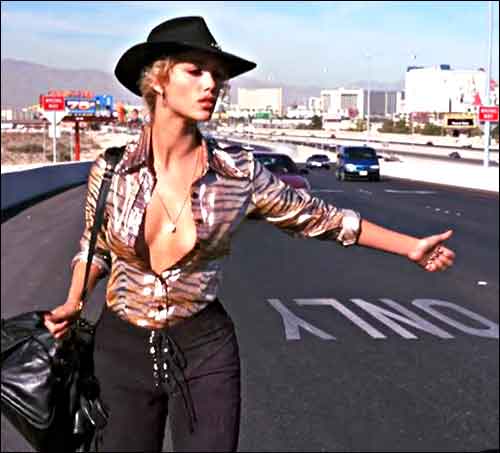
I’ll also credit Vacano and Verhoeven for their ability to depict sheer ugliness. If WHORE’s look was inappropriately glitzy, SHOWGIRLS has a visual hue that renders everything drab and sordid (for a Las Vegas-set film there’s shockingly little color). Note the downright horrific make-up job done on Elizabeth Berkley’s face; I’ve seen cement poured with more finesse.
Its target may have been America, but the film’s fatalistic sensibilities are thoroughly European. The uncompromising arc, complex protagonist (albeit played in a decidedly un-complex manner by Berkley) and unerring eye for sordid detail place the film in the company of early Verhoeven works like TURKISH DELIGHT (Turks fruit; 1973) and SPETTERS (1980). No wonder SHOWGIRLS flopped as spectacularly as it did; in the words of critic Jonathan Rosenbaum, “it’s a film that fundamentally said, ‘We’re all whores, aren’t we?’ and the American public answered, in effect, ‘Speak for yourself.’”

Which brings us to the central question that has dogged this film since its premiere: was it supposed to be as funny as it is? Verhoeven and screenwriter Joe Eszterhaus like to claim their intent was satiric, but both men, it seems to me, were entirely sincere in their intention to make a hard hitting drama. No wonder SHOWGIRLS is so hilarious, from Berkley’s priceless line-readings (my favorite being “No I’m not!” when asked if she’s a whore) to Gershon’s unbelievable Southern accent, to dialogue like “nobody can make my tits pop like you!” The film may be a failure in every conceivable aspect, but nobody can say it isn’t fun.
The good news for WHORE and SHOWGIRLS is that both enjoyed enormous post-theatrical success. WHORE had its home video release window shortened greatly by its distributor Vidmark (from the early 90s six month standard to half that), which put out no less than four versions on VHS: the NC-17 rated theatrical cut, an unrated version that added two minutes’ worth of steamy footage, a heavily cut R rated version and a similarly edited release titled thusly: IF YOU CAN’T SAY IT, JUST SEE IT. he gambit was a success, resulting in 90,000 units sold.
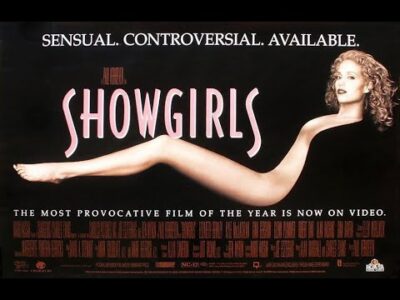
In the case of SHOWGIRLS, it was released in the standard R rated and unrated VHS versions. Those videos, and ensuing DVD and Blu-rays, have generated over $100 million in profit, with the film becoming one of MGM’s top 20 bestselling titles.
WHORE and SHOWGIRLS, for the record, have both generated cheap sequels. WHORE 2, written and directed by Amos Kollek (FAST FOOD FAST WOMEN), was an in-name-only follow-up that featured neither of the Russells and did a fast fade. SHOWGIRLS 2: PENNY’S FROM HEAVEN (2011) was written and directed by Rena Riffel, a supporting player from Verhoeven’s film who reprised her character Penny Slot, and got another SHOWGIRLS alum, Glenn Plummer, to return. The film thus has some continuity with its predecessor, but the results aren’t much better than WHORE 2, with a cheap veneer and tone that, unlike that of the previous film, strains very hard for campy comedy, and does absolutely nothing to further (much less enhance) its predecessor.