

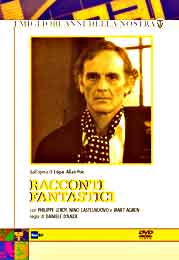
In the category of late 20th Century Edgar Allan Poe inspired miniseries, the Italians beat the French to the punch. I’ve already written about the French miniseries HISTOIRES EXTRAORDINAIRES, broadcast in 1981, but the Italian made FANTASTIC TALES BY EDGAR ALLAN POE (I racconti fantastici di Edgar Allan Poe) preceded it in 1979. As you may recall, I found HISTOIRES EXTRAORDINAIERS a severely mixed bag, and feel the same way about FANTASTIC TALES, whose major attribute is that, once again, it appeared first.
Italy’s relationship to Poe isn’t as proprietary as that of France, in which the highly Frenchified translations by Charles Baudelaire are better regarded than the original stories. The affection Italian filmmakers have for Poe’s work is quite evident nonetheless, with Federico Fellini and Dario Argento turning their attentions to Edgar Allan in Fellini’s “Never Bet the Devil Your Head” inspired TOBY DAMMIT (released as part of the 1968 French-made anthology film SPIRITS OF THE DEAD) and Argento’s “Black Cat” portion of TWO EVIL EYES (Due occhi diabolici, 1990). Sergio Martino also gave Poe his due in the “Black Cat” pastiche YOUR VICE IS A LOCKED ROOM AND ONLY I HAVE THE KEY (Il tuo vizio è una stanza chiusa e solo io ne ho la chiave; 1972), as did Lucio Fulci in THE BLACK CAT (Gatto nero, 1981).
FANTASTIC TALES BY EDGAR ALLAN POE offered a take on Poe’s fiction that was anything but orthodox. Co-written and directed by the Italian TV veteran Daniele D’Anza, it contained four linked segments, each inspired by multiple Poe stories. The settings are contemporary, the cast is prestigious (included are LE TROU’s Philippe Leroy, KILL BABY KILL’s Erika Blanc and RAT MAN’s Janet Agren) and the electronic score by the Italian pop band Pooh adds a supremely 1980s aura.
The “Primo Episodio,” broadcast on March 11, 1979, is “Notte in casa Usher” (“Night in Usher’s House”). D’Anza incorporates “A Descent into the Maelstrom,” “The Gold Bug,” “The Oval Portrait” and “The Tell-Tale Heart” into the 65-minute mix, which makes for an interesting, but also highly disjointed and distracting, film.
It begins with a judge (Gastone Moschin) and his young companion (Vittorio Mezzogiorno) on a country drive. Their car breaks down near a mansion, where they find themselves in what the judge later describes as “an absurd, sudden fog.” They’re met at the door of the mansion by one Roderick Usher (Leroy), who allows them to stay in this archaic structure, packed with dolls and a self-playing piano.
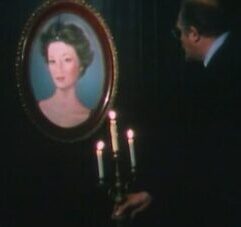
Usher talks about his long-dead wife (Maria Rosaria Omaggio). He killed her, he claims, by painting a portrait of her that leeched the woman’s life force. The portrait now hangs in the mansion and exerts a hypnotic allure, leading to a murder whose perpetrator unwittingly incriminates himself due to the fact that he can’t block out the sound of the beating of his victim’s heart.
The film is a severely mixed bag. There are inspired elements, but the whole thing is vastly overstuffed and lacking in character motivation, with behavior governed solely by the events of stories that don’t harmonize terribly well.
The “Secondo Episodio” is the 55-minute “Ligeia Forever,” aired on March 18, 1979. It once again mashes up several Poe tales, including “The Tomb of Ligeia” and “Morella,” but has a more cohesive flow than the previous episode, with the pull of a classic ghost story (and not necessarily one by Poe). I’d call it the series’ best episode.
Philippe Leroy is back as Roderick Usher. He lives in tortured solitude in his dilapidated family mansion (introduced in episode one), with his guiding credo being “My life is a race toward the abysmal blackness of the absolute.”
The focus this time is on Usher’s father Robert (Umberto Orsini). A flashback shows Robert living in an earlier, and much livelier, iteration of the family mansion. The place is haunted by Robert’s deceased wife Ligeia (Lassander), a film actress who committed suicide after Hollywood’s silent-to-sound transition torpedoed her career. Robert remains devoted to her, neglecting his much younger second wife Morella (Silvia Dionisio), who finds herself at the center of a supernatural love triangle. The ghostly Ligeia, you see, is jealous of her hubbie’s new bride, resulting in several dangerous “accidents” befalling Morella.
The 65-minute “Il delirio di William Wilson” (“The Delirium of William Wilson”) aired on March 25, 1979. Taking inspiration from “The Masque of the Red Death” and “William Wilson,” it centers on William Wilson (Neil Castelnuovo), a racecar driver who as the film begins confronts Roderick Usher at an elaborate masked ball held in his mansion.
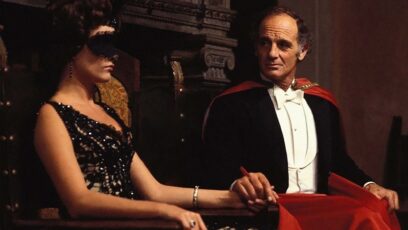
An extended flashback shows how Wilson became aware of a man (the series’ assistant director Giorgio Biavati) who closely resembled him, albeit with “a strange face…a way of looking that makes me uneasy.” This fellow also bears the name William Wilson, as well as a birth date identical to that of the protagonist, whose life the second Wison interferes with in ways that are agreeable and profoundly destructive by turns. Compelling, but there are too many divergences from the events of the story, starting with the car racing milieu, which simply doesn’t jibe with Poe’s narrative.
The 57-minute “La caduta di casa Usher” (“The Fall of the House of Usher”), broadcast on April 1, 1979, finishes things off appropriately, with the “fall” of the Usher residence. The major inspiration was “The Masque of the Red Death” in addition to the 1839 tale that provides the title, two stories that prove so harmonious I’m surprised nobody else has tried combining them. Also incorporated are “Eleonora” and “The Pit and the Pendulum,” whose presence struck me as overkill.
Roderick Usher is back at the masked ball seen in the previous episode, which continues, but not for long. Usher’s wife Eleanor (Agren) falls ill, and he abruptly ends the party, planning to spend the remainder of the night caring for his beloved. But the guests return, claiming that a black cloud bearing a deadly toxin has appeared on the horizon, and barricade themselves inside the mansion. As they increasingly give way to violence and debauchery Eleanor expires, but the increasingly deranged Usher grows convinced she’s still alive…
The blocking and camerawork here are far more baroque and expressive than in the previous segments, suggesting that D’Anza viewed this episode as the series’ apotheosis. Overambition, alas, is its greatest drawback, with “La caduta di casa Usher” joining “Notte in casa Usher” as an example of too much, too soon. Too bad.