
 The subject of this essay is the New Zealand filmmaker Taika Waititi. Once a critics’ darling for WHAT WE DO IN THE SHADOWS (2014) and JOJO RABBIT (2019), Waititi has since fallen out of favor with critically drubbed films like NEXT GOAL WINS (2023) and KLARA AND THE SUN (2026), which were, not incidentally, massive flops. The latter was especially cataclysmic, amassing a pathetic $701,059 in its opening weekend (a per screen average of around $796), leading to a now-infamous Instagram outburst in which Waititi unloaded on the “sad lost souls who couldn’t achieve their dreams of becoming artists, and thus settled, and became critics,” apparently “The same people who also hated JOJO RABBIT…Irrelevant. Out of touch. Obsolete. In the bin.”
Let’s break this down. Waititi is, for starters, wrong about JOJO RABBIT being “hated” by reviewers (in fact, it scored an impressive 81 percent on Rotten Tomatoes’ Tomatometer), but entirely correct in laying the failure of KLARA AND THE SUN at the feet of critics. An independent release, the film was dependent on critical notices in a way mainstream releases aren’t, and after receiving poor reviews during its BFI Film Festival premiere, KLARA AND THE SUN’s distributor Sony scaled back its US release considerably (meaning Waititi’s claims of critics being “Obsolete” and “In the bin” are off base). This explains why the publicity machine was so muted (if you were unaware of this film’s existence, much less release, you weren’t alone) and why so few people turned out for it.
Waititi’s actions are nothing new. Critic bashing has long been a favorite pastime of spurned artists, from British author Arthur Machen (1863-1947), who gleefully published several of his bad reviews in book form as PRECIOUS BALMS (1924), to filmmaker Tom Laughlin (1931-2013), who promoted the 1975 re-release of his critically maligned TRIAL OF BILLY JACK (1974) with a “Billy Jack Versus the Critics” campaign, 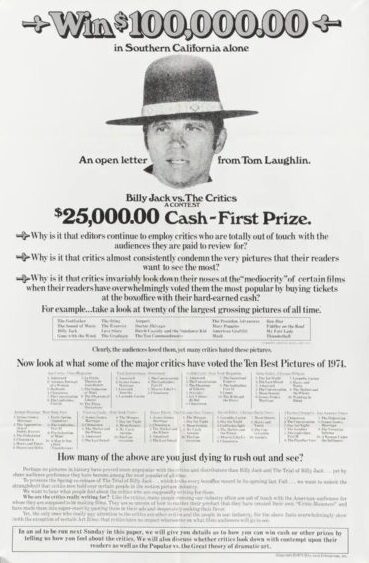 comprising an essay contest based around the question “Why is it that that critics are so totally out of touch with the audiences they are paid to review for?” (My answer: because critics take an intellectual approach to a medium whose appeal, as was famously articulated by the late Samuel Fuller, can be summed up in one word: Emotion.) FYI, one of the contest winners called THE TRIAL OF THE BILLY JACK “the most abominable product I have consumed in several years.”
This brings up a question Taika Waititi, like Tom Laughlin before him, would do well to ask himself: might his film have been at least somewhat deserving of the critical drubbing it received? I have yet to see it, and so can’t offer an opinion, but Waititi partially answered that question with the claim “I haven’t read a review of anything aimed at me or my peers in almost 15 years. But I do listen to the people.” He would appear to be referring to the KLARA AND THE SUN Rotten Tomatoes audience score, which is currently at 74%, as opposed to its 25% critic score (I’d argue that too few people saw the film to properly collate its audience reception, but anyway…).
This is a point that is, once again, familiar. Directors love to point to audiences, or fans, as nonjudgmental corollaries to bitter, nitpicky critics. As B-movie legend David DeCoteau wrote in 1992, “I make my movies for fans, not wannabe snobs”—specifically genre magazine editors and, of course, critics, who DeCoteau (like Waititi) damns as “jealous of the chosen few who can actually make a decent living directing movies.”
In truth, the “wannabe snobs” of America’s critical world are largely cloistered on the East Coast, whereas the jealous ones can generally be found in the west. This is to say that East Coast critics tend toward the snooty and highbrow, while the West Coasters are bitter and snarky. Contrast VILLAGE VOICE critic Amy Taubin’s take on BASIC INSTINCT (1992)—“What happens to women when they look at movies…you identify with the male characters…no matter what your preference is and your gender orientation and your presentation of self”—with that of the VOICE’s West Coast counterpart L.A. WEEKLY, whose head critic Michael Ventura wrote “If you think you’re fucked up and you go see this movie and you’re not sexually aroused by it—then you’re probably not as fucked up as you think you are.”
Whatever coast they might hail from, critics are among the most herd-like organisms that exist. Surely you’ve noticed how all the major critics seem to share largely identical opinions? I recall being puzzled when, back in 2001, a FILM COMMENT end-of-the-year critical round-up ranked films like BEAU TRAVAIL and THE HOUSE OF MIRTH as among the very best of the previous year. Did critics really like those films (both of which bored me shitless) or were they simply following the crowd? More recently, mainstream critics nearly all proclaimed ONE BATTLE AFTER ANOTHER the best film of 2025, and A POET (which would appear to rank with BEAU TRAVAIL and THE HOUSE OF MIRTH in terms of appeal) as the best of ‘26 (so far). In short, there’s a consensus opinion that major film reviewers all latch onto, and God help the critic who goes against that tide (just ask Armond White).
While on the subject of critical fallibility, I’ll take this opportunity to list some assorted mainstream critic annoyances: their obnoxious anti-commercial stances, shameless Pauline Kael borrowings (manifested in excess Kewpie doll comparisons), ferreting out of any and all traces of poignancy or sentiment in movies (see the abovementioned Samuel Fuller quote) and years-after-the-fact reversals about a previously trashed film. That latter point is being played out right now with the currently-in-release restoration of Ken Russell’s THE DEVILS (1971), which was widely dismissed as an exercise in wretched excess, but is now apparently a “Visionary Masterpiece” and an “unexpected miracle.”
Speaking as one who has stood in each of the three camps outlined in this essay—critic, filmmaker and viewer/fan—I find I’m having trouble choosing a side. If I identify as a critic, it seems, I’m a bitter and/or snarky grump, whereas being a filmmaker renders me unwilling to accept criticism (note that Waititi and co. have no problem with those critics who like their films), while as a fan I’m apparently duty-bound to seal clap for everything I see. None of those things sound very appealing.
The abovementioned David Decoteau quotes, I’ll reiterate here, were made prior to the internet age. In the years since 1992, as I’m sure we’re all aware, the critic-fan dynamic has shifted mightily, with the internet exposing the apparently sanguine film fans as being every bit as petty, exclusionary and obnoxious as the 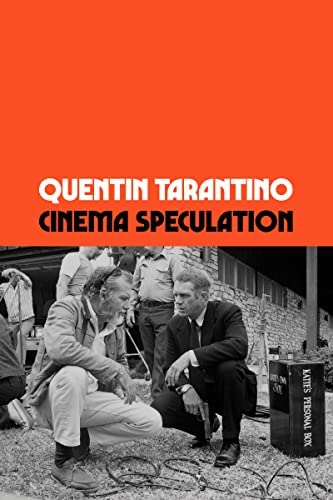 critics. This is reflected in the anti-“toxic fandom” sentiment that has taken hold in the media, and which Christopher Nolan recently mined in a broadside against “amateur critics” who “because they feel they’ve identified the mechanism (traditional storytelling tropes), they feel that invalidates it.”
Anther interesting post-internet development has been that of directors joining the enemy camp and becoming critics. The acclaimed director Paul Mazursky (1930-2014) retired from filmmaking in the aughts and, starting in 2011, served as a film reviewer for VANITY FAIR, while Quentin Tarantino has in recent years shown more interest in film criticism than filmmaking, publishing a slew of critical articles in SIGHT AND SOUND and the book CINEMA SPECULATION.
Things, in short, are changing. This means that perhaps the major problem with Mr. Waikiki’s anti-critic sentiments wasn’t that they were wrong, but that, recently made though they might be, they’re out of date.