
1960s smut publishing was a mighty distinct entity. As articulated by the porn lit impresario Linda DuBreuil, “In the late fifties and the early sixties the editorial requirements for pornography were many…A penis was nicely called ‘his manhood,’ or ‘his masterful staff.’ There were also acceptable substitutes like ‘family jewels…’” Regarding descriptions of sexual intercourse, publishers “insisted on words like coitus, making love, making out, heavenly moment of release and moment of bliss.” The early 1960s were a far cry, in short, from the XXX-rated anatomical extremes smut fiction reached in the following decade.
What of smut fiction of the mid-1960s? From what I’ve been able to discern, the level of explicitness wasn’t too far removed from that of the earlier part of the decade. For corroboration, let’s take a look at 1965’s NIGHT TRAIN TO SODOM by “Tony Calvano,” a.k.a. Thomas P. Ramirez, and the following year’s PARISIAN PASSIONS by “J.X. Williams” a.k.a. Edward D. Wood, Jr., two similarly oriented Paris-set smut novels from imprints of the William L. Hamling founded Greenleaf Publishing Company (Ember Library in the case of NIGHT TRAIN and Sundown Reader with PARISIAN PASSIONS).
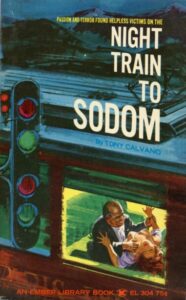
Thomas P. Ramirez was a pivotal figure in 1960s smut publishing, outdoing most of his fellows in prolificacy and sheer nastiness. S&M, which would go on to dominate such books, was a relatively novel subject in the early part of the decade that Ramirez/Calvano took to quite enthusiastically in novels like SEX PAWN (1961), FLESH CAPTIVE (1962) and CULT OF SHAME (1964), in which the nastiness had a tendency to outpace the erotic content. As one Goodreads user wrote about Calvano’s LUST MONSTERS (1963), “I thought I was getting a smut (novel), but it is pure horror from the perspective of a kidnapping victim. For a horror, it’s pretty damn good. For smut, what the fuck?”
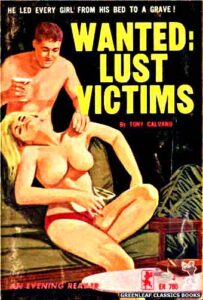
NIGHT TRAIN TO SODOM followed WANTED: LUST VICTIMS, another 1965 Calvano novel (about a nut who strangles women in Hollywood) that beat this one to publication by a few months. The two novels were evidently conceived concurrently, as both follow the same formula, although NIGHT TRAIN TO SODOM is the superior example.
It takes place in a Parisian setting far more opulently described than was standard for a Ramirez book (or the industry overall). We learn, for instance, that “Countless paintings have been executed to honor Paris in the Spring. Too little, however, has been said about another exceptional season: Paris in the Autumn,” when the city is “mist-drenched, melancholy, virtually deserted by the armies of tourists that inundate it during those spring and summer months. The real Paris.”
Inhabiting this “real Paris” is Sharkawi, an “extremely gross, oily-skinned, thin-mustached man” who targets unsuspecting women on a night train out of Paris, drugging and then degrading them in ways that, this being and old school smut novel, are never fully described. Particularly representative are hazily drafted passages like “She had vague impressions of that suffocating weight on her, of pain and breathless struggles. She recalled his howls, the fact that she’d been forced to her knees before him again.”
Also afoot are Joanna and Mayo Kinsolving, a conservative American couple on a business trip. They quickly fall under the spell of Roul and Aimee De Fonseca, insatiable horndogs who introduce Joanna and Mayo to the joys of anonymous sex, partner swapping and skin-tight black leather (all described as you’d expect, with deliberately elliptical lines like “His lips attacked the proud berried topping each of those ebony conoids, his hand speared that other peephole”). Joanna and Mayo eventually meet up with Sharkawi in a violent and revelatory encounter, followed by a singularly sappy happy ending.
This isn’t the best smut novel I’ve ever read, but it’s far from the worst. NIGHT TRAIN TO SODOM is nonetheless a standout in the Ramirez/Calvano oeuvre, and superior in all aspects to PARISIAN PASSIONS.
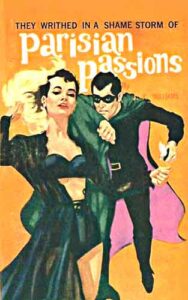
The latter was an early effort at novel writing by the late Ed Wood, who followed it with two of his more memorable prose efforts: WATTS… THE DIFFERENCE and SIDE-SHOW SIREN (both 1966), which were nearly strong enough to nearly pass as mainstream fiction. That’s not case with PARISIAN PASSIONS (a.k.a. 69 RUE PIGALLE), which is everything you might reasonably expect from an Ed Wood novel: messily plotted, unevocatively written and very dark, with a portrayal of the City of Light that, in direct contrast to the loving picture painted by Calvano, can be summed up by a climactic observation that “the coldness was cutting…It seemed to be more than a coldness of the weather. There was much more to it. There was a coldness not unlike that of a grave. A feeling of ultimate disaster, desolation. A feeling of the complete end.”
The “Night People” of Paris (so called because “all their lives they live in the darkness of their own creation”) are frequently alluded to in an account that once again delights in unveiling the city’s seamier corners, as seen through the eyes of a transplanted American. The Texan Sherrif Buck Rhodes, who finds himself in Paris due to a France-America officer swap, is drawn by one Inspector Henri Goulet into the search for “Jacques the Ripper,” a misanthropic black cape and eye mask wearing loon who strangles strippers in the seedy Pigalle district.
The book meanders for much of its length, with erotic content that even by mid-1960s standards is quite weak. It only really comes alive in act three, with the introduction of one Lorry Peters, who happens to be a drag queen.
This introduction occurs in a flashback of Sherrif Buck conducting an “inquisition” of a “female” criminal who turns out to be the cross-dressing Mr. Peters. He ends up being summoned to Paris to help with the investigation, all the while providing the reader with the requisite autobiographical shading; Lorry, like his creator, has a liking for pink angora and, also in common with Mr. Wood, served as a Marine in WWII (although whether Peters wore a bra and panties under his uniform, as Wood was known to have done, is left unexplained).
The fact that it takes so damn long for this character to be introduced was a very Ed Woodian miscalculation. Lorry Peters is, after all, PARISIAN PASSIONS’s most interesting personage, and proves pivotal to the outrageous finale, in which we learn that two major characters harbor non-heterosexual preferences, and in which Ed Wood’s writing comes to very nearly match his filmmaking in sheer so-bad-it’s-goodness.