


This week we bid adieu to Nelvana, the Toronto-based animation outfit. In doing so I find I’m flashing back to a quote about Canada versus America that stated, “To me, the United States is like a gregarious relative who slaps you on the back, laughs too loudly, and somehow takes up all the space in whatever room they happen to inhabit,” whereas Canada is “like a soft-spoken, more respectful, more tactful cousin who really brightens the space they’re in.” Whatever else Nelvana may have been, it was quintessentially Canadian.
In keeping with that status, Nelvana tended to do things quietly. It wasn’t big on press releases, preferring to conduct its business in relative silence; I’ll confess I thought Nelvana’s demise occurred years earlier than it did, as they’ve been so discreet. When the end did (apparently) arrive, Nelvana and its parent corporation were characteristically tightlipped about it, with no official announcements.

Nelvana, instituted in 1971, was the product of three men: Michael Hirsh, Patrick Loubert and Clive A. Smith, who ran the company out of an abandoned building in Toronto. Early success came in the form of animated TV specials like THE DEVIL AND DANIEL MOUSE (1978) and ROMIE-O AND JULIE-8 (1979), which introduced a wholly unique sensibility; in a late 1990s SHOCK CINEMA review I described the latter as “primo kid vid weirdness” containing “flying cigars, Romie’s trip across the planet by running atop a rolling garbage can (and) a tightrope walk across a cabin of falling debris…” There was also A COSMIC CHRISTMAS (1977), which inspired George Lucas to commission Nelvana to animate ten minutes of the notorious STAR WARS HOLIDAY SPECIAL (1978).
ROMIE-O AND JULIE-8 (1979) Full Feature
Nelvana’s most ambitious undertaking began in the late 1970s and was unveiled in 1983: RING OF POWER, a.k.a. ROCK & RULE, an animated music-fueled sci fi feature. It was by Nelvana standards a mega-production, costing $8 million and employing upwards of 300 animators. The script, a feature-length conflation of THE DEVIL AND DANIEL MOUSE, was said to have been severely underwritten, which much of the narrative invented as the filmmakers went along and the target audience shifting from youthful to mature. The animation, however, was innovative and eye-catching, utilizing well integrated live action and state-of-the-art computer-controlled cameras.
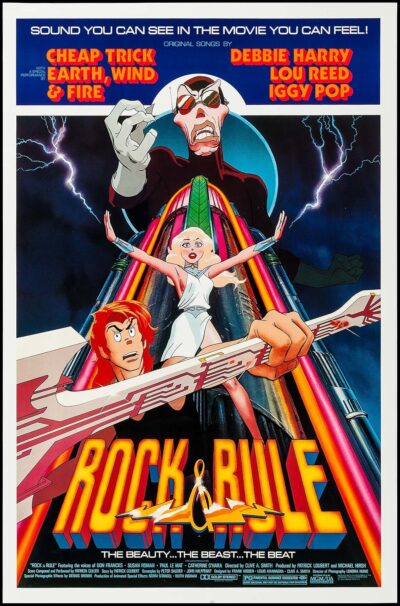
ROCK & RULE’s setting is a post-apocalyptic future in which animals have mutated into humans. The confusing narrative involves Mok, a shadowy rock star looking to summon a demon by kidnapping the small-time rock ‘n’ roller Angel, whose otherworldly singing voice is set to be the instrument of the summoning. ROCK & RULE’s director, the aforementioned Clive A. Smith, claims the film “should have made millions,” but the erratic pacing and inconsistent visuals—each of the film’s major set-pieces was overseen by a different lead animator—ensured a muted audience reaction.
ROCK & RULE (1983) Trailer
Indeed, the film was an outright flop upon its 1983 release, earning just $30,379 (although it’s since become a popular cult item). One problem was that HEAVY METAL, for which Nelvana was sought out (only to turn down the opportunity), was released in 1981 and stole ROCK & RULE’s thunder. Both films were adult-oriented, rock-fueled animated features, although ROCK & RULE was, I’d argue, the more interesting film. It also had a stronger musical line-up, with Cheap Trick, Debbie Harry, Lou Reed, Iggy Pop and Earth, Wind and Fire all contributing original songs.
That Nelvana was able to survive such a disaster shows it had unusual staying power. In fact, in the latter half of the 1980s Nelvana flourished due to sound business decisions (it acquired the character rights to the lucrative CARE BEARS toy line) and its association with George Lucas, for whom Nelvana produced the STAR WARS: DROIDS and STAR WARS: EWOKS (both 1985-86) cartoon series.
In the nineties the company suffered some setbacks, among them an adaptation of Clive Barker’s THIEF OF ALWAYS that never came to fruition and the production of several live action films, only one of which (1993’s MALICE) achieved any success. In 1998 Nelvana got a boost when it was selected by CBS to help fulfill the FCC’s Children’s Programming Order, which decreed that all American TV stations had to broadcast 3 hours a week of educational programming aimed at the under 16 set.
MALICE (1993) Trailer
Nelvana’s fate was decided in 2000, when it was acquired by the Canadian entertainment outfit Corus. Loubert and Smith promptly departed the company in 2001, followed by Hirsh in ’02. Corus-instituted reductions in staff appear to have been the major catalysts for the departures, and the layoffs continued in the 2010s and 20s, leading us to right now, when it appears that Nelvana is kaput.
Will there be a comeback? I’d opine most likely not (if Corus intends to restart Nelvana at some future date, why bother shutting it down?), so I’ll sign off with a heartfelt goodbye to Nelvana. It certainly had its ups and downs, but did make a mark, brightening the space it was in and the area beyond.