
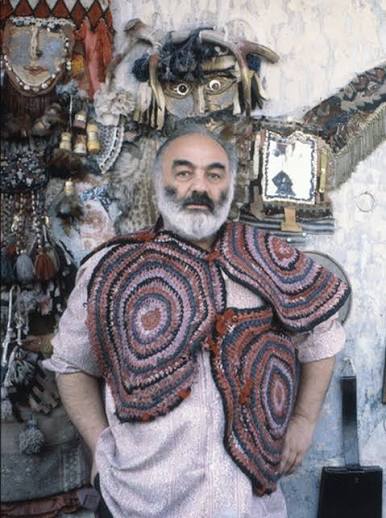
Sergei Parajanov
The late Soviet filmmaker Sergei Parajanov (1924-1990) was an unsung master of fantasy. The Soviet Union, of course, had its own very distinct brand of fantasy cinema, represented primarily by the work of the Alexanders, as in Ptushko (1900-1973) and Rou (1906-1973), in films like Ptushko’s ILYA MUROMETS (1956) and RUSLAN AND LUDMILA (Ruslan i Lyudmila; 1972), and Rou’s BARBARA THE FAIR WITH THE SILKEN HAIR (Varvara-krasa, dlinnaya kosa; 1970) and KINGDOM OF CROOKED MIRRORS (Korolevstvo krivykh zerkal; 1963). Parajanov’s sensibilities, which favored poetic symbolism, cultural immersion, and avant-garde storytelling, didn’t align with those of the more traditionally minded Alexanders (nor the Soviet authorities), yet fairy tale fantasy was the subject of Parajanov’s first and final feature.
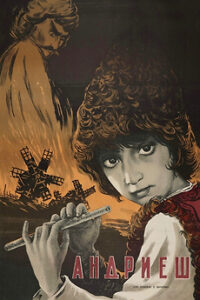
ANDRIESH
ANDRIESH (1954) is an erstwhile children’s fantasy that plays like a Ptushko epic crossed with H.R. PUFNSTUFF (1969-70). It began as MOLDAVIAN FAIRY TALE (1951), a 48-minute student project that Parajanov and co-director Yakov Bazelyan expanded to (near) feature length.
ANDRIESH (1954) Film
The subject: Andriesh (Kostya Russu), a young boy in pursuit of Black Hurricane (R. Visirenko-Klyavin), an evil sorcerer whose crimes include the theft of the boy’s dog. During his journey to the sorcerer’s fortress, Andriesh, with a magical talking flute in hand, encounters a goofy drunk, a giant, some talking trees and a flying horse. Eventually Andriesh and his newfound companions reach the fortress, where several people are held captive in suspended animation, and where a climactic showdown ensues between our hero and the bad guy (I wouldn’t dream of revealing who wins).
This being a debut film, there’s a lot of clumsiness and outright amateurism. Fans of later Parajanov masterworks like SHADOWS OF FORGOTTEN ANCESTORS (Tini zabutykh predkiv; 1965) and THE COLOR OF POMEGRANATES (SAYAT NOVA; 1969) probably won’t find much to savor here; Parajanov in his later years dismissed ANDRIESH, and all his pre-1965 films—which included state-approved programmers like THE FIRST LAD (Pervyy paren; 1958), UKRAINIAN RHAPSODY (Ukrayinsʹka rapsodiya; 1961) and FLOWER ON THE STONE (Tsvetok na kamne; 1962)—as “garbage,” but the film does contain a very Parajanovian sense of near-otherworldly strangeness, in addition to an ingenious multi-hued lighting scheme (color film stock was apparently something of a rarity in Soviet cinema of the time), achieved on an extremely tight budget.
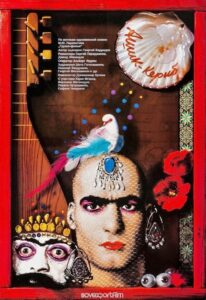
Ashik Kerib
ASHIK KERIB (Ashug-Karibi; 1988) likewise involved magic and a flying horse in a budget-lite fairy tale neverland. Made following back-to-back prison sentences (in 1973-77 and 1982) and the 1985 feature THE LEGEND OF SURAM FORTRESS (Ambavi Suramis tsikhitsa), co-directed by Dodo Abashidze, ASHIK KERIB was completed two years prior to Parajanov’s July 20, 1990 demise. Inspired by an 1837 story by Mikhail Lermontov, it was once again co-directed by Dodo Abashidze and, in an unjust but entirely predictable development, until recently was much easier to find than SHADOWS OF FORGOTTEN ANCESTORS or THE COLOR OF POMEGRANATES.
ASHIK KERIB (1988) Clip
The Azerbaijan set ASHIK KERIB features Yuri Mgoyan as a penniless singer-poet (or ashik) who embarks on a mystical journey to find money so he’ll be allowed to marry his beloved. He meets many weird folks, faces down a tiger with a spinning head, goes to heaven (represented by a house with blue doors) and travels across the world (represented by a spinning globe) on that fateful flying horse.
It’s done up in Parajanov’s signature tableaux style, with Azerbaijan culture celebrated in the same way THE COLOR OF POMEGRANATES honored Armenia, depicted by characters performing native dance routines amidst exquisitely patterned backgrounds. The overall mood is quite somber (psychological residue, I assume, from its maker’s incarceration), and the Russian overdubbing (in the form of a voice repeating the Azerbaijan dialogue in Russian) is downright obnoxious, but the film, in common with the entirety of Parajanov’s output, has a fecund bizarrie that here feels downright Jodorowskian (think an Eastern-centric EL TOPO), making one regret that Parajanov didn’t work more extensively in the fantasy field.
What’s missing from ASHIK KERIB is the polish of the earlier film, with the elderly Parajanov evidently not caring how threadbare and/or cheap the finished project may have looked. ANDRIESH, in short, is very much the product of a young man, while ASHIK KERIB is all-too-evidently that of one who was literally in his final days.