
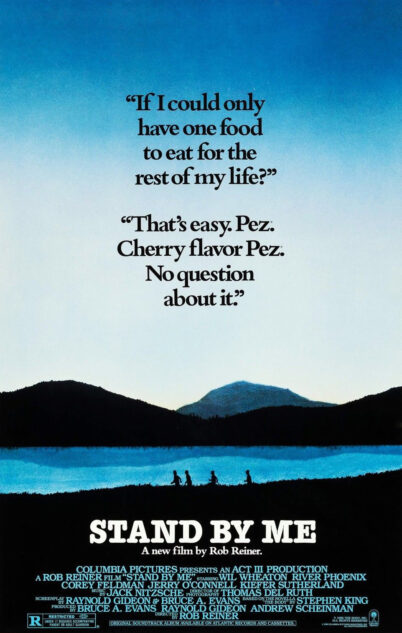
Were you to travel back in time to an American suburb in the fall of 1986, you might think you’d landed in the late 1950s. The reason? Rob Reiner’s 1959-set STAND BY ME, released in August of ‘86, which wasn’t merely a surprise hit that contradicted Reiner’s claim, “There’s no way this picture is going to do business, because no one who went to RAMBO will go to see our film,” but a pop culture phenomenon that had Gen-Xers getting crew cuts and its vintage pop tune packed soundtrack enjoying heavy rotation, with the 1961 Ben E. King title song (video below) becoming a chart topper. (I’m unsure how a 1961 song fits into a 1950s set movie, but never mind.)
STAND BY ME (1986) Trailer
BEN E. KING Song “Stand By Me” (1961) Video
STAND BY ME was the third feature directed by the late Mr. Reiner, and his first Stephen King adaptation. The source text was “The Body,” a semi-autobiographical novella that incorporated two previously published King stories, “Stud City” (1969) and “The Revenge of Lard-Ass Hogan” (1975), and was included in the 1982 collection DIFFERENT SEASONS. Reiner subsequently directed the King-inspired MISERY (1990), and shepherded several more King adaptations—THE SHAWSHANK REDEMPTION (1994), DOLORES CLAIBORNE (1995), THE GREEN MILE (1999), etc.—through his company Castle Rock Entertainment (1987-2002), named after the town depicted in STAND BY ME.
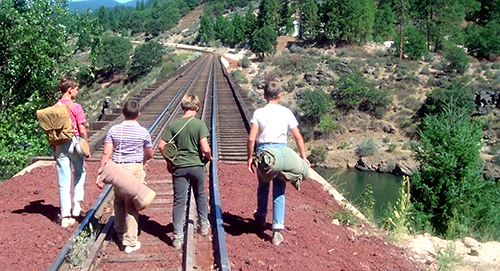
Wil Whetaon, Jerry O’Connell, Corey Feldman, River Phoenix
As in “The Body,” STAND BY ME is related (in voice-over) by the middle-aged novelist Gordie Lachance (Richard Dreyfuss), who after learning about the death of his childhood friend Chris Chambers (River Phoenix) decides to write about an incident that occurred in the summer of 1959. An extended flashback shows Gordie’s 12-year-old self (Will Wheaton) traumatized by the death of his brother Denny (John Cusak) and hanging with a crew that includes the misunderstood Chris, the angry and intense Teddy (Corey Feldman) and the nerdy Vern (Jerry O’Connell).
Vern informs his pals about the death of an unfortunate kid named Ray Brower, whose corpse can be found on the outskirts of Castle Rock. Brower was hit by a train, it seems, but his death wasn’t reported to the police because the finder of the body, Vern’s older brother Billy (Casey Siemaszko), is part of a gang led by the town bully Ace Merrill (Keifer Sutherland), who’s refrained from spreading the news due to the fact that a stolen car was involved in the discovery.
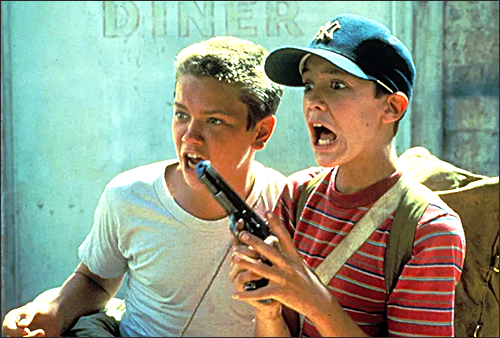
River Phoenix, Wil Wheaton
Gordie, Chris, Teddy and Vern decide to make a weekend expedition to see the body. This entails the theft of a gun owned by Teddy’s father, pooling their money to buy hamburger, tangling with a much-feared dog named Chopper, nearly getting run over by a train on a narrow bridge, wading into a leech-filled pond and eventually finding Ray Brower’s corpse. In so doing they’re forced into unpleasant confrontations with Merrill’s gang and their own collective mortality.
Along the way, there’s a great deal of pop culture inflected discussion among the boys that prefigures the dialogue of Quentin Tarantino, a tremendous dramatization of “The Revenge of Lard-Ass Hogan” that stands as the screen’s premiere vomit-a-thon, a weepy monologue by Chris about being stereotyped as a punk by Castle Rock’s populace and another by Gordie about his relationship with his asshole father. Eventually the kids all return home (entailing a shot, of Chris walking away from the camera and disappearing, that’s been copied a lot in the years since) and we return to the adult Gordie. His parting words: “I never had any friends later on like the ones I had when I was twelve. Jesus, does anyone?”
Having viewed STAND BY ME as a pre-teen during its 1986 theatrical run and again as a grown-up, I can attest that it plays very differently then and now. Back in ‘86 the film’s allure was its exotic (to me) depiction of a time and place without child safety laws or curfews, and language that was salty enough to garner an R rating (which made no difference to my middle school peer group, who went to see STAND BY ME, and 1986’s other big R-rated release PLATOON, multiple times).
Viewed in the light of adulthood, the film has a nostalgic allure that resonates far beyond its period setting. Hollywood in 1986 was heavily invested in “inner child” narratives (as evidenced by the following year’s BIG), and STAND BY ME was one of the foremost examples, depicting the pre-teen years as a never-to-be-repeated paradise. I’m not sure I agree with that sentiment, but can’t say it’s not persuasively presented.
STAND BY ME holds up much better than Rob Reiner’s other 1980s efforts THE SURE THING (1985) and THE PRINCESS BRIDE (1987), and stands as the premiere Stephen King adaptation of its time. Screenwriters Raynold Gideon and Bruce A. Evans (both coming off STARMAN) did an expert job accentuating the good things in “The Body” while paring down its excesses (the “Stud City” portion is thankfully jettisoned, as is the overwrought climax, in which Chris throws a tantrum in a rainstorm). Narratively speaking, only Gordy’s “My dad hates me” breakdown, shoehorned in by Reiner (in remembrance of his own childhood, dominated by a father he claimed was distant), feels out of place, adding a gratuitous crying scene to a film that already has more than its share, and needlessly underlining a point—“Your dad doesn’t give a shit about you!”—made earlier in the film.
Beyond that, STAND BY ME is solidly constructed, with convincing period detail (achieved on a tight budget) and excellent performances by a cast who were essentially playing themselves. The fact that one of those cast members, River Phoenix (1970-1993), is no longer with us gives the film an added poignancy, as does the demise of STAND BY ME’s director, which is prefigured, darkly, in the copious dialogue about father-son conflicts, and a refrain made by Teddy about killing his dad, which obviously played far differently in 1986 than it does now.
Vital Statistics
STAND BY ME
Columbia Pictures
Director: Rob Reiner
Producers: Andrew Scheinman, Bruce A. Evans, Raynold Gideon
Screenplay: Raynold Gideon, Bruce A. Evans
(Based on a novella by Stephen King)
Cinematography: Thomas Del Ruth
Editing: Robert Leighton
Cast: Will Wheaton, River Phoenix, Corey Fefdman, Jerry O’Connell, Kiefer Sutherland, Casey Siemaszko, Gary Riley, Bradley Gregg, Jason Oliver, Marshall Bell, Frances Lee McCain, Bruce Kirby, William Bronder, Scott Beach, Richard Dreyfuss, John Cusak