
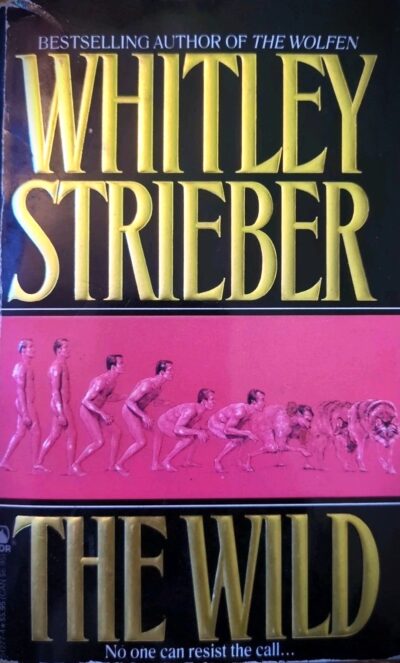
By WHITLEY STRIEBER (Tor; 1991)
I first learned of THE WILD’s existence in an August 1986 TWILIGHT ZONE MAGAZINE interview with Whitley Strieber, in which he talked this in-the-works publication up mightily, calling it his “breakthrough” novel and “the best thing I’ve ever done.” An italicized postscript to the interview, however, revealed that Strieber had since decided to put the book aside because “I just felt it wasn’t as good as I first thought it was.”
As it happened, Strieber got back to work on THE WILD, and it finally appeared in 1991, as a paperback original with little fanfare. It’s certainly no masterpiece, nor the “breakthrough” that was initially promised, being self-indulgent and uneven to a fault–but not completely uninteresting.
Strieber is of course the author of THE WOLFEN (1978), one of the standout horror novels of the seventies, and the apocalyptic YA novel WOLF OF SHADOWS (1985), with THE WILD being his third major wolf themed work. The focus is on Robert Duke, a NYC stockbroker who finds himself transforming into a werewolf, conveyed in lengthy sensory-inflected passages that enumerate Robert’s increasingly animalistic nature and the oft-painful reformation of his anatomy.
As you might guess, Robert’s unique state results in huge upheavals both domestic and professional. His ditzy wife Cindy, Kafka-obsessed young son Kevin (with the METAMORPHOSIS connection made quite overt) and ultra-posh shrink Monica are understandably non-plussed by his transformation, and desperately try to track the movements of the increasingly outdoorsy Robert. That proves difficult, as he gradually learns to enjoy his wolf state, eventually taking up with a roving wolf pack and birthing a litter of cubs.
Much of THE WILD is impacting, but Strieber wasn’t wrong in putting it down back in ‘86. The opening bits are marred by clumsy attempts at William Burroughsian stream-of-consciousness prose (“Well, he was tried in the court of the tranquilizer dart, and in that court the sentence is always the same: life behind bars, thank you very much”), while the later portions feel unnecessarily drawn-out (the story is perilously thin for 378 pages) and the forced happy ending is downright lame.