
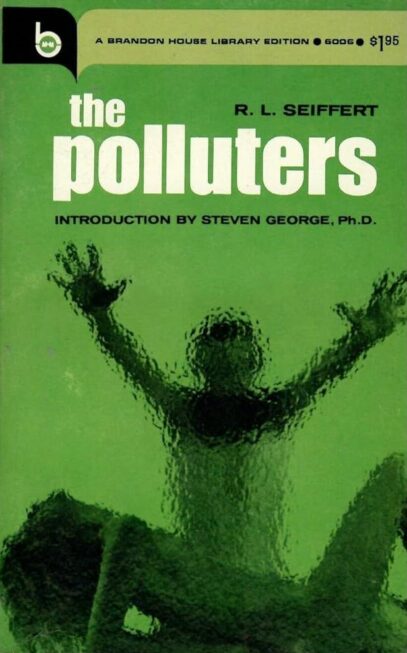
By R. L. SEIFFERT (Brandon House; 1968)
The idea of city folk driven mad by a chemical agent was a popular one in late 1960s-early 70s fiction. Introduced in the nonfiction DAY OF ST. ANTHONY’S FIRE (1968), the concept was utilized in the mainstream paperback THE TOWN THAT TOOK A TRIP (1968), the Essex House publication MINDBLOWER (1969) and the outrageous THE GAS (1970), which was commissioned by Essex but published elsewhere. THE POLLUTERS, a product of the upscale smut outfit Brandon House (from which Essex House was spun off), reads like a watered-down template for THE GAS.
THE POLLUTERS’ setting is Chicago and the invasive chemical substance is LSD, introduced into the city’s water supply by troublemaking hippies. This results in a building manager getting frisky with her tenants, nuns (of the “Order of the Bleeding Crack”) having a mass orgy, lesbians using gun shop merchandise in a highly inappropriate manner, and bikers embarking on a sex and looting spree, conveyed via descriptions that tend toward the crude (“Just then, the brazen lance of the Mediterranean butt-fucker struck Stan’s prostate gland with a deep stroke”).
The protagonist is Stan Markham, a raging alcoholic who never drinks water, and so is immune from the contamination. Upon leaving his apartment one morning, he’s sexually propositioned (“We saw you ride up and we were hoping you’d stop on the way down”) and/or assaulted by seemingly everyone he meets, both male and female. Stan’s sexual stamina proves quite impressive, as does his capacity for violence, which grows increasingly prevalent as the story progresses.
In its final third the novel undergoes a tonal change, with Stan becoming an elder sage to the hippie punks who set all the madness in motion, lecturing them on proper revolutionary etiquette. This suggests “R.L. Seiffert” (a pseudonym, no doubt) may have taken all this nonsense seriously, which would have been a mistake; as satire THE POLLUTERS almost works, but as cautionary drama it fails completely.
As was often the case with Brandon House books, this one contains a high-falutin’ introduction meant to elevate the novel’s literary bonafides. Penned by one “Steven George, Ph.D.,” it bemoans “All the mirthlessness of our disgrace,” with THE POLLUTERS apparently aiming its barbs “among the illusionary pariahs, the self-punishing victims in the name of a higher life only duplicitously believed by those who wear their suits and dresses over the minds of their genitals.” Huh?