
2025, as we all know, was a pretty sorry year for film, yet, unexpectedly enough, the literary output of ‘25 was somewhat encouraging. Sure, there was plenty of romantasy and “cozy” horror crap that had to be waded through, and some disappointments (the inexplicably overrated STRANGE PICTURES first and foremost), but the fact that I was able to come up with over a dozen exciting releases (around half of which were mainstream publications) for this “Bedlam in Print” ranking was an encouraging sign.
The following publications, you’ll find, are quite eclectic, with a movie making-of book, a fiction anthology, a graphic novel, a quasi-experimental novella, a movie review compilation and a couple showbiz memoirs. From best to worst, here’s my ranking…
1. THE MAKING OF QUENTIN TARANTINO’S ONCE UPON A TIME…IN HOLLYWOOD By JAY GLENNIE (Insight Editions)
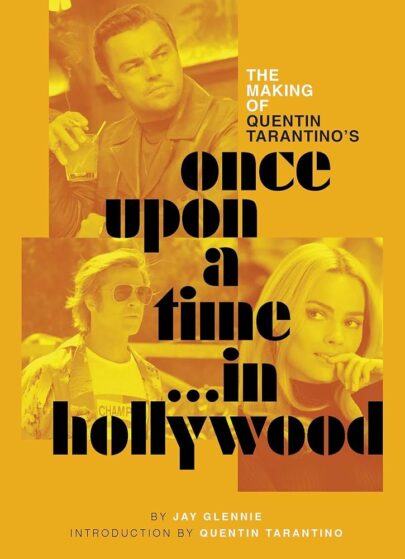
Covered in this hefty (in every sense of the word) hardcover is the casting, filming, editing and reception of Quentin Tarantino’s ONCE UPON A TIME…IN HOLLYWOOD (2019). The info in all cases is extremely dense, and anchored by extensive interviews with nearly all the film’s principals. Such an in-depth approach runs the risk of boring the reader, but author Jay Glennie’s highly novelistic, narratively informed treatment proves quite absorbing. Tarantino’s is, appropriately, the dominant voice, but we also get to know longtime QT crewmembers like casting director Victoria Thomas, first assistant director Bill Clarke and editor Fred Raskin, as well as the major cast members Brad Pitt, Leonardo DiCaprio, Margot Robbie and Al Pacino. An essential read, even if you’re not a Tarantino fan.
2. ARKADI AND THE LOST TITAN By PHILIPPE CAZA (Humanoids)
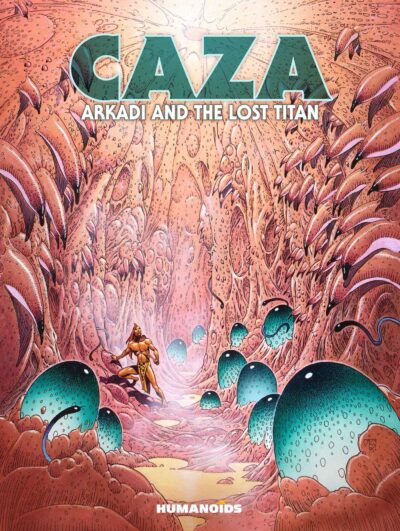
The undoubted magnum opus of France’s Philippe Caza, a 528 page SF oriented graphic novel whose inception spanned the years 1989 to 2008 (and the comic book industry’s transition from analogue to digital printing). Nudity, both male and (especially) female, is prevalent, as is a straight-faced presentation of wordage like “After the accidental incineration of the clone of the chosen one named U-Ri-D-C, Or-Phe went back on a mission to the great exterior,” and artwork that’s bold and detailed, reveling in voluminously detailed wide shots. What renders ARKADI unusual in the Euro-comic pantheon is its robust narrative drive, which is reasonably coherent (showcasing Caza’s reverence for the plot-oriented American comic book model), and its impressively varied range of subject matter. About a young warrior coming of age in a future Earth that has stopped spinning, the story encompasses apocalyptic grunge, Jodorowskian weirdness, heroic fantasy and cyberpunk, with clones, androids, physical mutation, mythological resonance and prophetic dreams all figuring into an account that’s nothing if not wide-ranging and jam-packed.
3. SCENE By ABEL FERRARA (Simon & Schuster)

Blunt, heartfelt and profane are words that adequately describe this memoir by filmmaker Abel Ferrara. It stands as an excellent primer on the horrors of heroin addiction, a defining tenet of Ferrara’s existence that led to numerous arrests and at least one eviction. Also contained is the expected industry name-dropping, with Asia Argento described as ruthlessly stringing along Ferrara during the production of NEW ROSE HOTEL (1998), while frequent Ferrara performer Christopher Walken is remembered for the “super weed” he “always carried around,” and the late Zoë Lund for shooting up onscreen in BAD LIEUTENANT (1992)—on “her birthday of all things.” The overriding arc is an optimistic one, with Ferrara in the final pages claiming to have gotten clean and married a good woman (who happens to be more than 40 years younger). Whether this idyllic existence lasts is an open question, but Abel Ferrara’s filmic legacy will unquestionably live on, as, I predict, will this book.
4. THE UNCOOL By CAMERON CROWE (Simon & Schuster)
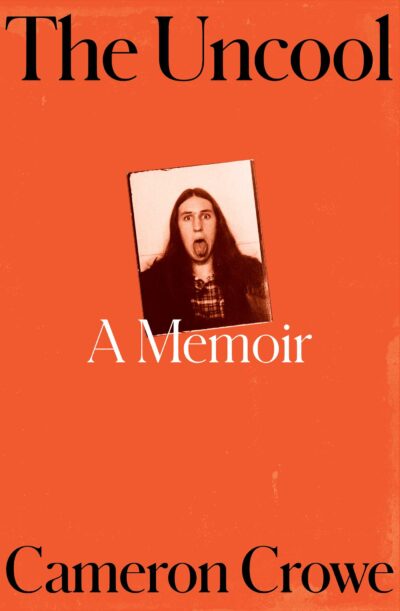
It only took 44 years, but author/filmmaker Cameron Crowe has finally put out a second autobiographical tome. His first was the legendary 1981 high school exposé FAST TIMES AT RIDGEMONT HIGH, and in THE UNCOOL Crowe goes back even farther, to the 1970s, which he spent interviewing bands for ROLLING STONE magazine. Included are thoughtful portraits of Jim Morrison’s late biographer Danny Sugarman, an irrepressible hustler Crowe likens to Eddie Haskell; David Bowie, whose months-long transformation into his “Thin White Dude” persona was meticulously documented by Crowe; the Allman Brothers, with whom Crowe toured (and got accused of being a narc by Gregg Allman); and Jimmy Page, who really hated ROLLING STONE but agreed to let Crowe interview him for the mag. Crowe’s famously amiable nature shines through in his unfailingly generous descriptions and very forgiving recollections of his subjects’ oft-questionable behavior. A very, very good book.
5. ART! TRASH! TERROR! ADVENTURES IN STRANGE CINEMA By CHRIS ALEXANDER (Headpress)
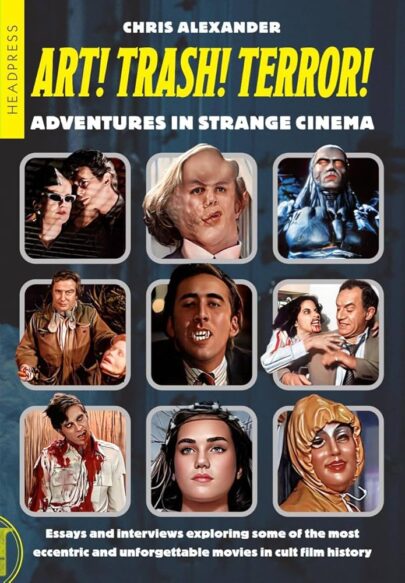
Quite simply, if you’re a horror fan this book, which collects several decades’ worth of reviews of “movies that refuse to behave,” is a must read. It was penned by Chris Alexander, whose write-ups are the very definition of passion pieces. Alexander makes no apologies for his love of the horror genre, giving classics like DAWN OF THE DEAD (1978) and DEATH LINE/RAW MEAT (1972) their just due, and demonstrating enormous reverence for poorly regarded films like GRAVEYARD SHIFT (1990), which “feels mean and dangerous and is deeply, unapologetically weird,” and MAXIMUM OVERDRIVE (1986), a “hubcap headed, gas spitting 1986 action trash classic.” Also included are interviews with luminaries like John Waters, Joe Dante and Gene Simmons that in some cases contain an accompanying narrative, the highlight of which is a piece that involves a trip to the Bahamas, a mutant rooster and Nicolas Cage acting like Nicolas Cage—ideal accompaniment, in short, to a book about horror movies.
6. BRINGING IN THE CREEPS By RAY VAN HORN, JR. (Anuci Press)
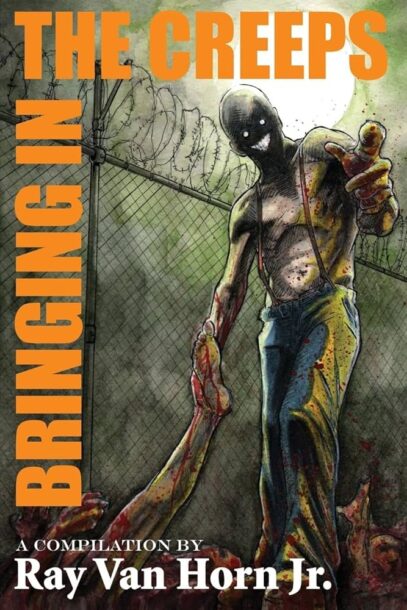
The category of pop culture infused fright fiction can said to be cornered, quite definitively, by Ray Van Horn, Jr. Mass art minutia and horror admittedly don’t sound like a terribly invigorating pairing, but it works in this collection due to the enormous wit and fluidity of Mr. Horn’s prose (“An agonizing yowl pierces my ears, louder than standing next to Motorhead’s Marshall SuperBass amp at Ozzfest ‘98 without ear plugs”), and also the subject matter and settings of his narratives, which tend to harmonize quite well with all the name dropping (among which are TRON, horror writer Nancy Collins, COBRA KAI, THE TINGLER and Stephen King). Standout stories include “Run,” which takes the form of an exercise log by an overweight twentysomething in an account that’s alternately funny and tender—at least until a creepy old fellow comes to dominate a narrative that grows increasingly bleak. “Chickeerun,” set in 1957, is even stronger, describing a game of automotive chicken interrupted by a ghostly presence that’s packed with authoritative detail (bequeathed by the author’s Boomer parents) and nuanced characters, not all of whom are particularly likeable.
7. INSOMNIA By ROBBIE ROBERTSON (Crown)
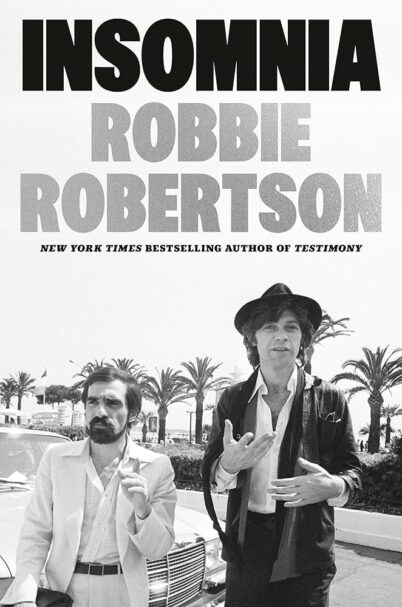
For me the primary interest of this posthumously published recounting by The Band’s late guitarist Robbie Robertson (1943-2023) is the fact that its subject is Robertson’s friendship with film director extraordinaire Martin Scorsese. This “whacked out odd couple” were finishing up THE LAST WALTZ (1978), the renowned documentary about The Band’s final concert, when the newly single Robertson elected to move into Scorsese’s Mulholland Drive home. What followed was a great deal of film watching, encounters with movie folk ranging from Francis Ford Coppola (who insisted on hiring a personal chef for Robertson and Scorsese) to Isabella Rosselini (who became Scorsese’s main squeeze for a time), and much dabbling in the fabled “rock ‘n’ roll lifestyle.” This is an admittedly slight book: its arc is pretty standard (with Robertson coming to the Earth-shattering realization that drugs and casual hook-ups aren’t good life choices) and it doesn’t contain much info about Scorsese that I didn’t already know.
8. A VIEWING GUIDE TO THE PANDEMIC By RICHARD SCHEIB (Headpress)
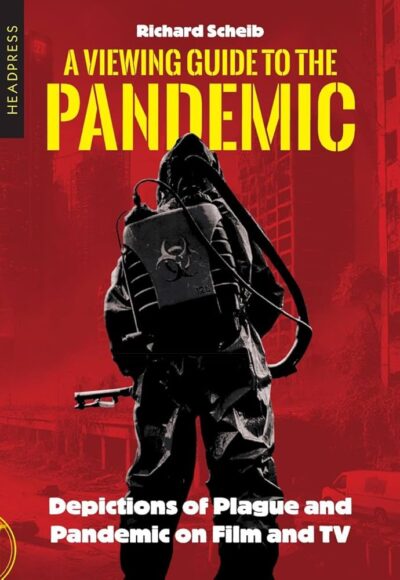
A long-in-coming study of disease/pandemic movies, courtesy of Richard Scheib, who runs the UK based Moria film review website (www.moriareviews.com). Admirably exhaustive in its scope, the book commences with a breakdown of THE PLAGUE OF FLORENCE (PEST IN FLORENZ; 1919), and continues with subsequent disease-themed films, some of which, like PANIC IN THE STREETS (1950), THE ANDROMEDA STRAIN (1969) and 12 MONKEYS (1995), are classics, while others, like EBOLA SYNDROME (1996), aren’t. Also covered are zombie-themed films like NIGHT OF THE LIVING DEAD (1968) and PONTYPOOL (2008), and oddities like WHAT’S SO BAD ABOUT FEELING GOOD? (1968) and THE HOLE (DONG; 1998). Most impressive are the chapters focused on Covid-centered disease movies, such as the Charles Band production CORONA ZOMBIES (2020), and “post-pandemic” films like ANTHROPOCINE (2020) and SONGBIRD (2020), which imagined a covid-ravaged future involving internment camps and permanent indoor confinement, and were compromised, inevitably, by budgets too low to properly convey the filmmakers’ ambitions.
9. THE BIGGER PICTURE By JON LANDAU (Hyperion)
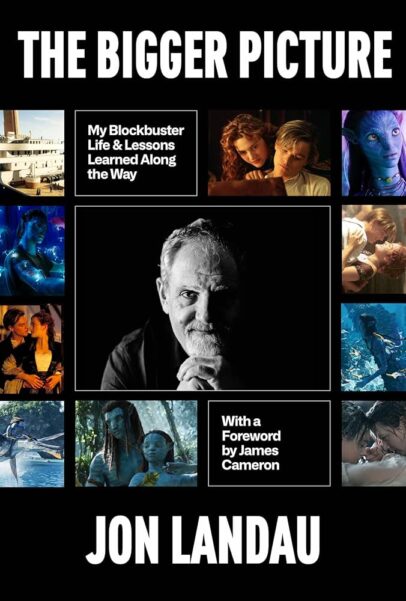
A posthumous memoir by the late Jon Landau (1960-2024), who’s known for producing TITANIC and the AVATAR pics—films that can be credited largely to their writer-director James Cameron. Landau’s association with Cameron was one of a succession of lucky breaks that commenced with the fact that Landau was sired by successful documentarians. Thus, he had no trouble finding his way into Hollywood’s echelons, and working on forgettable films like KEY EXCHANGE (1985) and CAMPUS MAN (1987), about which he reveals very little. The bulk of Landau’s recollections are devoted to his work with Cameron, whose tremendous drive is lauded and his dark side acknowledged (to an executive’s plea “Jim, I’m just trying to be your friend,” Cameron is quoted as responding, “I choose my own friends, and I don’t choose you”). Such an avalanche of good fortune, it turned out, wasn’t without consequence, with Landau contracting cancer in his early sixties, and dying before this book’s publication. Final thought: THE BIGGER PICTURE is an enjoyable read by a pleasant fellow, but far from essential.
10. TICK TOWN By CHRISTOPHER A. MIKLOS (Castle Bridge Media)
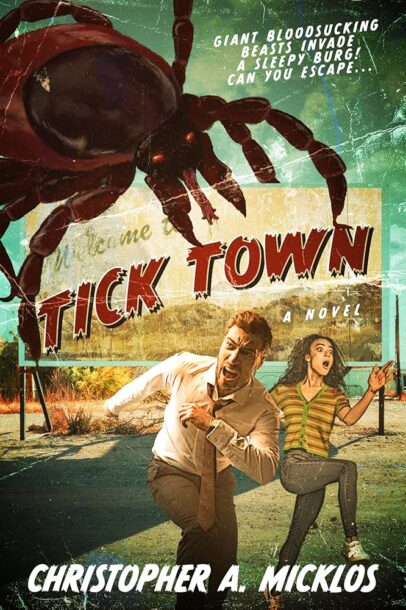
If lines like “The decisive blast slammed into the monster’s face, which at near point-blank range exploded in a grisly splatter of tick goo” resonate with you (as they do me) then TICK TOWN is the book to read. It’s an enthusiastic updating of the “nasties” horror fiction model of the 1970s and 80s, when authors like James Herbert, Guy N. Smith and Shaun Hutson wrote about mutant insects, rodents and crustaceans. The setting here is the secluded Wisconsin community Tomahawk Hollow, which is infested with desk-sized ticks, the result of questionable experimentation by a pesticide production plant. Miklos keeps things lean and compact in terms of prose, plotting and page length (186), with a suitably splat-happy climax that comes complete with a digital countdown. There’s also an unobtrusive but quite overt sense of humor, evident in passages like the one in which the town mayor ponders the identity of a dead child, hoping it was sired by a tourist rather than a local, because “That would sting just a little less.”
11. HUMANIMALITY By RAINER J. HANSCHE (Contra Mundum)
Rainer J. Hansche, who runs the micro-niche publisher Contra Mundum Press, previously wrote DIONYSOS SPEED, a “visionary concoction that can be categorized as surrealist poetry or avant-garde science fiction” (me). The same can be said of HUMANIMALITY, a self-proclaimed “hybrid monster of a book that interrogates humanity’s troubled relationship with its animality.” There’s an eco-horror angle, manifested in descriptions of animals the world over savagely turning on humans, and in the process developing advanced intelligence. This results in odd phrases scrawled on walls, plucked-out human pineal glands found massed in bowls, gravestone markings rendered illegible and religious artifacts defaced. As if all that weren’t enough, an especially deadly pandemic sweeps the Earth, intensified by a rash of tornadoes and dust storms. An anti-human novel? Absolutely, and given the richness of the imagery on display, I can’t say I’m too offended.
12. POSSESSION: DREAMS OF SUFFERING AND SANITY By CHRIS KELSO (PS Publishing)
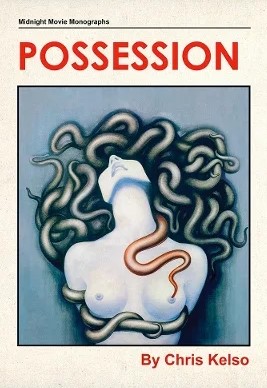
Andrzej Zulawski’s POSSESSION (1981) is an open wound of a movie, a frenzied Berlin-set depiction of a disintegrating marriage that weaves in a humping cucumber monster. Author Chris Kelso, in a monograph released by PS Publishing’s Midnight Movie Monograph imprint, takes an approach similar to that of Stephen Bissette in his 2020 Midnight Movie Monograph THE BROOD, providing a highly scattershot blend of autobiographical recounting, behind-the-scenes tidbits and philosophical asides, with Kafka, Freud and an unnamed ex-girlfriend drawn into the mix. POSSESSION: DREAMS OF SUFFERING AND SANITY lacks the formal audacity of Bissette’s near-700 page tome, with Kelso compressing his text into 90 pages and emerging with a choppy and discordant, but not uninteresting, whole.
13. THE HISTORY OF THE DOLLS AND WHAT THEY DID By JESSE BALL (Hanuman Editions)
I was under the impression that the Chelsea Hotel based Hanuman Editions (known for printing books that fit quite literally in the palm of one’s hand) was defunct, yet here’s a brand new Hanuman publication. It’s a quasi-experimental novella about two young girls and their dolls. The girls, Vivian and Abigail, decide for some reason to subject the dolls to interrogation and torture, only to have these supposedly inanimate objects turn the tables and initiate brutal interrogations of their own. As a warped political allegory THE HISTORY OF THE DOLLS AND WHAT THEY DID has some interest, but doesn’t work at all as the straightforward horror story it purports to be.
14. ARMIES OF THE NIGHT By MICHAEL GINGOLD, CHRIS POGGIALI (1984 Publishing)
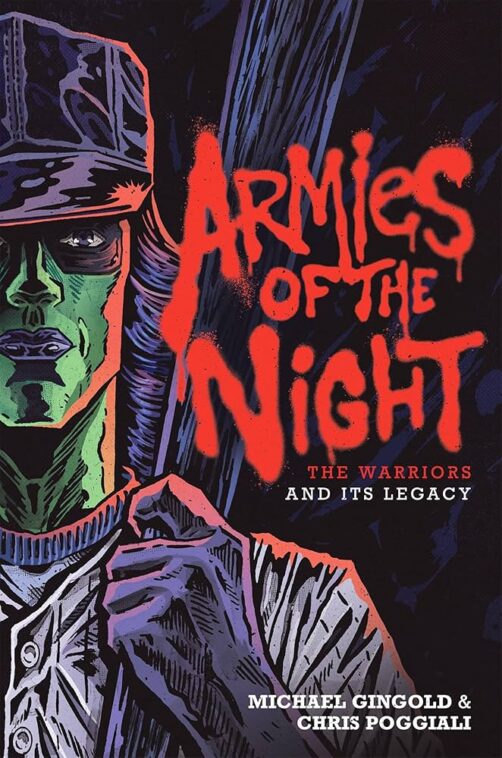
For grindhouse nerds, Michael Gingold and Chris Poggiali are a dream pairing. Longtime horror-exploitation film commentators both, Gingold and Poggiali’s combined knowledge is staggering—which makes me wonder why they expended it on a book about THE WARRIORS (1979). A great film, to be sure, but it’s one that’s already been covered in various reviews, articles and books, of which ARMIES OF THE NIGHT isn’t the best. In fact, it feels a bit perfunctory, running a scant 158 pages and taken up largely with stills from the movie. The information dished out by the authors is dense and authoritative, as expected, and covers all the high points of the WARRIORS saga—the source novel by Sol Yurick, the filming and the controversy generated by its supposedly deadly influence on wayward youths—so the book isn’t entirely without worth, but given Gingold and Poggiali’s combined pedigree I was expecting much more.
15. WHO KNEW By BARRY DILLER (Simon & Schuster)

If MEMOIRS OF THE DEVIL weren’t already taken, I’d suggest it as an alternate title for WHO KNEW. It’s a memoir by mega-mogul Barry Diller, one of the main architects of the movie apocalypse that occurred in the late 1970s and early 80s, when Hollywood shifted from a creative to corporate-based business. To his credit, Diller doesn’t try and disguise his true nature, fully owning up to and even bragging about his “accomplishments.” Also aired in these pages are some disheartening, and on-target, observations about the entertainment industry in its present form: “Today, in the final throes of what I believe is the end of Hollywood as we know it…All is now controlled and dominated by the tech overlords.” Diller doesn’t seem to understand that his dealings were what unwittingly set the stage for this sorry state.
16. STRANGE PICTURES By UKETSU (HarperCollins)
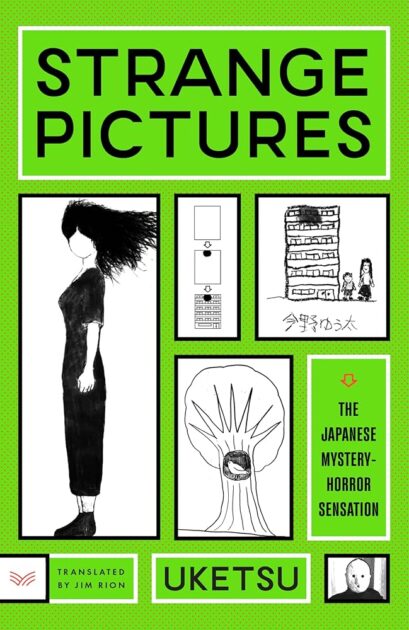
I don’t get it. A great deal of media attention has been expended on this supposed “Eerie Journey through Disturbing Drawings” by the debuting Uketsu, but there’s really not much here. STRANGE PICTURES consists of close examinations of nine childish drawings, all of which contain hidden depths, and all of which combine to tell an overarching story. To me the book reads more like a school exercise (a dull one) than a proper narrative.
Also:
COLD FRONT By BARRY HAMMOND (Fathom Press)
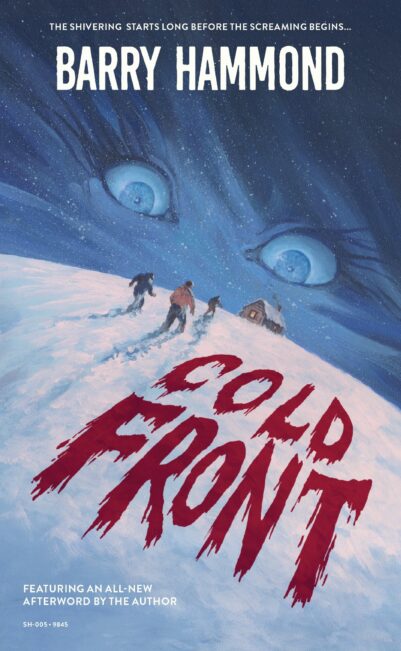
A reprint of one of the rarest horror paperbacks of the 1980s: COLD FRONT by Barry Hammond, a 1982 account of a Wendigo loose in a remote Canadian wilderness. It may be familiar splatter movie fodder, but the prose is quite refined, and the descriptions strong and convincing.
FUCK JOURNAL By BOB FLANAGAN (Hanuman Editions)
I’ve long been intrigued by this uber-rare 1987 text by “Supermasochist” Bob Flanagan, so this ‘25 reprinting was thrice welcome. Truth be told, it’s not much, being a perfunctory cataloguing of all the times Flanagan and his GF Sheree Rose had sex over the course of a year, resulting in morsels like “SHE’S ON TOP WITH THE CAT-OF-NINE-TAILS WRAPPED AROUND MY NECK.”
THE GREAT VICTORIAN COLLECTION By BRIAN MOORE (Valancourt Books)
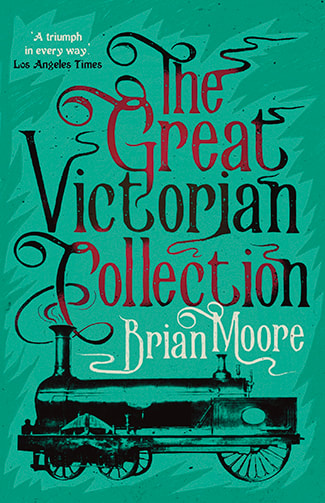
A reprinting of Brian Moore’s altogether fascinating Kafkaesque reverie from 1975, about a man who literally dreams into existence a vast collection of Victorian artifacts in the parking lot of a Carmel, CA hotel.
PAPERBACK FANATIC 50
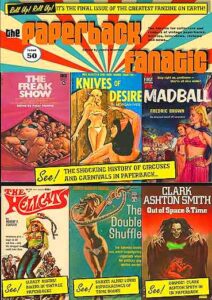
A 130 page compilation of paperback-related goodness, with much learned info on Michael McDowell, Ray Bradbury, Clark Ashton Smith, folk science fiction, Guy N. Smith and lots more.
SHOCK CINEMA 66
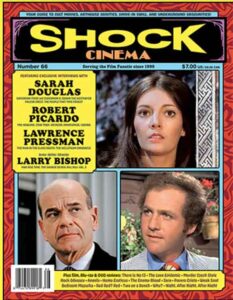
A new issue of SHOCK CINEMA is always welcome (and not just because I, as always, contributed several reviews), and this one is a standout, featuring revealing interviews with Sarah Douglas and Robert Picardo, and insightful reviews of obscure films like THERE IS NO 13 and TWO ON A BENCH.
THERE’S NOTHING OUT THERE Edited by SOPHIE ESSEX (Black Shuck Books)
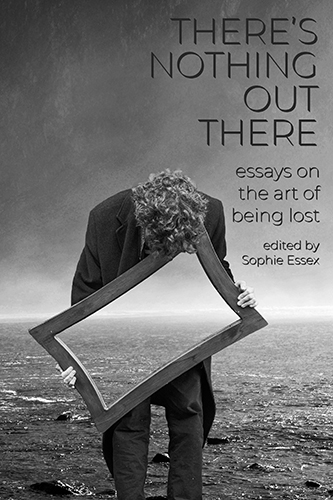
A fun non-fiction anthology centered on films about “being lost.” I, for the record, contributed a piece about the 1985 Ozploitation flick FORTRESS that I think is pretty good (although I’m not too happy that the accompanying poster art is of the similarly titled, but completely unrelated, 1992 Stuart Gordon flick).
WEIRD FICTION REVIEW 13
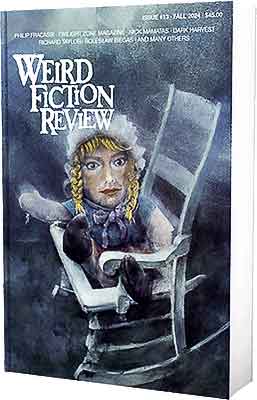
The Centipede Press published WEIRD FICTION REVIEW periodicals are always worth reading, even though they seem to take longer and longer to appear. How long, precisely, did this new issue take? My article for it, “The Strange Case of Roger Elwood,” was written four years ago. Better late than never, I guess.
Looking Forward…
BOMBYX By R.C. MATHESON (PS Publishing)
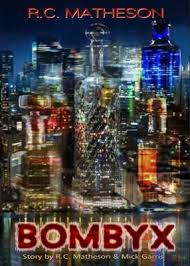
A novel by the gifted son of Richard Matheson, “from a story by Mick Garris” about “a man whose life turns into a nightmare of public hatred, terror, and a deadly, hidden conspiracy after returning from rehab.”
THE GEEK By TINY ALICE (NEH)
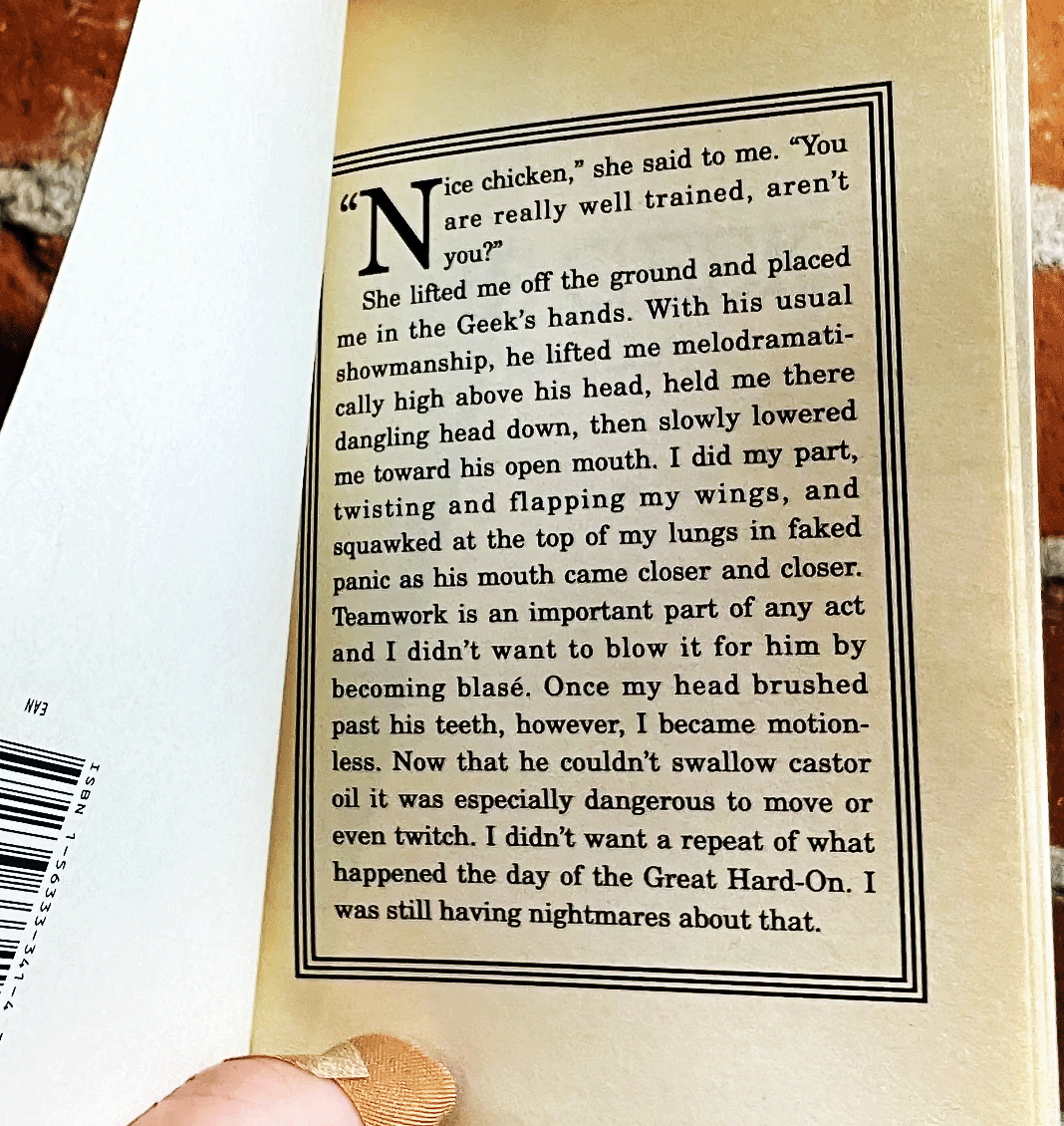
Click image to read text.
A reprinting of one of the more bizarre products of the late smut publisher Essex House: an outrageous tale told by a chicken, reporting on perverse doings amid the denizens of a travelling carnival.
THE LAST CANTERBURY TALES By JEAN RAY (Wakefield Press)
A newly translated book by MALPERTUIS’ late Jean Ray, which is all I really need to know.
OPUS SINIESTRUS
By LEONORA CARRINGTON (NYRB Classics)
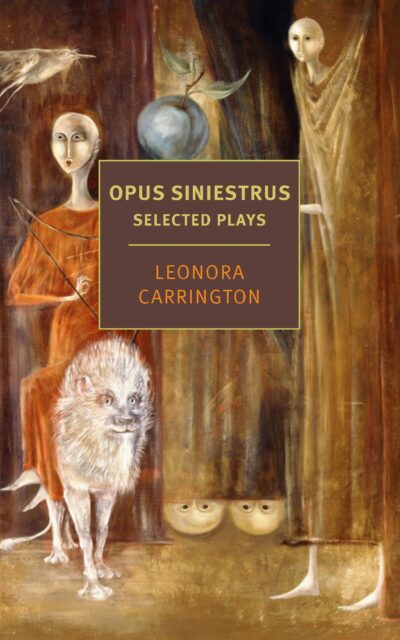
Something new (for English speakers, at least) in the oeuvre of surrealist legend Leonora Carrington: a selection of never-before-translated plays that, from what I can tell, are of the same bizarre hue as Carrington’s prose fiction.
OVER THE EDGE: MOVIES, MADNESS, GAMBLING AND OTHER CELESTIAL PLEASURES By JAMES TOBACK (Arcade)
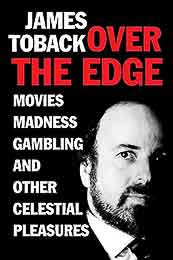
A memoir by screenwriter/director/madman James Toback, who with this book is sure to offend most everyone.
SUCH NICE PEOPLE By SANDRA SCOPPETTONE (Valancourt Books)
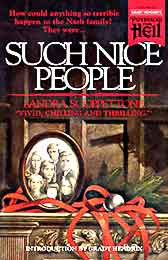
A 1981 “Paperback from Hell” (given new relevance by the popular Grady Hendrix book of that name) about a deranged teen planning to murder his family.
THE SUNSET LANDS By JULIEN GRACQ (Wakefield Press)
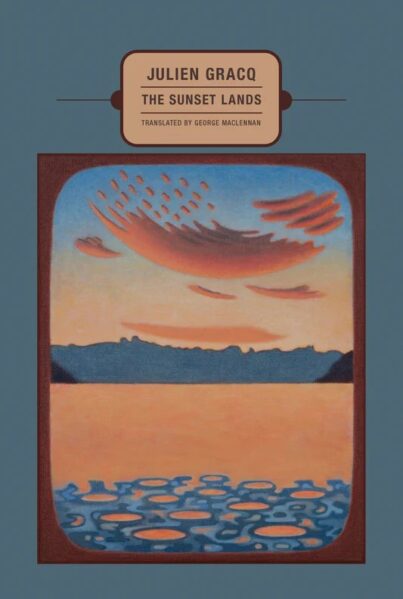
The fiction of France’s Julien Gracq hasn’t always been well served by its English translations, but this novel, described as a “dreamlike epic of a willfully blind empire on the verge of collapse,” sounds worthwhile.
TAXI DRIVER, THE MAKING OF By JAY GLENNIE (Coattail Publications)
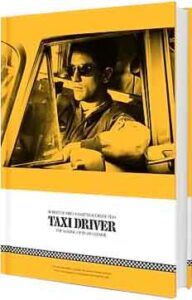
Mr. Glennie has been teasing this book, which promises to be the last word on Martin Scorsese’s immortal classic, for some time, and I for one am eagerly awaiting its arrival.