
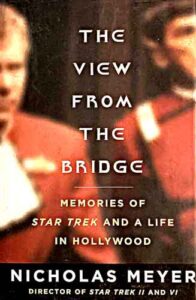
By NICHOLAS MEYER (Viking; 2009)
(See Also: STAR TREK: THE MOTION PICTURE)
THE VIEW FROM THE BRIDGE is a terrifically entertaining Hollywood memoir by novelist/screenwriter/director Nicholas Meyer. His screenplay credits, which are myriad, include the grade-B classic INVASION OF THE BEE GIRLS (1973) and the Sherlock Holmes pastiche THE SEVEN PERCENT SOLUTION (1976), while his self-directed films range from the time travel potboiler TIME AFTER TIME (1979) to the nuclear war themed miniseries THE DAY AFTER (1983) and the Tom Hanks vehicle VOLUNTEERS (1985), and his published books include THE WEST-END HORROR (1976) and THE CANARY TRAINER (1993). Yet Meyer, as he freely admits, seems destined to remain best known for helming STAR TREK II: THE WRATH OF KHAN (1982) and STAR TREK VI: THE UNDISCOVERED COUNTRY (1991), and partially scripting STAR TREK IV: THE VOYAGE HOME (1986).
Meyer’s work in the TREK universe takes up a large portion of this book (and provides the title and cover art). The irony is that, as recounted here, Meyer was never much of a TREK fan, with his involvement in STAR TREK II coming about largely by chance. Despite that film being widely credited with reinvigorating the franchise, it was reportedly a difficult assignment, involving a lot of clashing egos (particularly those of William Shatner and Gene Rodenberry) and an extremely tight budget.
Meyer’s other film projects weren’t exactly problem-free. His directorial career, jumpstarted by STAR TREK II, was tarnished by flops like the Merchant-Ivory production THE DECEIVERS (1988) and COMPANY BUSINESS (1991), while his post-STAR TREK scripts, for SOMMERSBY (1993) and THE HUMAN STAIN (2003), ended up heavily rewritten. Even successful productions like TIME AFTER TIME (a major influence on BACK TO THE FUTURE) and THE DAY AFTER (apparently the most widely viewed TV movie of all time), were fraught with difficulty.
Some of Meyer’s assertions, such as the claim that THE DAY AFTER single-handedly inspired Ronald Reagan to reverse his stance on nuclear weapons, seem self-aggrandizing, but he’s also quite frank about his failings. Meyer fully owns up to his shortcomings as a writer-director (he admits he’s incapable of coming up with an original idea) and his oft-bad behavior (rudeness to Gene Rodenberry is something he still regrets), and admits the many disappointments he suffered have taken a not-inconsiderable psychological toll. Particularly heartrending is Meyer’s recollection of the 1993 death of his wife Lauren Leigh Arnold, which took the wind out of his sails through much of the 1990s–and, it would seem, far beyond.