
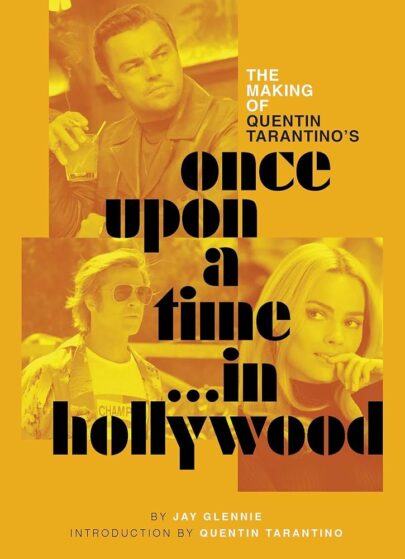
By JAY GLENNIE (Insight Editions; 2025)
The large format movie making of books of the UK’s Jay Glennie have attained legendary stature among film book nerds. I have yet to read any of Glennie’s pre-2025 publications, as thus far none have been published stateside (and shipping costs are prohibitively expensive). Thankfully, in late 2025 a Jay Glennie book was finally published in the US, and showed us what we’ve been missing.
Covered in these pages (issued in the large format hardcover form of Glennie’s previous books) is Quentin Tarantino’s ONCE UPON A TIME…IN HOLLYOOD: the writing of the script (inspired in large part by the recollections of Tarantino regular Kurt Russell), the casting, filming, editing and reception. The info in all cases is extremely dense, anchored by extensive interviews with seemingly all the film’s principals. Such an in-depth approach runs the risk of boring the reader, but Glennie’s highly novelistic, narratively informed treatment proves quite absorbing.
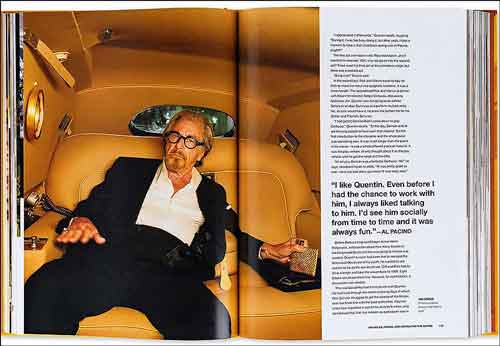
Tarantino’s is, appropriately, the dominant voice, with his inimitable speech patterns well preserved by Glennie (“Stuntman Mike is a fucking maniac, alright? He’s a serial killer, alright? So he is not Stuntman Mike. But Kurt said he was really sketchy”). We also get to know the voices of longtime QT crewmembers like casting director Victoria Thomas, first assistant director Bill Clarke and editor Fred Raskin, as well as production designer Barbara Ling, a Tarantino newbie (hired for her work on THE DOORS).
It’s in its extremely deep dive into the casting process that this book really shines. Brad Pitt, Leonardo DiCaprio, Margot Robbie and Al Pacino are all heard from, as are lesser known talents like Rafal Zawierucha, who played Roman Polanski (apparently on a recommendation from the man himself), and Damon Herriman, who played Charles Manson. This is, in fact, the most in-depth depiction of the casting of a movie that I’ve ever read, with Glennie superbly conveying the anxiety and uncertainty experienced by potential cast members auditioning for the closest thing that exists to a modern-day Stanley Kubrick—and no, that’s not an exaggeration.
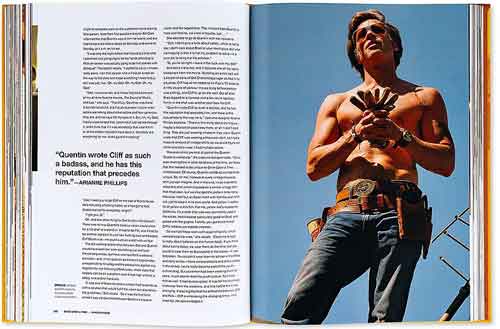
Quite simply, no other modern filmmaker enjoys the amount of creative freedom granted Tarantino. So renowned is he by Hollywood’s gatekeepers that two major studios, Warner Bros. and Sony, went to great lengths to lure Tarantino into their fold, with Warners going so far as to garb its employees and Burbank studio in late 1960s décor (Sony, of course, won out).
According to the deep digging Glennie, on this production Tarantino broke a personal prohibition about giving out frivolous associate producer credits, doing just that for Playboy Mansion owner Daren Metropoulos in exchange for letting him film at that iconic location. We also learn why it is that the Mikey Madison incarnated Susan Atkins doesn’t turn up until the final twenty minutes (because Madison was locked into the TV show IMPOSTERS), and the inception of a paperback Di Caprio’s character is seen reading in one scene (it was created by Tarantino and his art department because they were unable to secure the rights to an actual book).
If I have a complaint, it’s with the overall attitude. The book and its subjects are a bit too fawning; more than one respondent claims the ONCE UPON A TIME…IN HOLLYWOOD script is the best s/he has ever read, and all were invariably bowled over by the dailies, of which “every shot was fabulous.”
There are a few negatives to be found, including an admission by actor Emile Hirsch that he blew the table read and the unexpected death of one of the film’s major actors—Burt Reynolds—before his scenes could be filmed. It seems, however, that for the most part everyone had the greatest time making ONCE UPON A TIME…IN HOLLYWOOD and everything went well. I’d have preferred a bit more drama.