
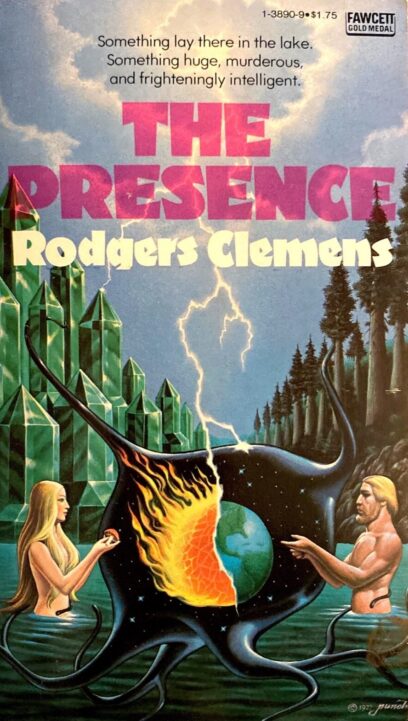
By RODGERS CLEMENS (Fawcett Gold Medal; 1977)
“Rodgers Clemens” was actually the late Roger Lovin (1941-1991), a former newspaper editor, political activist, and smut novelist (of the notorious ELEVEN) who in the late 1970s tried to reinvent himself as a pulp meister. Based on the present novel and APOSTLE (1978), the gambit might have been successful had not real life intervened (in the form of a jail sentence for possession of child pornography).
THE PRESENCE has some problems, but overall registers as above-average in the monster-on-the-rampage category. It follows a template that by 1977 was well-worn: a monster is loose in a lake, where it devours people in horrific fashion. The response of the town mayor is all too predictable: he insists on keeping the lake open so he can collect as much revenue as possible. It’s up to Blake Wiley, a plucky scientist, to figure out a way to understand, and stop, the critter.
The cliches hold back THE PRESENCE, which otherwise offers a nifty melding of creepy-crawly horror and visionary sci-fi (of a type in which Lovin dabbled extensively in the late 1970s). The eponymous presence is an otherworldly blob-like substance whose doings are conveyed via lengthy italicized passages interspaced with the main narrative, which comes to include top military personnel, government officials and the President of the United States, with a timeline that involves a plan to nuke the area containing the presence, who expands relentlessly to the point that it comes to threaten the entire world. Yet the presence, as we learn, is far more intelligent than it initially seems.
The critter, moreover, can communicate with its human antagonists via computer, as is discovered by Wiley. In this way the presence (which could have done with a more evocative moniker) goes from a JAWS-like killing machine to the possible savior of the world, a dichotomy that nearly places this story in Stanislaw Lem territory.
That comparison, of course, gives this book far too much credit. At its best THE PRESENCE is precisely what it appears to be: an unassuming paperback original for an undemanding readership. There’s not a whole lot to it, but Mr. Lovin clearly worked overtime to create an ambitious monster-fest with all the trimmings: gore, slime, muted political commentary and Lovecraftian overtones, with the overall emphasis on grade-B fun.