

By CHRISTOPHER PRIEST (Harper & Row; 1974)
One of the SF field’s most provocative and enduring concepts is contained in THE INVERTED WORLD by the late Christopher Priest. For proof, see the French ICE COMPANY series and the Korean SNOWPIERCER graphic novels and films, whose depictions of train cities hurtling through post-apocalyptic landscapes were prefigured in THE INVERTED WORLD (expanded from a similarly named story that, as Priest takes pains to enumerate in an author’s note, has little in common with this novel).
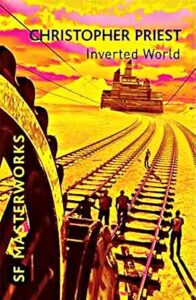
The mobile community described by Priest is a literal city—called Earth—comprised of multi-storied buildings constantly shuttled north on makeshift train tracks. Said tracks are laid by specially placed residents and surrounding “tooks” (non-Earth-affiliated individuals), whose ranks also comprise women filched to complement the city’s largely male populace. The city is powered, it seems, by a nuclear reactor, and situated, it seems, on a distant planet.
The protagonist, whose account is related in alternating first and third person chapters, is Helward Mann, a young man who, like everyone else in the city, has his age delineated in miles, being “six hundred and fifty miles old” when the novel commences. The city, with its tightly regulated atmosphere of rigid conformity and patches of rebellious “Terminators” (another instance of prophetic invention), represents the only existence Helward knows, but he gets quite an education upon becoming an apprentice Future Surveyor. This entails venturing outside Earth’s confines to study the terrain upon which tracks are to be laid and (when rivers are sighted) bridges built.
This job requires the taking of an oath whose tenets complicate Helward’s arranged marriage to a young woman named Virginia. This union produces a child, whose birth Helward is unable to witness due to being sent on an officially sanctioned southward sojourn to the area “down past”—a sojourn that serves primarily as a vision quest, upon which Helward learns the true nature of the world in which he finds himself situated, and why the city has to keep moving north.
That explanation, involving gravitational anomalies and physical distortion, is fascinating, even if, in the words of the late SF agent Virginia Kidd (quoted on the acknowledgements page), “the physics had a hole so large a city might be driven through.” Enter Elizabeth, a young took who becomes Helward’s love interest after Virginia dumps him; being non-city affiliated, Elizabeth offers an entirely different, more scientifically sound perspective on this inverted world.
Christopher Priest had a liking for twists, and through Elizabeth offers a last act twist that throws cold water on the novel’s more mind-tugging conceptions. Said twist is a disappointment that’s not too far removed from the tried and untrue it’s-all-a-dream reveal, or the no-longer-surprising final shot of PLANET OF THE APES (1968).
The true shame of this “surprise” ending is that in THE INVERTED WORLD Priest does most everything else right. His world-building is rigorous and exhaustive, and pulled off with a welcome absence of alienating scientific detail. The novel’s universe is quite gritty and unforgiving (more than one infant meets a nasty end), but never off-puttingly so. Furthermore, Helward Mann (the overwrought moniker aside) proves an extremely compelling centerpiece, with his odyssey providing a highly immersive trip into a very weird world.