
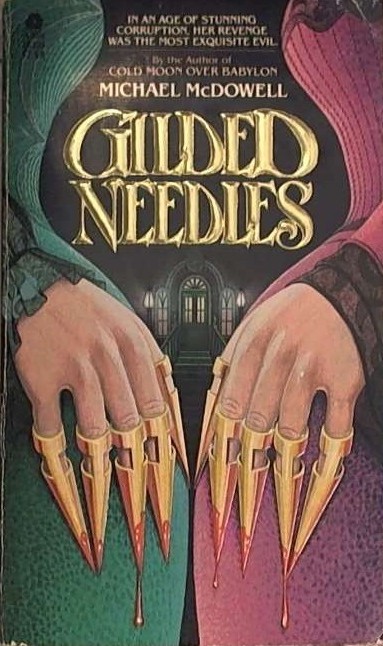
 By MICHAEL McDOWELL (Avon; 1980)
Further proof of the adage that most if not all genre writers none-too-secretly yearn to write historical fiction. Here the writer in question was the late horror novelist Michael McDowell, who provides a scrupulously researched depiction of New York City in the late 19th Century.
GILDED NEEDLES was issued in 1980 by its initial publisher Avon (and again in 2017 by Valancourt) as a horror paperback in line with McDowell’s previous novels THE AMULET and COLD MOON OVER BABYLON, complete with trashy cover art and a fitfully macabre title (which I can’t help but suspect was ordered by the publisher, as gilded needles only feature briefly in the text). In truth it functions more as a period thriller, albeit one with extremely horrific elements; in contrast to many of his fellows (such as the late SF legend John Brunner, who famously destroyed his career with the 1983 period epic THE GREAT STEAMBOAT RACE), McDowell was careful to combine his fictional interests.
It begins on New Year’s Eve, 1882, in the notorious Black Triangle section of NYC, a hotbed of prostitution, back alley abortions, opium dens and casinos. There the German “Black Lena” Shanks runs a ruthless criminal empire comprised of her daughters and grandchildren.
A few blocks away, in the city’s wealthier quarters, the staunchly republican Judge James Stallworth resides with a family of his own. This supposedly refined brood, however, isn’t as upstanding as it might seem, with Stallworth’s minister son-in-law Edward being a severe hypocrite and the latter’s son Benjamin a degenerate gambler, while Edward’s wife Helen grows increasingly besotted with the Black Triangle’s depraved inhabitants.
Black Lena, it so happens, hates Judge Stallworth “more than any other man on Earth,” due to the fact that he had her husband hanged. When a suspicious death sets in motion a chain of circumstances that result in the judge ordering the executions of two more of Lena’s family members, we’re led to McDowell’s favorite subject: revenge, heralded by funeral invitations sent to each of the Stallworths, with the funerals announced being their own.
The novel is a superlative example of historical fiction. That’s despite the fact that it’s a tad overwritten (as is often the case with period novels, the author is a little too eager at times to show off the breadth of his research) and containing some plainly implausible plot points (it strains credulity that Stallworth’s daughter Marian, knowing there’s a hit out on her family, blithely hires a woman she meets on the street to look after her children).
The setting and period detail feel authoritative yet never compromise the suspense of the narrative or the many nasty surprises offered up by McDowell. His skill as a shockmeister is put to excellent use in the book’s concluding chapters, which involve blackmail, insanity, kidnapping and a moral reckoning in which all the surviving characters, “good” or otherwise, get their just desserts.